• About
    • Introduction
    • Explore The Other Tour
    • 2026 Itinerary of The Other Tour Istanbul
    • Common Questions Answered
    • The Other Tour Reviews
    • About Us
    • Contact
  • Istanbul
    • Tour Guides
    • Attractions
    • Tours
    • Neighborhoods
    • Eat & Drink
    • Stay
    • Shop
  • Turkey
    • Turkey Tours
    • Destinations
    • Istanbul
    • Cappadocia
    • Ephesus
    • Pamukkale
    • Antalya
    • Bodrum
  • Services
    • Private Tours
    • Daily City Tours
    • Made-to-order Travel
    • Hire a tour guide
    • Unique Activities
    • Airport Transfers
    • Hotel Selection
    • Vacation Booking
    • Corporate Group Tours
    • Culinary Tours
    • Event Planning
    • Istanbul Layover Tours
    • Family Time
  • Blog
    • TOP 5 ISTANBUL
    • Events
    • Documentary
    • History
    • News
    • All
No Result
View All Result
  • About
    • Introduction
    • Explore The Other Tour
    • 2026 Itinerary of The Other Tour Istanbul
    • Common Questions Answered
    • The Other Tour Reviews
    • About Us
    • Contact
  • Istanbul
    • Tour Guides
    • Attractions
    • Tours
    • Neighborhoods
    • Eat & Drink
    • Stay
    • Shop
  • Turkey
    • Turkey Tours
    • Destinations
    • Istanbul
    • Cappadocia
    • Ephesus
    • Pamukkale
    • Antalya
    • Bodrum
  • Services
    • Private Tours
    • Daily City Tours
    • Made-to-order Travel
    • Hire a tour guide
    • Unique Activities
    • Airport Transfers
    • Hotel Selection
    • Vacation Booking
    • Corporate Group Tours
    • Culinary Tours
    • Event Planning
    • Istanbul Layover Tours
    • Family Time
  • Blog
    • TOP 5 ISTANBUL
    • Events
    • Documentary
    • History
    • News
    • All
No Result
View All Result

10 People Who Built a Bridge Between East and West (On Purpose)

TheOtherTour by TheOtherTour
February 20, 2026
in Istanbul Travel Blog, Read, Specials, Turkey Travel Blog
Reading Time: 8 mins read
A A
1

Take a breath and look at Istanbul for what it is: not “between” two worlds, but a seam where worlds get stitched together—sometimes beautifully, sometimes violently, often both at once.

Table of Contents

Five who bridged worlds with power, law, and cities

So here’s a list we actually like for The Other Tour: ten figures who didn’t just collide civilizations—they designed ways for them to coexist, translate, and survive one another. Think: governance that can hold differences, courts that import ideas, philosophers who refuse to pick one canon and burn the other.

This list might surprise you, but that’s kind of our forte at The Other Tour.

1) Cyrus the Great

Portrait of Cyrus the Great

Cyrus (6th c. BCE) is the prototype for a specific kind of empire: one that expands westward into Anatolia and eastward into Mesopotamia—then tries to keep those worlds governable by adopting local legitimacy instead of erasing it. His conquest of Babylon (539 BCE) is the clearest example: the Cyrus Cylinder is written in Akkadian cuneiform and speaks in a distinctly Babylonian political-religious register, presenting Cyrus as the ruler the god Marduk “chose” to restore order.

What that meant on the ground was pragmatic “bridge-building”: respecting native religious institutions, supporting local customs, and advertising himself as a restorer—especially through temple restoration and the return of displaced communities (most famously, the Jewish exiles’ return and temple rebuilding).

This is bridging as statecraft: not “one culture replaces another,” but “multiple cultures get a workable umbrella”—with Persian power on top, and local life allowed to keep its language, gods, and civic rhythms underneath.

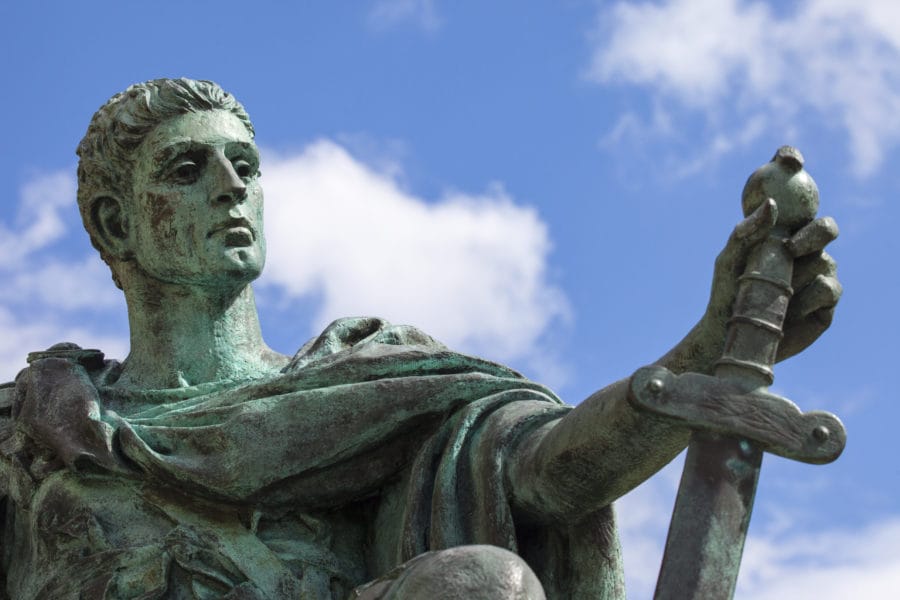
2) Constantine the Great

Roman Emperor Constantine the Great

Constantine’s bridge wasn’t a speech—it was a capital. When he refounded Byzantium as Constantinople (dedicated 11 May 330), he planted the imperial “center of gravity” in a place that physically faced both directions: the Greek-speaking eastern provinces and the Latin-speaking western elite. From there, the Roman Empire’s story starts breathing with two lungs—Latin West and Greek East—tied together by a single imperial machine with one court, one fiscal spine, and a new ceremonial center.

But the bridge wasn’t only geographic. Constantine also tried to standardize belonging in a diverse empire by managing religion as public order. The Edict of Milan (313) helped end the legal war on Christians and affirmed broad religious toleration (and the return of confiscated property), reducing one of the empire’s most explosive internal fault lines.

Then he moved from toleration to coordination: by convening the Council of Nicaea (325), he attempted to calm intra-Christian conflict (Arianism) by pushing the church toward a shared formula of belief—less “one religion replaces another,” more “one empire can’t afford rival truth-systems ripping its cities apart.” The point was unity, not theology for theology’s sake.

And underneath the symbols, he reinforced the bridge with bureaucracy: Constantine strengthened a more layered imperial administration, including regional praetorian prefects with civil authority, so distant provinces could be governed with fewer improvisations and fewer local fractures.

Net effect: Constantinople becomes both a hinge city and a governing method—a place, and a system, built to keep different peoples, languages, and religious communities inside the same imperial frame.

3) Mehmed II (Fatih)

Portrait of Sultan Mehmed II (Fatih)

Mehmed is the rare conqueror who reads like a librarian with an army. After 1453, he doesn’t just seize a city—he claims its intellectual inheritance. He gathers Greek scholars and Italian humanists at court and builds a palace library that treats Greek and Latin learning as assets of empire, not trophies to be burned.

That matters because Constantinople wasn’t guarding only “classical Greece.” Its book-world sat at the intersection of Greek, Latin, Arabic, Persian, and Ottoman Turkish—a living archive where ancient philosophy, late antique commentary, and the broader Mediterranean/Islamic scholarly tradition could be copied, translated, argued over, and repurposed. Mehmed actively commissions and collects across those languages, turning conquest into a kind of cultural logistics: texts don’t just survive; they circulate.

He also chooses governance that keeps plural worlds operational. He preserves the Orthodox Church as an institution under Ottoman rule—creating continuity for the Rum Christian community even as the city is rebuilt and repopulated.

And he doesn’t merely tolerate “Western” art—he recruits it. Inviting Gentile Bellini to his court and commissioning a European-style portrait is a signal of confidence: Mehmed is willing to be represented in the visual language of Renaissance diplomacy, while remaining unmistakably Ottoman.

Finally, he imports the Timurid scientific moment into the city’s bloodstream: Ali Kuşçu’s arrival links Constantinople to the astronomer-mathematician culture of Samarkand, briefly plugging the post-conquest capital into another apex of Eurasian learning.

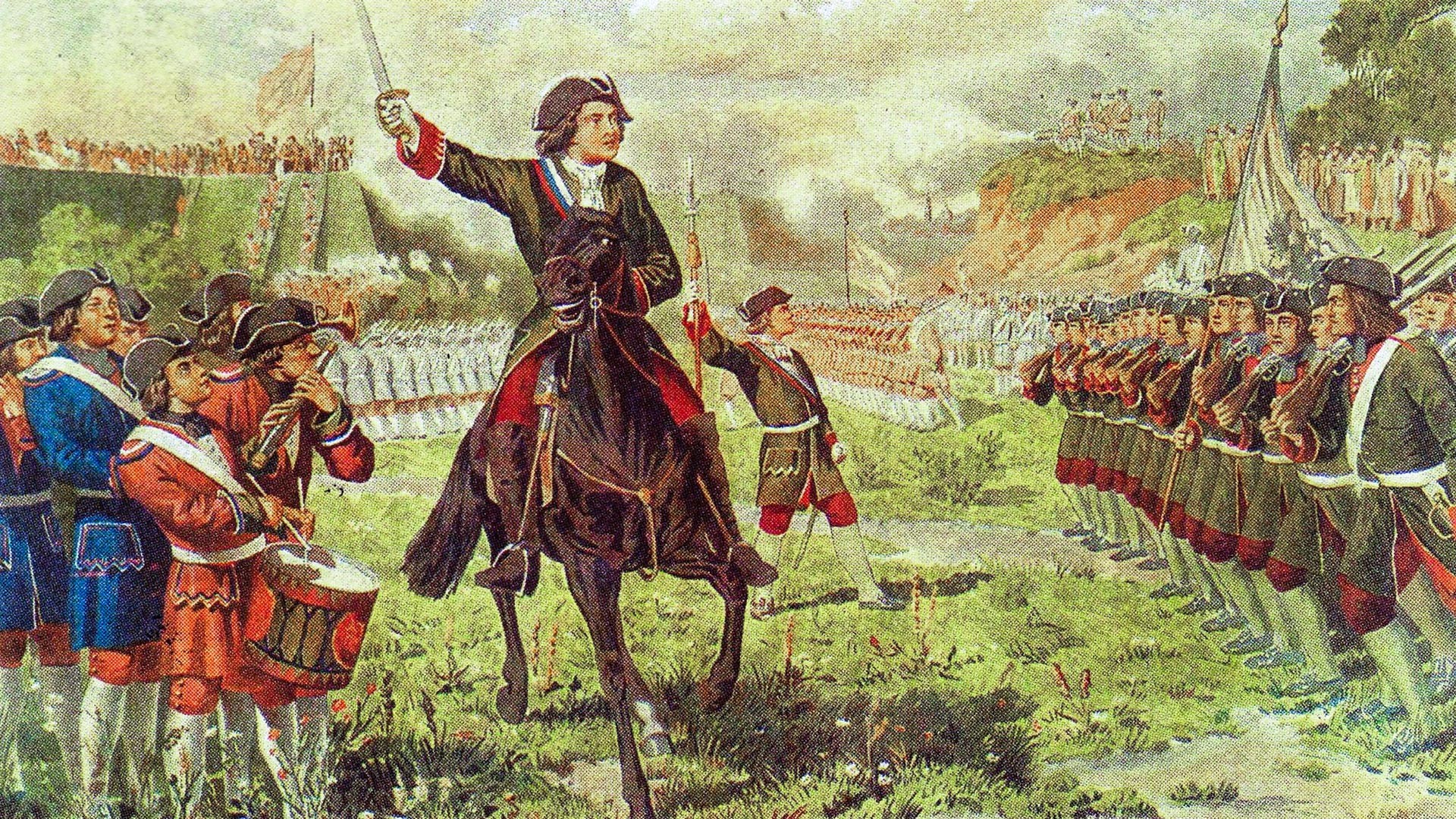
4) Peter the Great

Portrait of Peter the Great of Russia

If you want “bridge” as a means of modernization by translation, Peter is unavoidable, importing European institutions and techniques to rewire a Eurasian state.

And Istanbul is part of Peter’s shadow story, too—because Russian–Ottoman rivalry, diplomacy, faith, and exile all leave fingerprints here. Our Russian Istanbul Tour frames this perfectly: Pera as diplomacy “staged in stone,” Fener as the city’s living Orthodox heart, and the Bosphorus as a political shoreline where geography becomes geopolitics.

5) Mustafa Kemal Atatürk

Photo of Mustafa Kemal Atatürk

Atatürk’s bridge is built out of education, law, and identity: reforms aimed at a modern, secular nation-state—free compulsory primary education, new schools, women’s rights, a modern legal framework, and the Latin alphabet as a civilizational pivot in daily life.
If Mehmed is “the Renaissance sultan,” Atatürk is modernity turned into infrastructure.


Five who bridged worlds with ideas

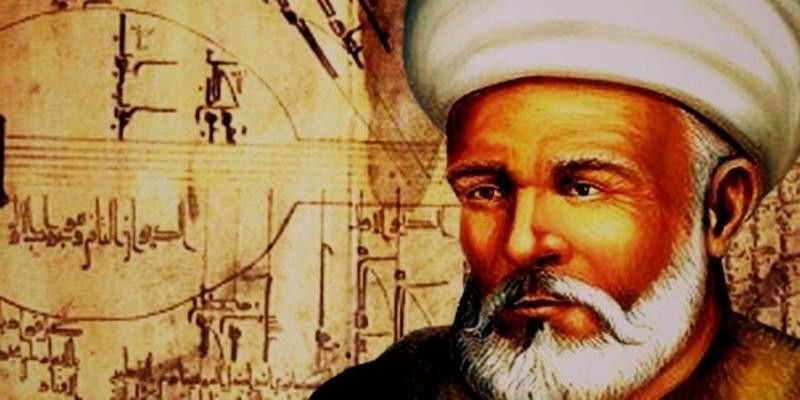
6) Al-Fārābī

Illustration of Al-Fārābī

Al-Fārābī treats Greek philosophy as something you can adopt without surrendering your own world. Britannica even notes he was regarded as the greatest philosophical authority after Aristotle in the medieval Islamic world.
That’s bridging as a method: translation + synthesis + a new intellectual home.

If you want the local frame, start with our guide to philosophers of Anatolia.

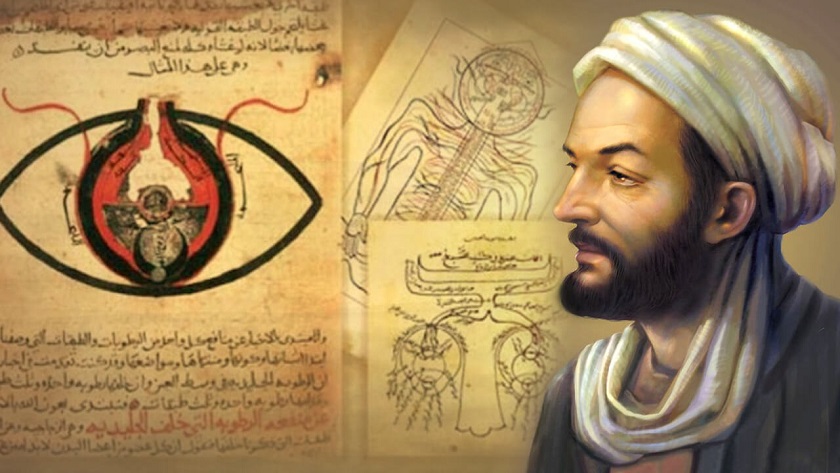
7) Avicenna (Ibn Sīnā)

Illustration of Avicenna (Ibn Sīnā)

Avicenna is a system-builder—Aristotelian logic, metaphysics, medicine—so strong it travels. Britannica calls him the most famous and influential of the philosopher/scientists of the medieval Islamic world.

The point isn’t “East borrowing West” or “West borrowing East.” It’s a shared toolkit that stops belonging to one shore.

If you end up in Sultanahmet, the Istanbul Archaeological Museums are an easy place to feel how old ideas turn into systems.

8) Averroes (Ibn Rushd)

Statue of Averroes (Ibn Rushd) in Córdoba

Averroes is the bridge’s hard spine: Rigorous commentaries on Aristotle that end up inside Latin intellectual life. Britannica notes he wrote extensive commentaries on most of Aristotle’s works and that these were incorporated into Latin versions of Aristotle’s complete works. He makes “reason” a common battleground where both worlds have to sharpen their arguments.

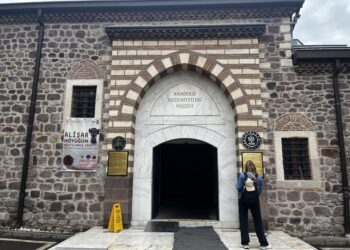
If your trip takes you through Ankara at any point, the Museum of Anatolian Civilizations makes a surprisingly good “big picture” companion to this kind of thought.

9) Maimonides

Portrait of Moses Maimonides

Maimonides is a three-way bridge: Jewish theology, Greek philosophy, and the wider Islamic intellectual atmosphere. Britannica describes The Guide for the Perplexed as applying Neoplatonic and Aristotelian philosophy to biblical and rabbinic theology.

That’s synthesis with consequences—because once you do it, nobody gets to pretend the other side’s questions don’t exist. In Istanbul, you can still see the multi-tradition layer in everyday life around Fener and the Ecumenical Patriarchate.

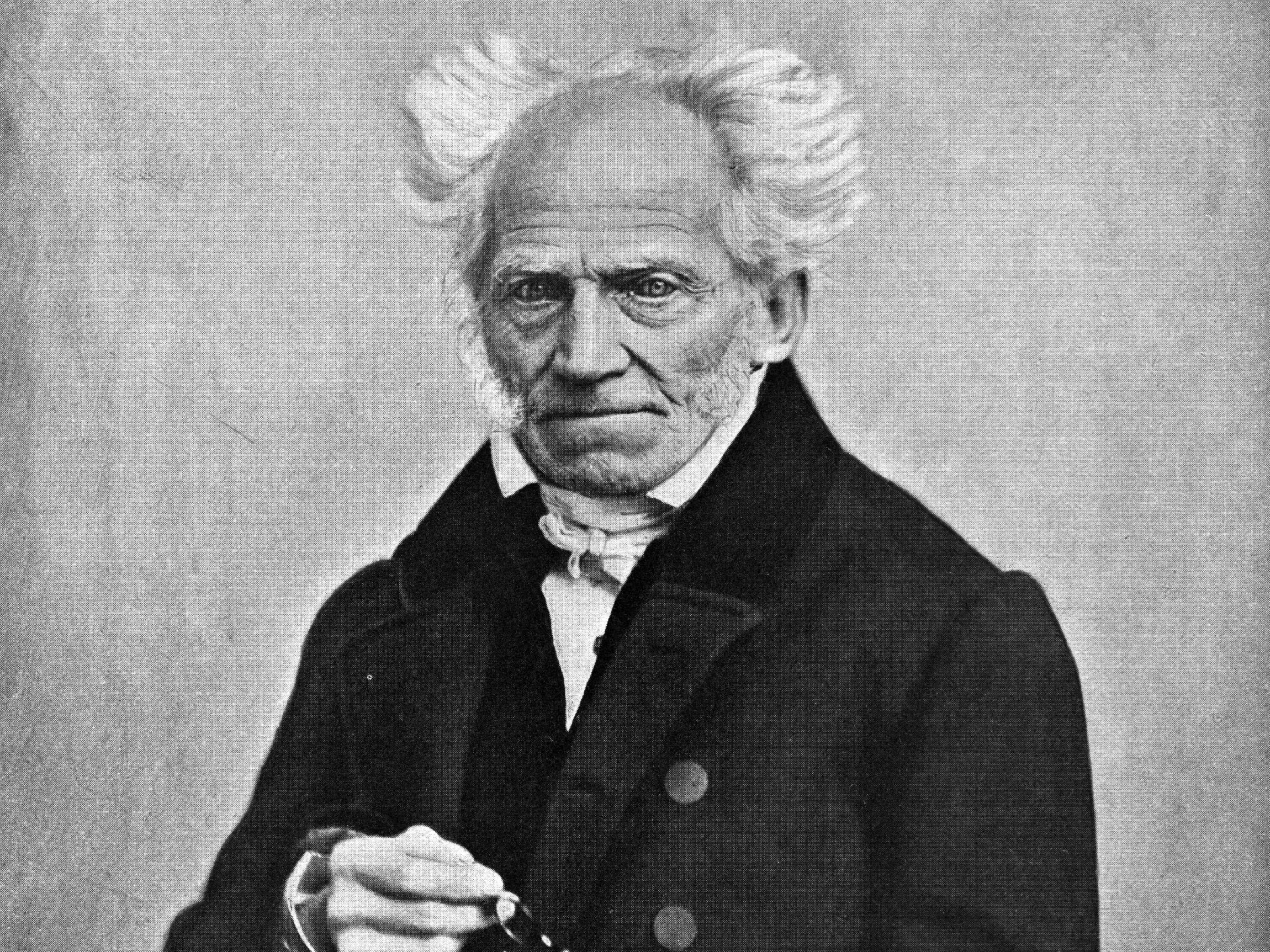
10) SchopenhauerPortrait of Arthur Schopenhauer

Schopenhauer is one of the earliest, loud examples of the bridge running the other way: Modern European philosophy taking Indian thought seriously enough to let it reshape the work. Scholarly writing explicitly frames his engagement with the Upanishads as a deep influence and a “bridge” between India and modern Europe.

If this theme is what brought you here, Istanbul beyond myth is a good companion piece for how the city carries it today.


One last stop: Why this belongs to Turkey (not just textbooks)

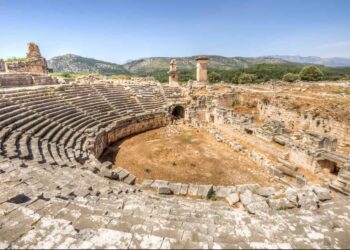
Our Miletus piece reminds us that Anatolia isn’t a footnote—it’s a generator: a crossroads city shaping trade, philosophy, and urban planning, with Ionian thinkers pushing reasoned explanations of nature.
That’s the long pre-Istanbul preface to Istanbul: the habit of ideas moving, mixing, and becoming practical.

Tags: AnatolianAncient CivilizationsAtaturkCultureGreek CultureHellenisticMediterraneanPersianPhilosophyReligion
Share132Tweet83
TheOtherTour

TheOtherTour

Established in 2011, TheOtherTour has evolved from offering alternative city tours in Istanbul to becoming a trusted travel agency that provides top-quality services and curated travel experiences throughout Turkey. With 15 years of experience exploring the nooks and crannies of Istanbul, we delight ourselves in sharing the city's hidden gems, from underground art scenes to music schools and various intimate spaces. The focus is not just on showing you the sights but also on introducing you to the city's heartbeat, its people, and its unsung tales. We have tested and curated the best of what Turkey has to offer—be it boutique hotels, unique experiences, or cultural journeys. The company is committed to sustainable tourism, partnering with local artisans, guides, and businesses to offer an authentic experience that benefits communities as much as it delights travelers. Follow and join us for insider tips, exclusive reviews, and inspirational stories that will make your next journey truly unforgettable.

Related Posts

Hagia Sophia: The Eternal Dome of Civilizations
11-Day Tours

The Grand 10-Day Turkey Tour

See Turkey‘s most iconic cities and landscapes in a beautifully planned 11-day journey. Istanbul, Cappadocia, Antalya, Pamukkale and Ephesus.

chora church
Istanbul Attractions

Chora Church or Mosque or Museum: Dazzling History

Among Istanbul's unique architectural jewels is the Chora Church (Kariye Museum), renowned for its exquisite Byzantine mosaics and frescoes.

Camlica Mosque – Newest Icon on Istanbul’s Highest Peak
Istanbul Asian Side

Camlica Mosque – Newest Icon on Istanbul’s Highest Peak

Explore Çamlıca Mosque's architecture, symbolic design, and role in Istanbul’s skyline, blending Ottoman heritage with modern significance.

Istanbul Street Markets
TOP 5 ISTANBUL

Istanbul Street Markets

The fantastic local street markets of Istanbul that adds another authentic flavor to this city that really doesn't need it. Here's our Top...

Çatalhöyük – The Dawn of Civilization
Anatolia Archaeology

Çatalhöyük – The Dawn of Civilization

Discover Çatalhöyük, one of the world’s oldest cities. Explore its Neolithic homes, murals and artifacts, revealing urban life from 7500 BCE!

Best of Turkey – 10 Days Tour Itinerary
10-Day Tours

Best of Turkey – 10 Days Tour Itinerary

This 10-day journey unites Turkey’s defining landscapes—historic battlefields, ancient cities, coastal havens, and Cappadocia’s otherworldly valleys—into one seamless and beautifully paced route.

Next Post
Bukoleon Palace: Istanbul’s Seaside Byzantine Dream

Bukoleon Palace: Istanbul’s Seaside Byzantine Dream

Comments 1

  1. Antoinette says:
    1 week ago

    I really enjoyed this post — the “seam where worlds get stitched together” idea is exactly how I experience Istanbul!

    Reply

Leave a Reply Cancel reply

Your email address will not be published. Required fields are marked *

  • Ömer Çelik — Istanbul’s Lead Tour Guide in 2026

    Is it safe to travel to Turkey in 2026?

    16 shares
    Share 2247 Tweet 1405
  • Istanbul Earthquake: A 2026 Update

    42 shares
    Share 1894 Tweet 1184
  • Exploring Istanbul’s Asian Side

    10 shares
    Share 805 Tweet 503
  • The Mystery of Turkish Language

    46 shares
    Share 659 Tweet 412
  • Top 5 Bookshops in Istanbul

    15 shares
    Share 684 Tweet 428

Our Tags

Aegean Sea Ancient City Ancient Civilizations Archaeology Architecture Arts & Culture Asian side Best Tours in Turkey Bosphorus Byzantine Legacy Cappadocia Church Constantinople Cruise Culture Day trips Environment Ephesus European Side Events and Happenings Fun Hagia Sophia Hellenistic Historic Landmarks History Hotels Istanbul Istanbul Tours Istanbul travel Istanbul Trip Istanbul Visit Mediterranean Museums Nature Ottomans Recommendations Religion Reviews Sultanahmet The Other Tour Turkey Turkey Travel Turkish Cuisine Turkish Culture Water

About us

We offer a unique, immersive city tour experience in Istanbul that explores lesser-known areas, engaging participants in cultural activities like local home visits, market explorations, and Bosphorus cruises.

In addition to our signature tour 'The Other Tour', our travel agency also provides a variety of wheelchair-assisted guided tours, custom itineraries, and specialized tours covering historical, cultural, and niche interests like Jewish heritage, vegan spots, and bird-watching. We also offer transportation services with professional guides for a more personalized and flexible experience.

Newsletter

The Other Tour is an immersive Istanbul experience, taking you beyond tourist spots to explore local culture with activities like home-cooked meals, school visits, and Bosphorus cruises. As a travel agency, we also offer personalized travel planning in Istanbul and Turkey, crafting custom itineraries and unique experiences tailored to each traveler.

Company

  • Explore
  • 2026 Itinerary
  • Services
  • F.A.Q.
  • Blog
  • Philosophy
  • About The Other Tour Istanbul
  • Contact

Our Services

  • Private Tours
  • Private Tour Guides
  • Airport Transfers
  • Made-to-order
  • Hotel Selection
  • Culinary Tours
  • Shopping Tours
  • Unique Activities

Turkey

  • Destinations
  • Istanbul
  • Cappadocia
  • Ephesus
  • Pamukkale
  • Bodrum
  • Antalya
  • Mediterranean
  • Terms & Conditions
  • Privacy Policy
  • Jobs
  • Get in touch

© 2026 THE OTHER TOUR by BEFORE TRAVEL - TÜRSAB NO: 7651.

No Result
View All Result
  • Home
  • Explore!
  • The Other Tour
    • Introduction
    • 2026 Itinerary
    • F.A.Q.
    • About us
    • Reviews
    • Contact
  • Istanbul
    • Tours
    • Tour Guides
    • Attractions
    • Neighborhoods
    • Food
    • Stay
    • The Bosphorus
  • Turkey
    • Turkey Tours
    • Destinations
    • Cappadocia
    • Ephesus
    • Pamukkale
    • Antalya
    • Bodrum
  • Services
    • Private Tours
    • Daily City Tours
    • Made-to-order Travel Planning
    • Unique Activities
    • Hire a tour guide in Istanbul
    • Layover Tours
    • Culinary Tours
    • Hotel Selection
    • Family Time
    • Event Planning
    • Corporate Group Tours
    • All Our Services
  • Blog
    • TOP 5 ISTANBUL
    • Read
    • Events
    • News
    • Turkey
    • Documentary
    • Turkish Food
    • Turkish Music
    • Istanbul Videos
    • All Categories
    • All Posts

© 2026 THE OTHER TOUR by BEFORE TRAVEL - TÜRSAB NO: 7651.