Before Copernicus, there was Ali Kuşçu. Fleeing the collapse of Samarkand’s golden age, this brilliant astronomer brought his mastery of the stars to Istanbul. Discover how his mathematical genius helped Sultan Mehmed II transform a newly conquered city into a 15th-century intellectual powerhouse.
Table of Contents
Early Life In Samarkand
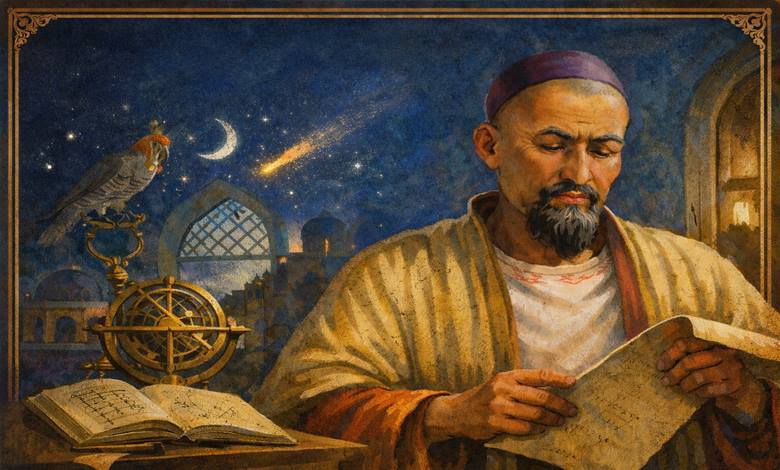
Ali Kuşçu was born in Samarkand, the crown jewel of the Timurid Empire and the intellectual playground of Ulugh Beg—a ruler who was himself a renowned astronomer. Kuşçu grew up immersed in a rare golden age of scholarship. He trained within Ulugh Beg’s famous observatory, a facility that housed the most advanced scientific instruments in the 15th-century world.
Surrounded by the greatest minds of his era, Kuşçu mastered astronomy, mathematics, logic, and theology. His intellect was so sharp that he earned the nickname “Kuşçu,” meaning “falconer.” While it was originally a family title, it became a poetic fit for a man who spent his life tracking the movements of the heavens.
But the scientific renaissance of Samarkand did not last. When Ulugh Beg was assassinated in 1449, the city’s brilliant community of scholars was forced to scatter. Ali Kuşçu first fled to Herat and Tabriz, seeking refuge under new rulers. Eventually, the weight of his unmatched reputation carried him westward, leading him directly to the gates of Constantinople.
Envoy Of Science: From Tabriz To Constantinople

After the collapse of Samarkand’s scientific community, Ali Kuşçu found refuge in Tabriz under Uzun Hasan, ruler of the Aq Qoyunlu. Recognizing Kuşçu’s diplomatic tact, Uzun Hasan sent him to Constantinople to negotiate peace with the Ottoman Empire.
There, Sultan Mehmed II was captivated by the scholar’s intellect. Seeing him as the visionary needed to elevate his new capital into a global center of learning, the Sultan offered Kuşçu an unprecedented salary to stay.
Despite the lucrative offer, Kuşçu remained bound by honor. He declined, insisting he must first return to Tabriz to fulfill his diplomatic duties and formally resign. Mehmed agreed to wait, a rare testament to his respect for the scholar. True to his word, Kuşçu soon journeyed back to the Ottoman borders. Arriving with a grand entourage of scholars and family, he was finally ready to lay the scientific foundations of a new era.
Shaping The Sciences In Constantinople
Upon settling in Constantinople, Ali Kuşçu was appointed to the Hagia Sophia Madrasa and began revolutionizing the Ottoman educational curriculum. His time in the capital produced concrete, lasting advancements that elevated the empire’s scientific standing.
Mapping The Heavens: The Conqueror’s Treatise
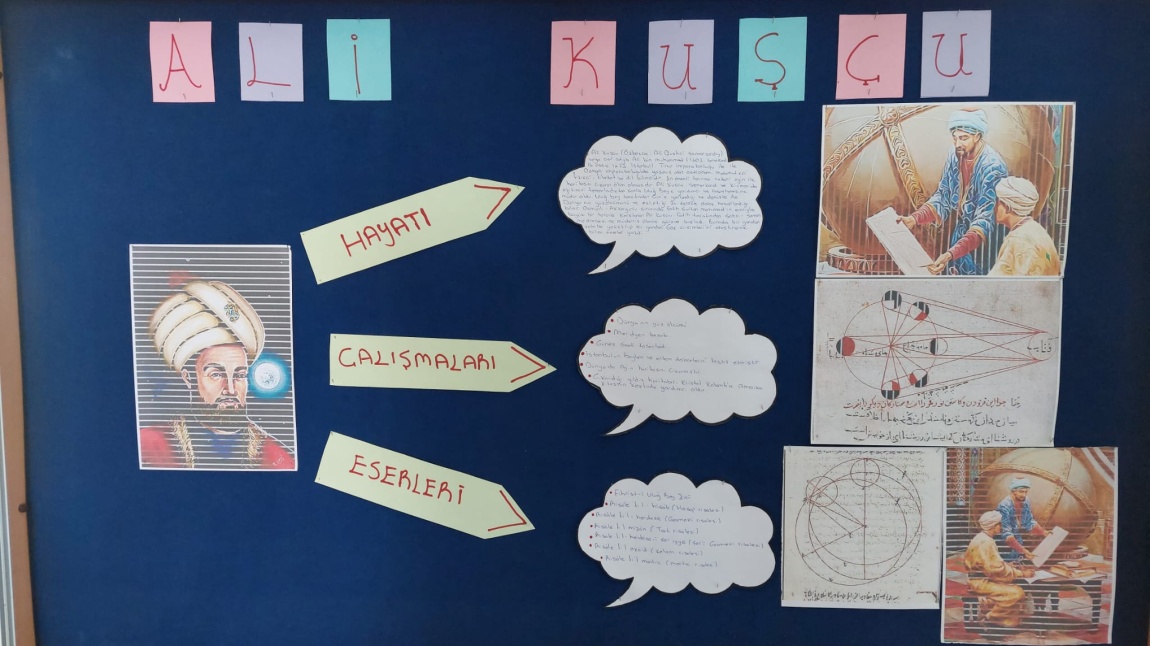
In 1473, Ali Kuşçu presented Sultan Mehmed II with al-Risāla al-Fathiyya fī’l-Hayʾa (The Conqueror’s Treatise on Astronomy). Commemorating the Ottoman victory at Otlukbeli, this work was a comprehensive synthesis of advanced astronomical knowledge, drawing heavily from the mathematical traditions of Samarkand. Kuşçu meticulously detailed planetary models, celestial mechanics, and sophisticated observational techniques.
Recognizing its immense value, Ottoman authorities quickly integrated the treatise into the core curriculum of madrasas across Constantinople. For generations, it served as the definitive textbook for aspiring scholars and imperial astronomers. By providing a standardized foundation in rational sciences, Kuşçu’s treatise elevated the intellectual prestige of the empire and firmly guided Ottoman scientific thought.
Anchoring The City: Coordinates And Timekeeping
Before Kuşçu’s arrival, the geographical data defining Constantinople relied heavily on outdated historical estimates. Applying his rigorous mathematical training, he initiated a project to meticulously recalculate the latitude and longitude of the capital. Utilizing complex geometric principles, he anchored the city on the scientific maps of the fifteenth century with a precision that closely aligns with modern measurements.
Beyond theoretical geography, Kuşçu applied his expertise to the practical needs of the metropolis by constructing a sophisticated sundial at the Fatih Mosque. This complex engineering was vital for regulating daily life and determining precise prayer schedules. As a significant scientific instrument, it stood as a public testament to his genius, seamlessly blending advanced astronomy with civic life.
A Quiet Revolution: Separating Science From Philosophy
Perhaps Kuşçu’s most profound intellectual contribution was his bold challenge to the accepted scientific dogmas of his time. Astronomy was deeply entangled with traditional Aristotelian philosophy, which dictated rigid rules about celestial mechanics. Kuşçu argued that astronomical phenomena must be evaluated strictly through empirical observation and pure mathematics, independent of these ancient philosophical assumptions.
By advocating for this methodological separation, he broke new intellectual ground within the academic circles of Constantinople. He famously treated the rotation of the Earth as a valid mathematical possibility that could be precisely modeled, rather than a philosophical heresy. This pragmatic approach quietly dismantled centuries of limitations, laying essential theoretical groundwork for modern astronomy.
Death And Legacy: A Lasting Imprint On Istanbul

Ali Kuşçu passed away in Istanbul in 1474, just a couple of years after his momentous arrival. Though his time in the Ottoman capital was relatively brief, his intellectual impact was monumental.
He was buried near the sacred Eyüpsultan complex, an immense honor that reflected his high status within Sultan Mehmed II’s court. Today, his tomb still stands in the historic Eyüpsultan Cemetery, serving as a quiet resting place for the man who bridged the scientific minds of Central Asia and the Ottoman realm.
His influence endured long after his death, fundamentally shaping Ottoman education for centuries. Generations of scholars learned the stars and mathematics from his treatises, and his empirical methodology became the gold standard within the empire’s madrasas. His legacy remains visible throughout Istanbul today—not only in the enduring sundial at the Fatih Mosque but also in the daily geography of the city.
Following Ali Kuşçu’s Footsteps In Istanbul
Travelers curious about the tangible legacy of this brilliant astronomer can still trace his impact across Istanbul. While centuries have passed, his presence is still felt in several historic locations throughout the city.
Read More About Historical Figures
If you are inspired to explore the rich history of Istanbul and walk in the footsteps of legendary figures, our team is here to help you design the perfect itinerary. Whether you want to visit the Fatih Mosque or discover other hidden gems across Turkey, we provide expert guidance tailored to your personal interests.
To start planning your unforgettable cultural journey, please get in touch with us by filling out the form below. Share your travel dates, preferences, and any specific sites you wish to experience, and we will promptly reach out to craft your ideal historical adventure.