Table of Contents
Introduction to Jim's Cat Tours
Some stories begin with a confession. This one does too.
On April 27, 2025, a message landed in our inbox from a man named Jim Johnson. It was short and full of curiosity:
“This is my fourth visit to Istanbul. I am writing a book on my personal travel experiences, and I would love to include information on Istanbul’s cats and the people who take care of them. Can you organize this?”
That single email changed The Other Tour. At the time, we did not even offer a cat tour. We are a small team, and one of our authors — Berra — read Jim’s note, fell in love with the idea, and quietly decided to build the tour from scratch. She mapped the neighborhoods, sat down with the kediseverler (cat-lovers) of the city, knocked on the doors of NGOs, and stitched together a route that would eventually become one of our best-selling experiences. A year later, Berra’s cat tour is something we are deeply proud of, and it exists because Jim asked.
But the story of how Jim’s first cat tour went is not the one we want to tell. It went badly. I’ll say it plainly.
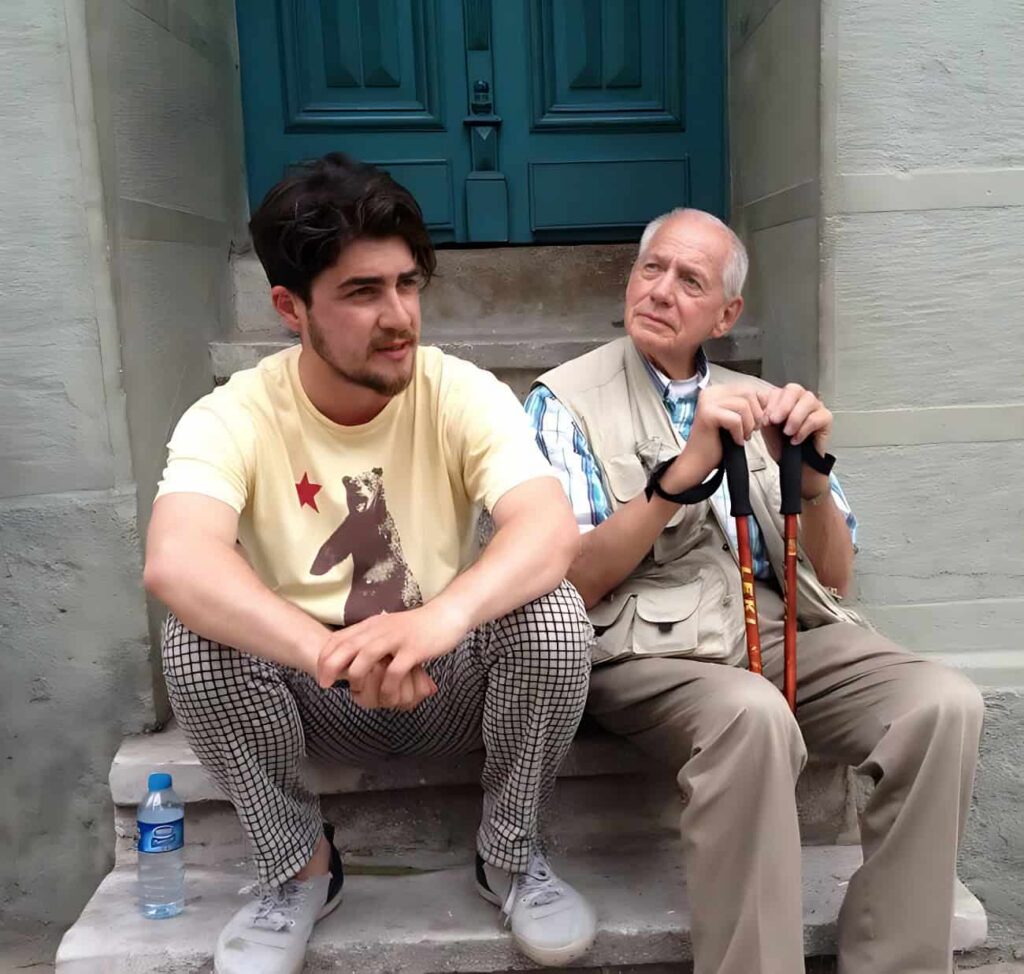
I’m Fethi Karataş, the founder of The Other Tour. I am the one who builds these new itineraries — the one who goes out and meets the guides, the academics, the artists, the archaeologists, the drivers, the service providers. The people who make our tours feel like Istanbul rather than a postcard. When Jim first wrote, a colleague answered him and — wanting to be generous — promised the world at a price (€220 per day) that was nowhere near what those promises required. Lined-up interviews. Appointments with NGOs. Personal introductions to the city’s cat heroes. Every line of that pitch was a commitment that needed someone in the real world to do the work behind it.
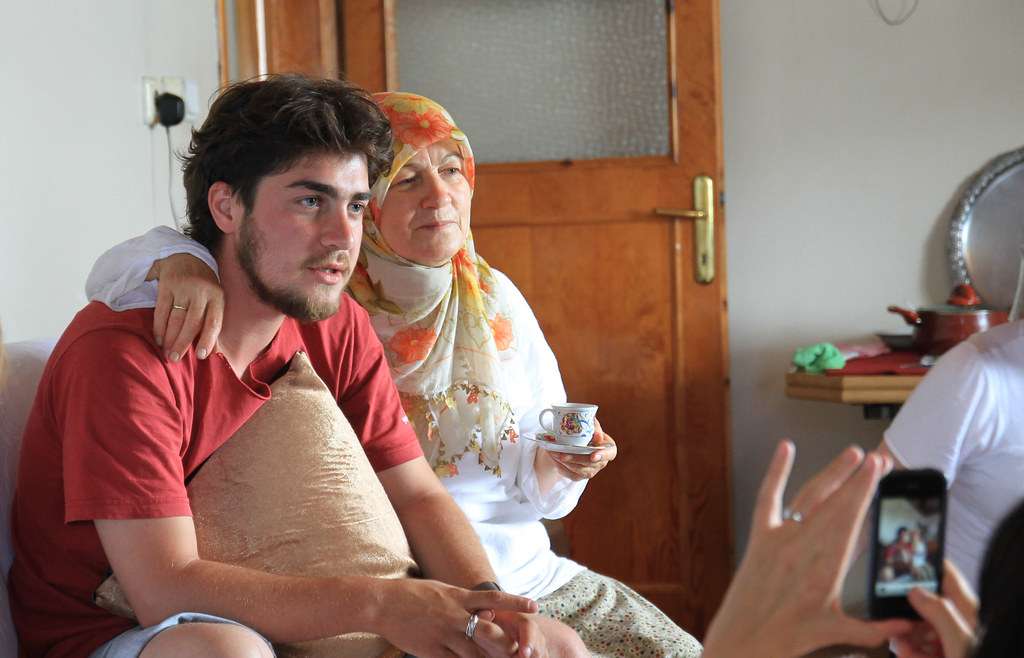
And then, on July 30, 2025, my mother Ayşe Karataş passed away.
I will not pretend the two events are equal — they are not. But the truth is that everything I had been quietly holding together for our newer, more ambitious tours came undone in those weeks. Jim arrived in Istanbul a few days later. The custom interviews were not lined up. The NGO meetings had not materialized. He was handed off to a guide who had not been briefed properly and who, through no fault of his own, could not deliver the experience we had promised. Jim was rightfully upset. He paid nothing. I told him I would make it right, and I meant it.
And Jim came back.
This April — his fifth time in Turkey and his fifth visit to Istanbul — Jim Johnson returned and let us try again. Four days, April 23 through 26, 2026. One subject. A city with somewhere between hundreds of thousands and a million street cats, and the human network that quietly feeds them, treats them, names them, mourns them, and protects them. This time, Berra’s tour was real. The introductions were real. The interviews happened. And Jim, who writes generously and beautifully about the places he visits at his Substack Jim’s Travels, came along for the whole ride with the same curiosity he had a year earlier — and, somehow, with even more grace than we deserved.
Over the next four posts, we’ll walk through it day by day — every neighborhood, every meeting, every cat hero, every cat (and there were many). But before any of that, we owed Jim — and ourselves — this introduction.
Some debts you pay in money. Some you pay in showing up the second time and doing it properly.
Welcome back, Jim. Thank you for trusting us again.
The Night Before: April 22, Zübeyir Ocakbaşı
Before the cat tour officially began, we did what any reasonable person should do on the eve of four hard-walking days in Istanbul: we ate.
Jim and I met at Zübeyir Ocakbaşı in Beyoğlu — one of those ocakbaşı spots where the grill is the centerpiece of the room and the smoke does half the talking. We ordered lamb. Then more lamb. Kebabs that don’t apologize for being kebabs, the kind where the fat does its job and the bread is there to keep up.
It was the first time Jim and I had broken bread since the long, complicated correspondence that followed last year’s tour, and somewhere between the second skewer and the third glass of ayran, the conversation stopped being about logistics and started being about people. That, more than anything, set the tone for what came next.
Tolga Bensan — our professional guide, who would walk every step of the next four days with us — was set to pick Jim up the following morning. Jim, who is famously an early riser, went home to rest. I went home to overthink the itinerary one last time.
Day 1 (April 23) — Balat: A Day With the City’s Quietest Heroes
At a respectable hour the next morning, Tolga picked Jim up from his place on Sıraselviler Caddesi, just down from Taksim Square. They grabbed a taxi and crossed the Golden Horn down to Balat, where I was waiting.
I welcomed them into the Çıfıt Çarşısı — the old “Jewish Market” street — and tried to do what I always try to do here, which is give the place its history before its photographs. In 1492, when the Sephardic Jews were expelled from the Iberian Peninsula, Sultan Bayezid II famously opened the Ottoman Empire‘s doors to them. Many settled in Balat, and the Çıfıt Çarşısı became a civilian, neighborly commercial spine — Jewish merchants, Greek neighbors, Armenian craftsmen, Muslim regulars, all making a living within shouting distance of one another. The street is quieter today, but if you know where to look, the layers are still there.
We popped into Fatinye for a few minutes to say hello to Zeynep — these little check-ins are part of how Balat works; you don’t pass a friend’s door without knocking — and then made our way to Ayça.
Ayça, and the Walk to Aynur
Ayça runs Ayça Eastern Design, a small, sharp little shop in Balat. Before Istanbul, she lived in New York for years, and that mix — local instincts and a New Yorker’s directness — makes her one of the best people to introduce a visitor to this neighborhood. She closed up the shop, joined us, and led us to a nearby park to meet the person Jim had really come to meet: Aynur.
Aynur is the kind of person you write a chapter about, not a paragraph.
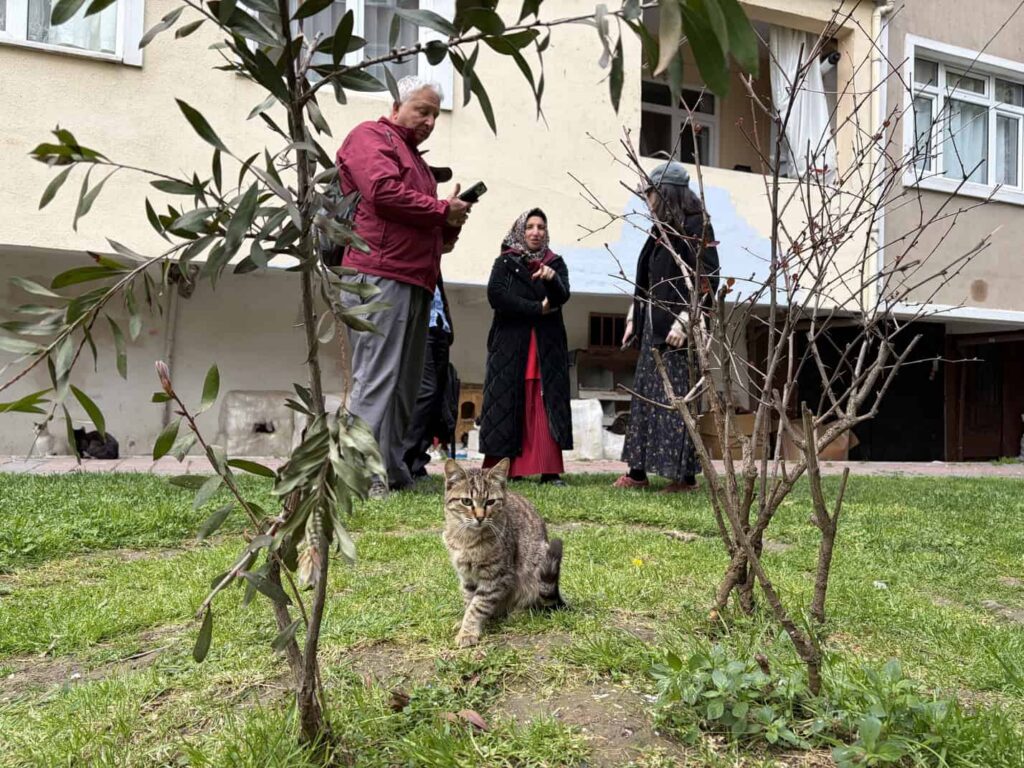
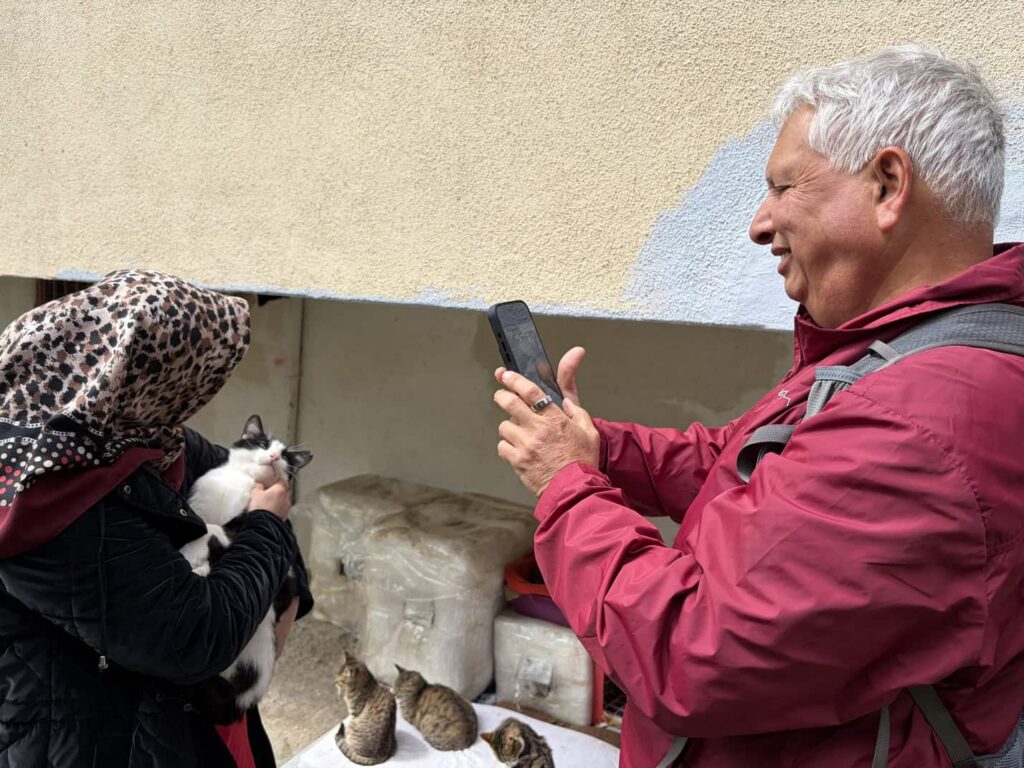
She is a Muslim woman who lives between two lives: her husband is in Beylikdüzü, on the far western edge of the city, and her elderly mother lives in a building right here in Balat. Three or four days a week, Aynur leaves Beylikdüzü and comes to be with her mother — and, by extension, with the cats. She personally cares for around thirty of her own cats, and beyond that, she is the unofficial cat helpline for half the Golden Horn. If a Balat resident finds an injured kitten, a pregnant stray, a sick old tom — they call Aynur.
She walked us into the yard adjacent to the park, where she has built, by hand, a small cat city: shelters, feeding stations, water, a clean rhythm of routine. Most of these cats are family at this point — she knows them, they know her, and they come when she speaks. The thing she wants visitors to understand, though, is that this whole operation is also a peace treaty with the neighbors. As the colony grew, the complaints grew with it. So Aynur did the unglamorous, expensive, thankless work: she had every single one of them neutered. That is what makes a colony sustainable instead of a problem. That is what nobody puts on Instagram.
Jim took notes. Tolga translated. Cats wandered between our ankles like we were furniture they tolerated.
Coffee at Sekiz., and the Backstreets
After Aynur, we started doing what Balat is built for: walking. The backstreets of this neighborhood reveal themselves slowly — pastel facades, laundry lines, a stray cat on every other doorstep, a grandmother on every third — and we let the streets do the work.
We climbed up to Sekiz. — a small café tucked above the rooftops — and took our coffees on the terrace. From up there, you can see the geography of Balat the way Aynur sees it: a map of doorsteps and feeding stations.
The Vet, and a Cat Named Lucky
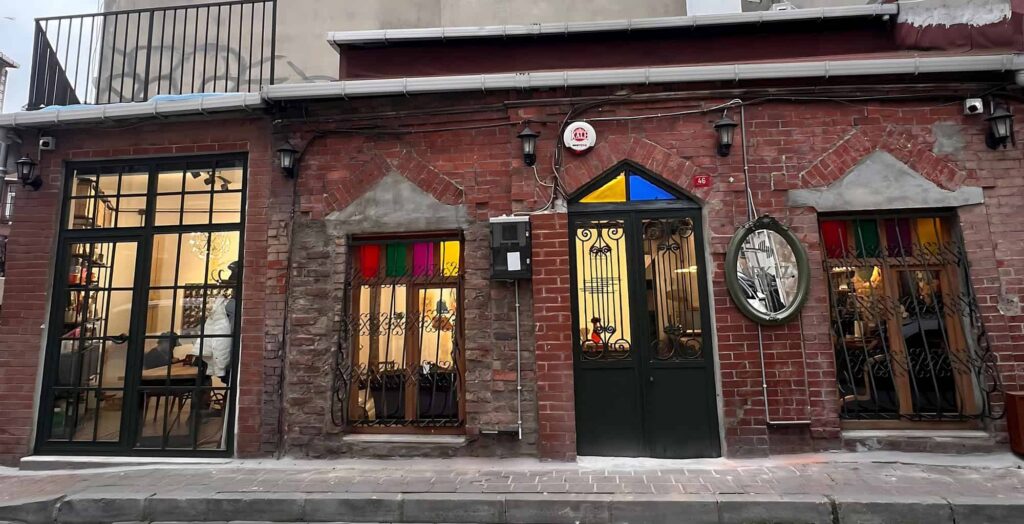
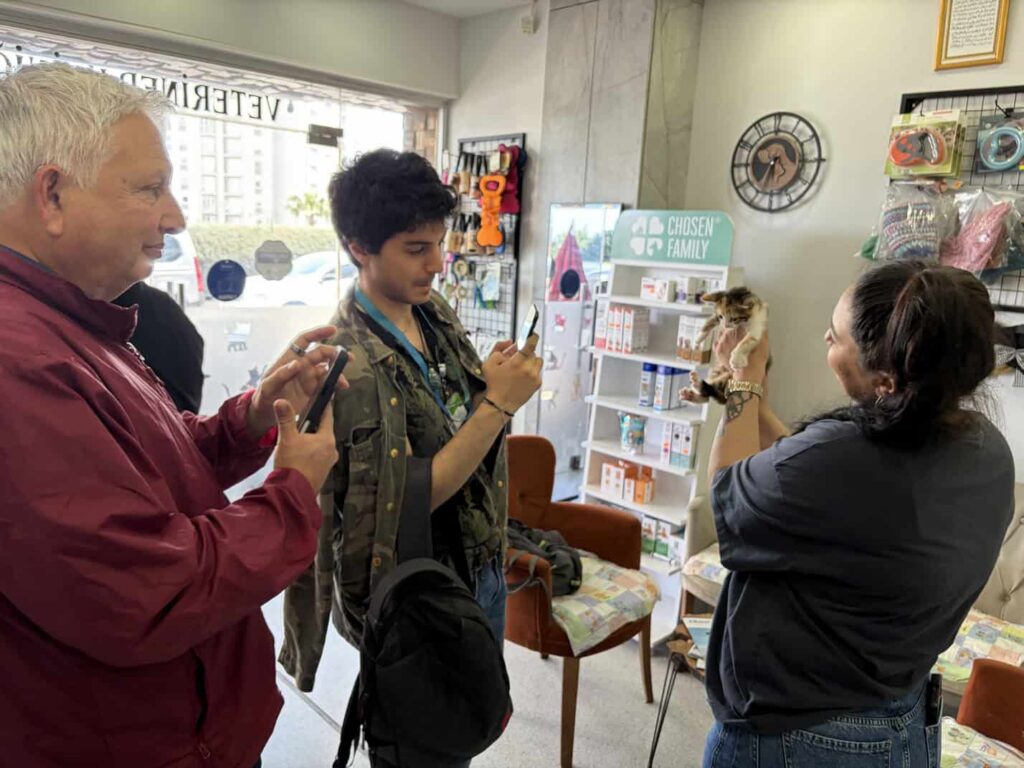
From the café we walked to the Balat Veteriner Muayenehanesi — the Balat veterinarian — and this is where Day 1 stopped being a tour and started being a story.
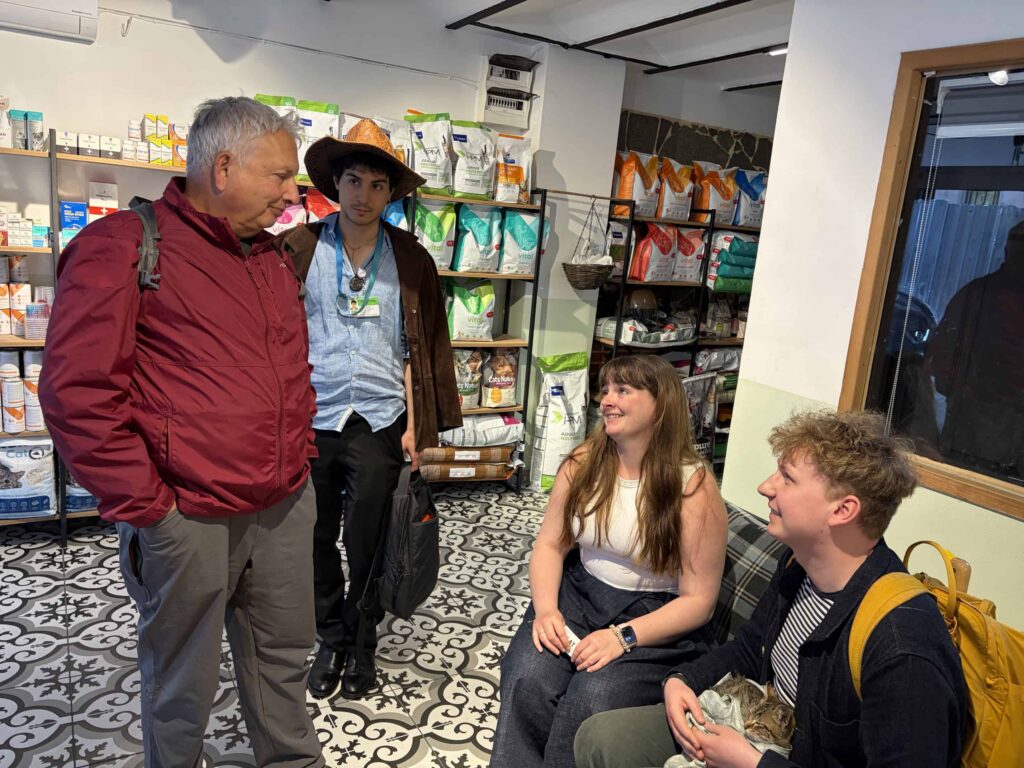
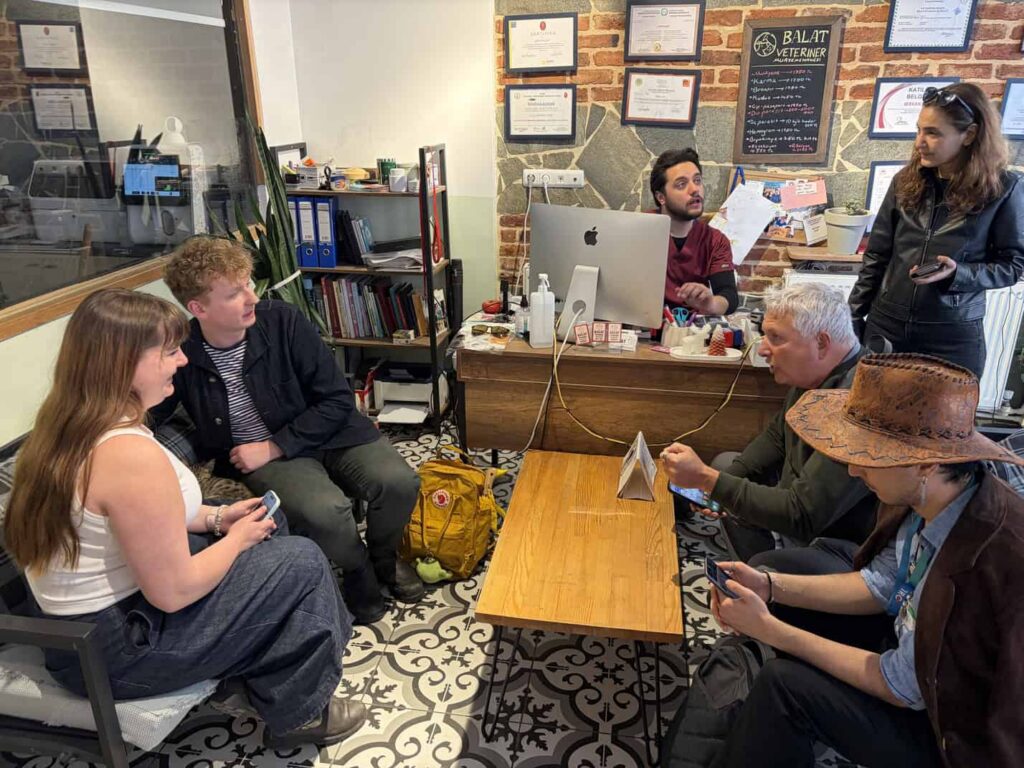
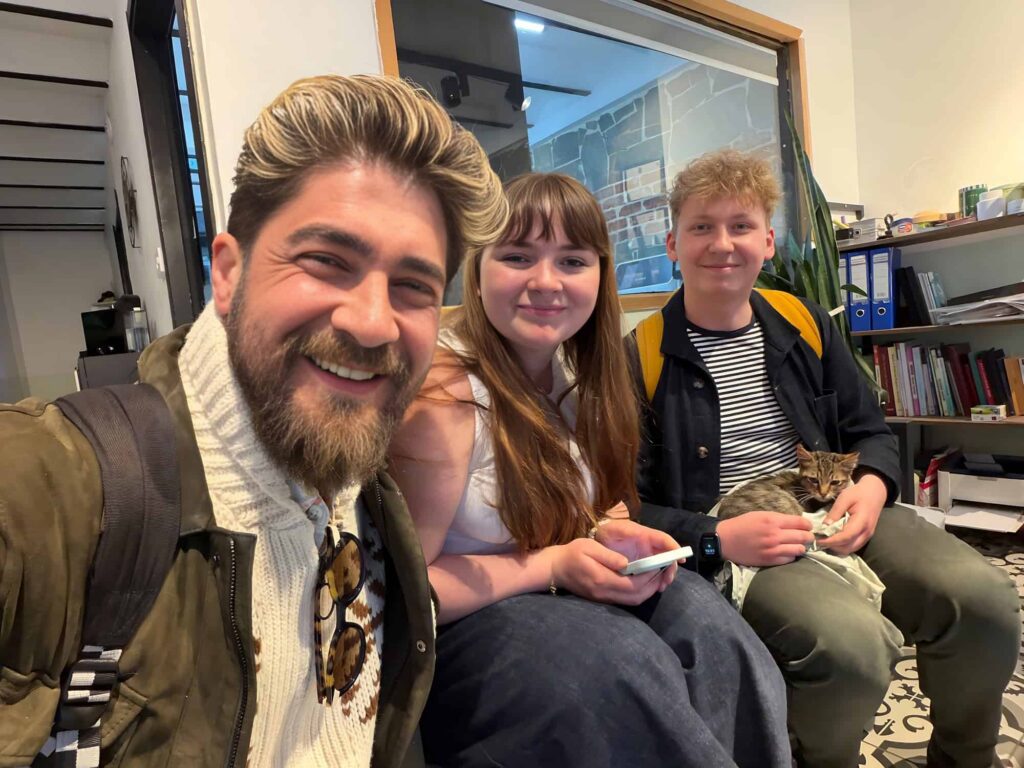
Inside the clinic, we met an unforgettable couple: Jodie, a British woman, and Bartek, her Polish friend. They had found a kitten in the streets in bad shape. The vet’s diagnosis was FIP (Feline Infectious Peritonitis) — a disease that, until recently, was almost a death sentence for cats. Today there’s a treatment, but it’s a serious one: roughly two months of daily care, the kitten boarded at the clinic’s animal-care unit, and a bill of about 1,000 US dollars.
Jim looked at the kitten. He didn’t hesitate.
He named her Lucky.
The five of us — Jodie, Bartek, Jim, Tolga, and me — chipped in together and covered the treatment. We didn’t make a thing of it. We just decided. There is a WhatsApp group now, the five of us, and Jodie sends photos and updates from the clinic. Lucky is in good hands. Lucky has a name. Lucky has five strangers from four countries pulling for her.
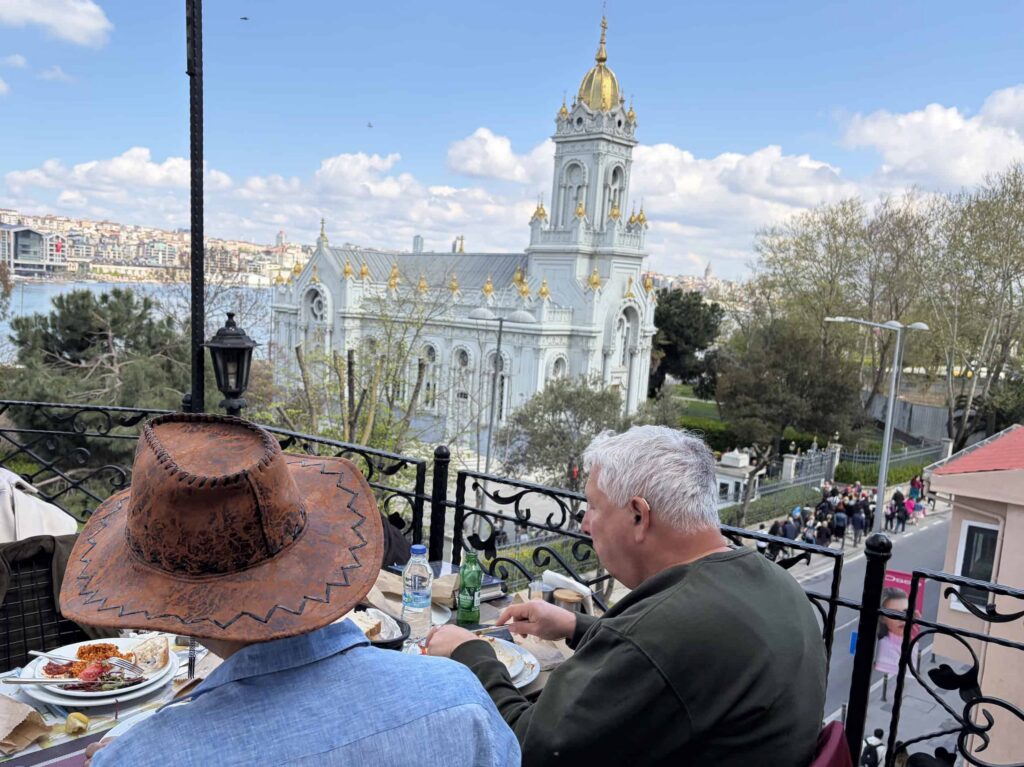
Lunch at Fındık Kabuğunda Köfte
We had made the decision at the vet, but the paperwork could wait fifteen minutes — we were starving. We walked to Fındık Kabuğunda Köfte (“Köfte in a Hazelnut Shell,” which is one of the better restaurant names in Istanbul) and had lunch. Then we doubled back to the clinic, sat with Jodie and Bartek again, checked on Lucky, and paid the bill on the spot.
Arc Coffee Co. — Uğur, Joseph, and a Painter Walking By
The Balat day was not done.
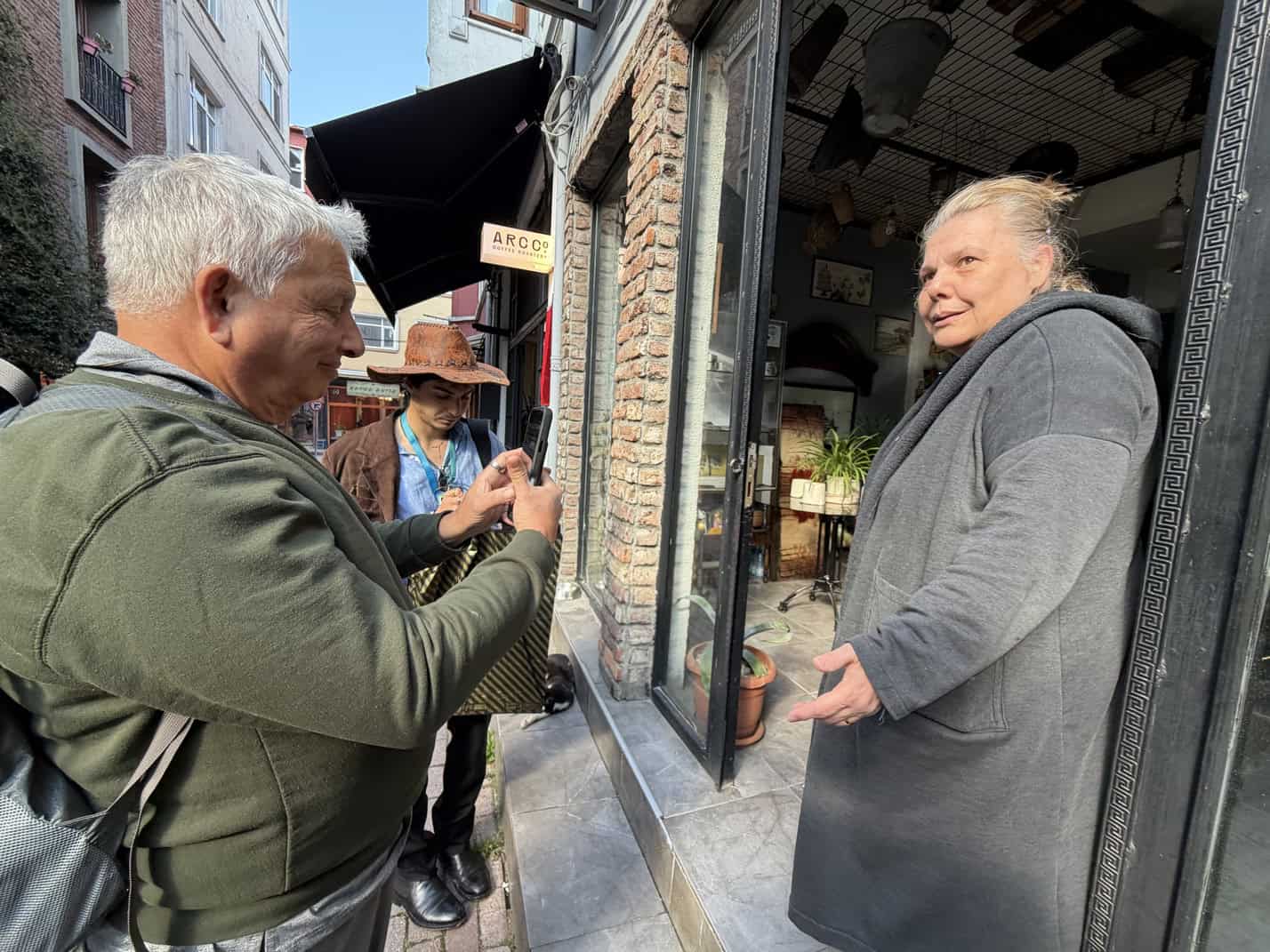
We finished it at Arc Coffee Co., a small specialty café whose owner, Uğur, is — naturally — also a cat-carer. (At this point, Jim had clocked the pattern: in Balat, almost every shopkeeper is also quietly running a small animal-welfare operation on the side.)
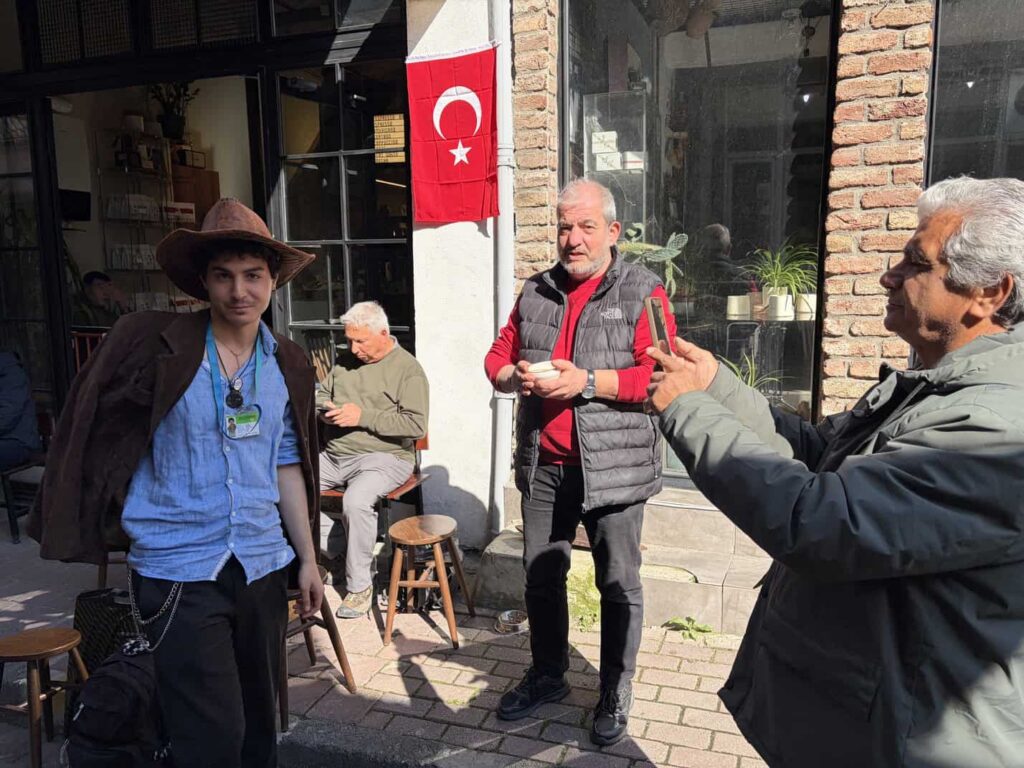
Over coffee, I introduced Jim to Joseph — my good friend, and as far as we know, the only Jew still living in Balat. A neighborhood that was once defined by its Jewish community now has, in a sense, one keeper of that thread. Joseph carries it lightly, with humor and warmth, and he and Jim got on immediately.
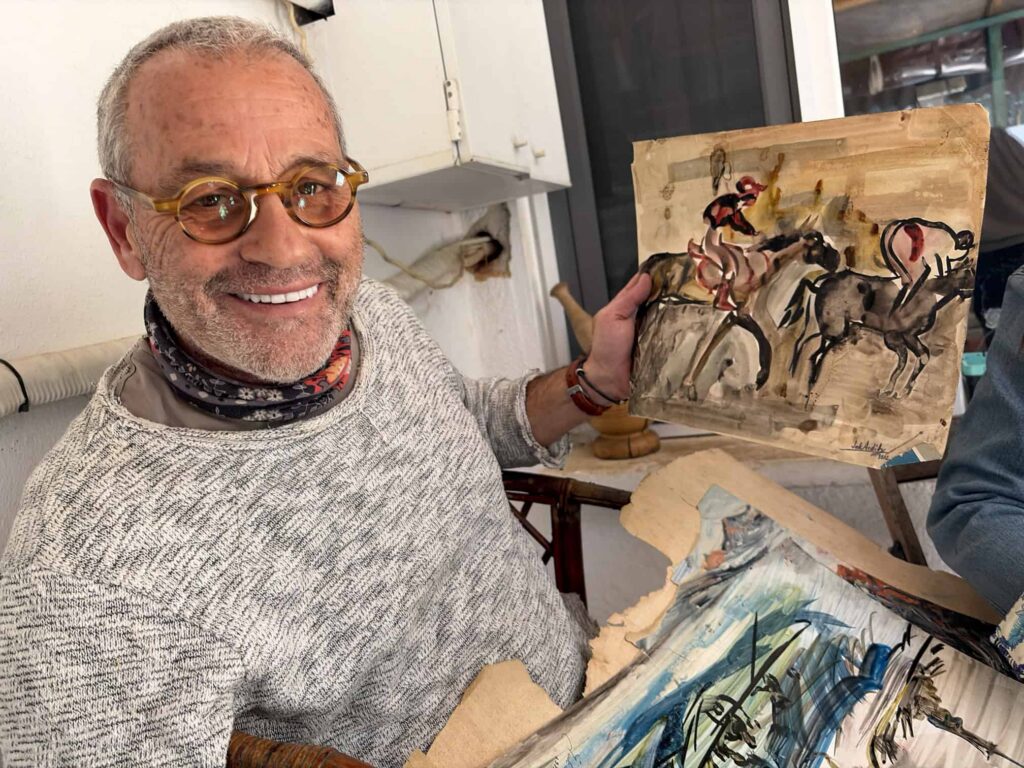
And then — and I still don’t quite believe this — the same thing that happened a few months ago happened again, in the exact same spot, in front of the same café. The famous Turkish painter Ümmet Karaca walked by. We waved him over and the four of us — Joseph, Ümmet, Jim, and me — stood on the sidewalk and chatted for a few minutes like the city had quietly arranged it for us. Maybe it had.
Arzu — The Local Legend Across the Way
Right next to Arc Coffee Co., there’s a small shop run by Arzu. Across the street from her shop is the kahvehane — the traditional men’s coffeehouse — where her husband presides over a daily congregation of retired regulars and their boardgames.
Arzu is a Balat institution.
She has one arm. She helps dozens of cats. She does it every day. And she is good friends with Aynur — the woman with whom our day began. So the day, by accident and by design, closed its own circle. Two of the most important cat-carers in Balat, friends with each other, bookending Jim’s first day on the tour.
Home Before Sunset
Jim, true to form, was tired by late afternoon. He sleeps early and wakes earlier — the secret of every traveler I trust — and so, around 5 p.m., we drove him back across the Golden Horn.
Day 1 was a confession of a neighborhood: that Balat’s beauty isn’t its façades, it’s the network of people who live behind them, and that an extraordinary number of those people happen to be cat-carers. We had met two of the best of them, paid for one kitten’s life, run into a celebrated painter on the same sidewalk twice, and eaten köfte under a Hazelnut Shell.
Tomorrow would be another cat day. A bigger one.
Day 2 (April 24)— From Cihangir to the Theodosian Walls
If Day 1 was a deep dive into one neighborhood, Day 2 was the opposite: a long, looping line across Istanbul, from the boutique cafés of Cihangir, out to the working-class high-rises of Sultangazi, down through Zeytinburnu, past the 5th-century Theodosian Walls to the Yedikule Animal Shelter, and finally into the heart of ancient Byzantion itself, ending with dinner on top of a 4th-century Roman palace.
Jim took it like a champion. Tolga, our guide, kept the rhythm. I tried to keep up.
Morning — Le Oba, Cihangir
We started where every good Istanbul day should start: with coffee.
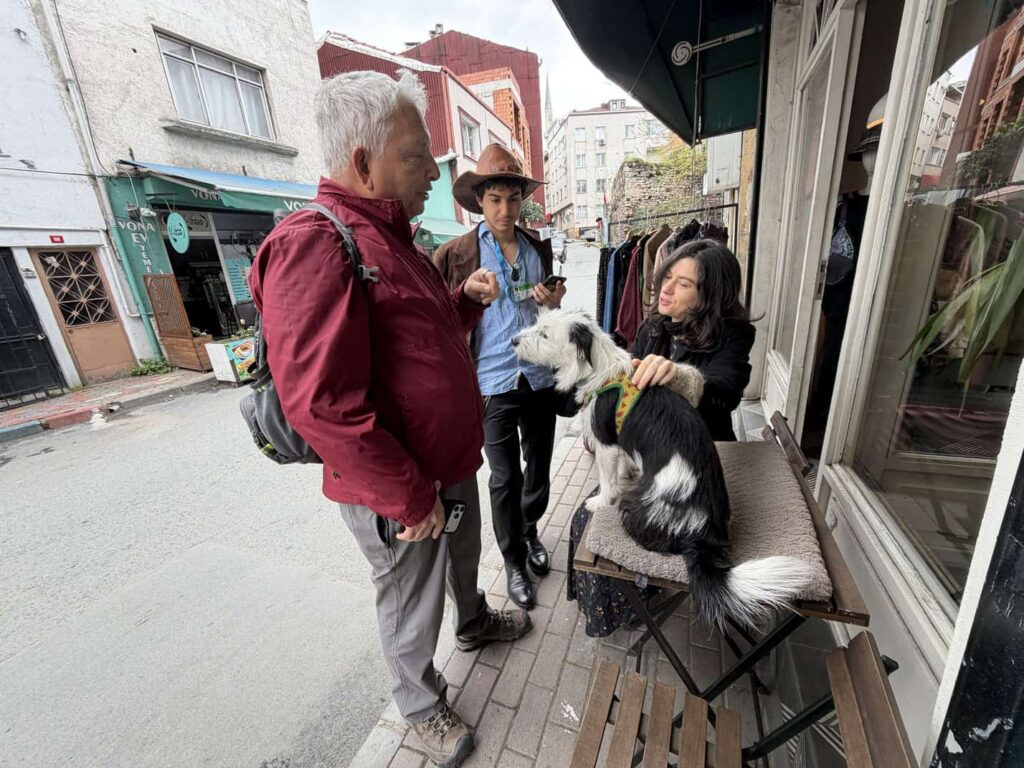
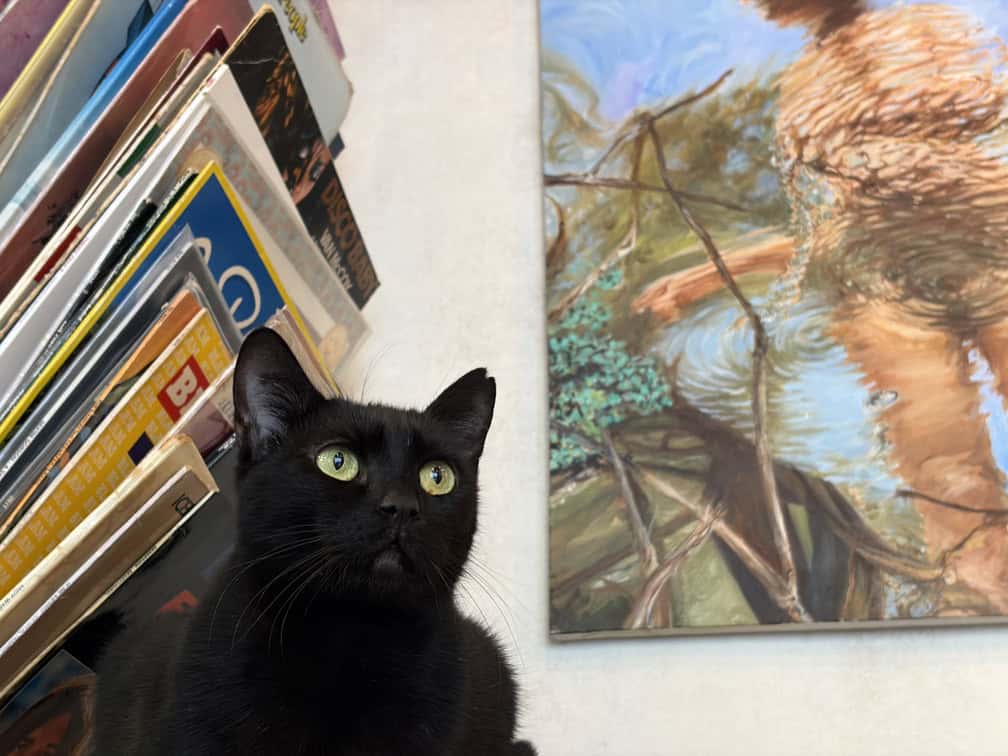
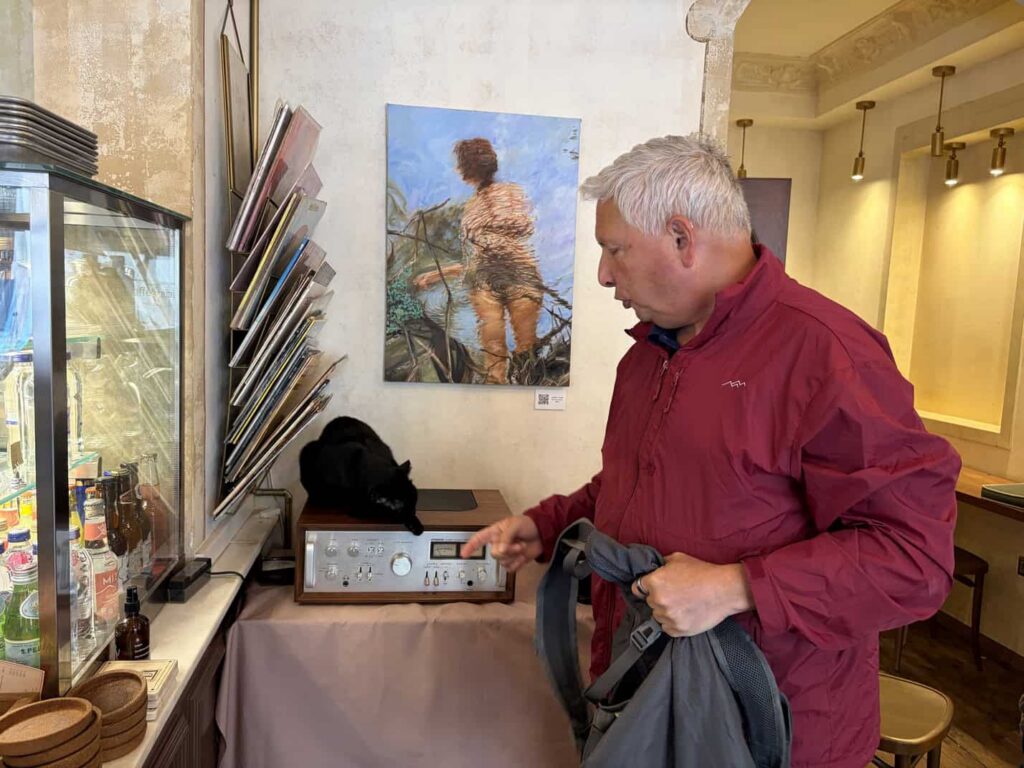
Le Oba, in Cihangir, has the kind of mood you can sink into for an hour without noticing. It also has a beautiful black cat that walks the room like she owns it — which, in any honest accounting, she does. We petted her, she tolerated us, and Jim got his first cat encounter of the day before he’d even finished his cup. A perfect omen.
Fatih and "Union and Company"
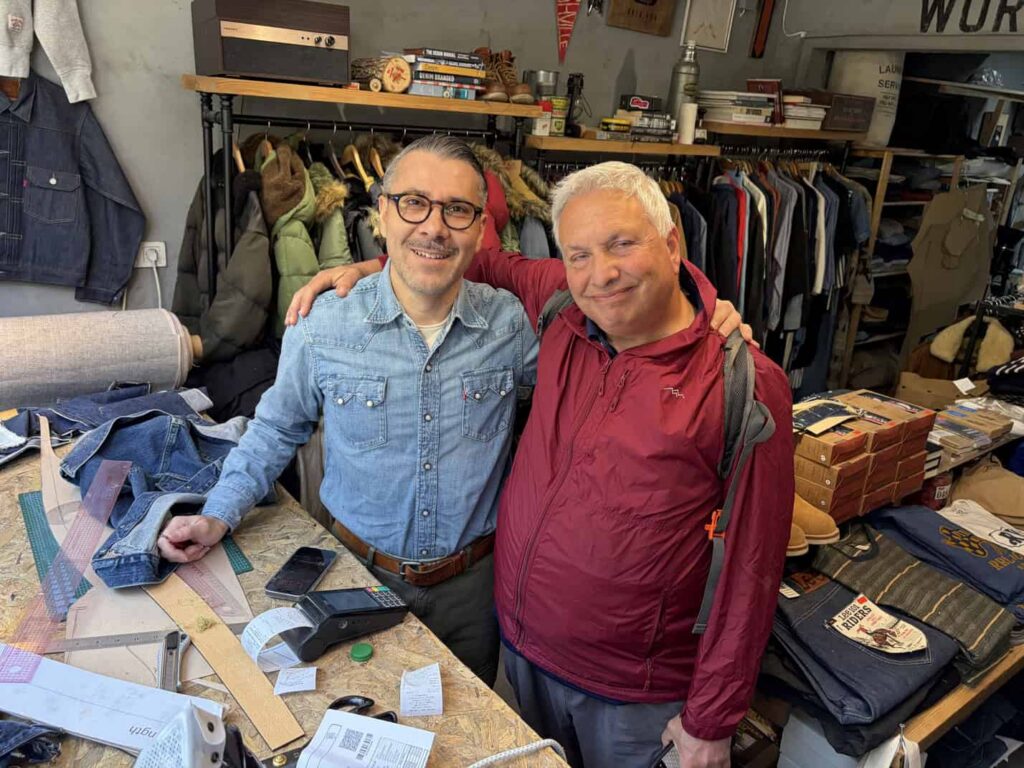
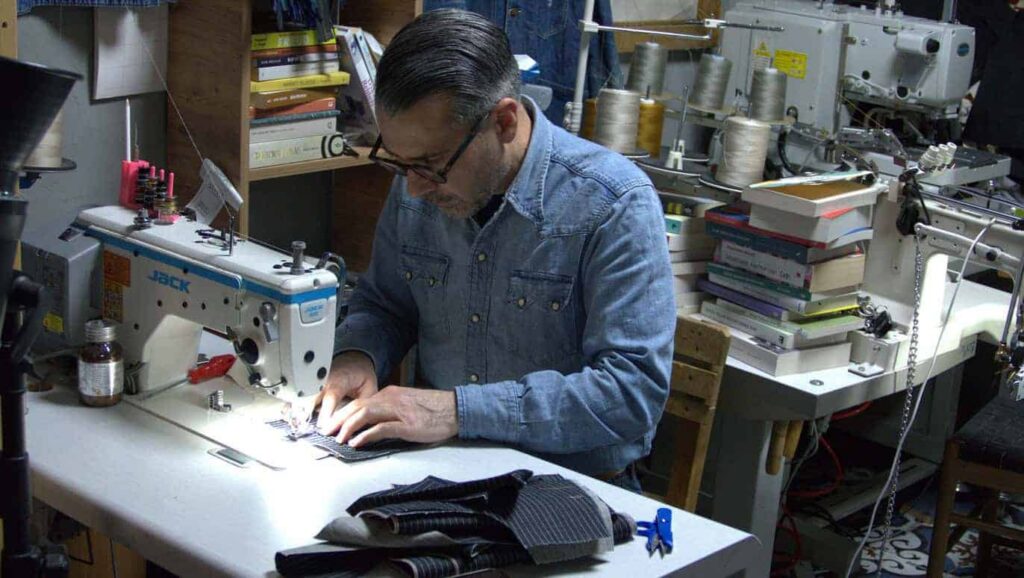
A short walk down Cihangir Caddesi, we stopped at one of my favorite small businesses in the neighborhood: Union and Company Western and Work Clothing, a tiny clothing-and-tailor shop run by a man named Fatih.
Fatih is one of those quiet Cihangir fixtures. He sells beautifully made workwear, he is also a tailor, and — like seemingly half the shopkeepers we’d meet on this trip — he runs a personal cat-rescue operation out of his storefront. We said hello, petted his cats, and he told Jim his story: how he started, who the cats are, why he can’t not do this work. Jim took notes.
Then we did something I love about how this trip was unfolding: we used the room.
We told Fatih about Lucky — the kitten from Day 1 with FIP — and Fatih, without missing a beat, gave us the contact information for someone in İzmir who sources additional medication for FIP treatment. Two minutes later we had Berşan, the vet in Balat, on the phone, running the lead by him to make sure it would complement the protocol Lucky was already on. That’s how this network actually works. A clothing shop in Cihangir helps a kitten in Balat. Nobody finds it strange. Nobody finds it strange because it isn’t.
Taxi With Birol — A Tip About a Blonde Cat
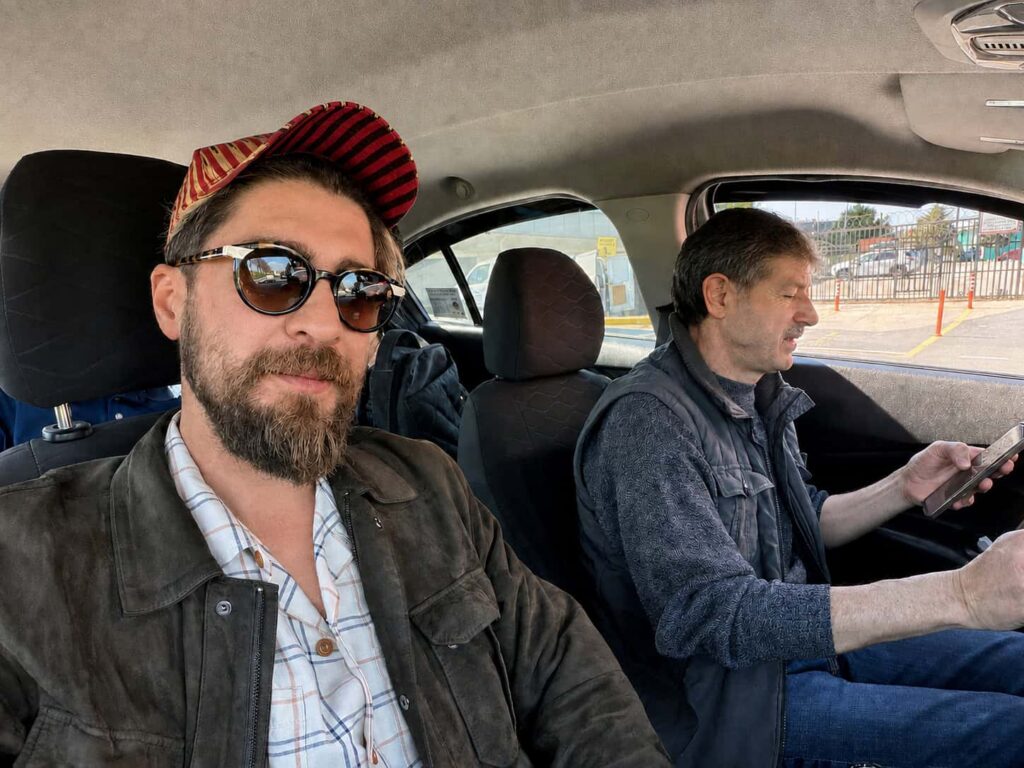
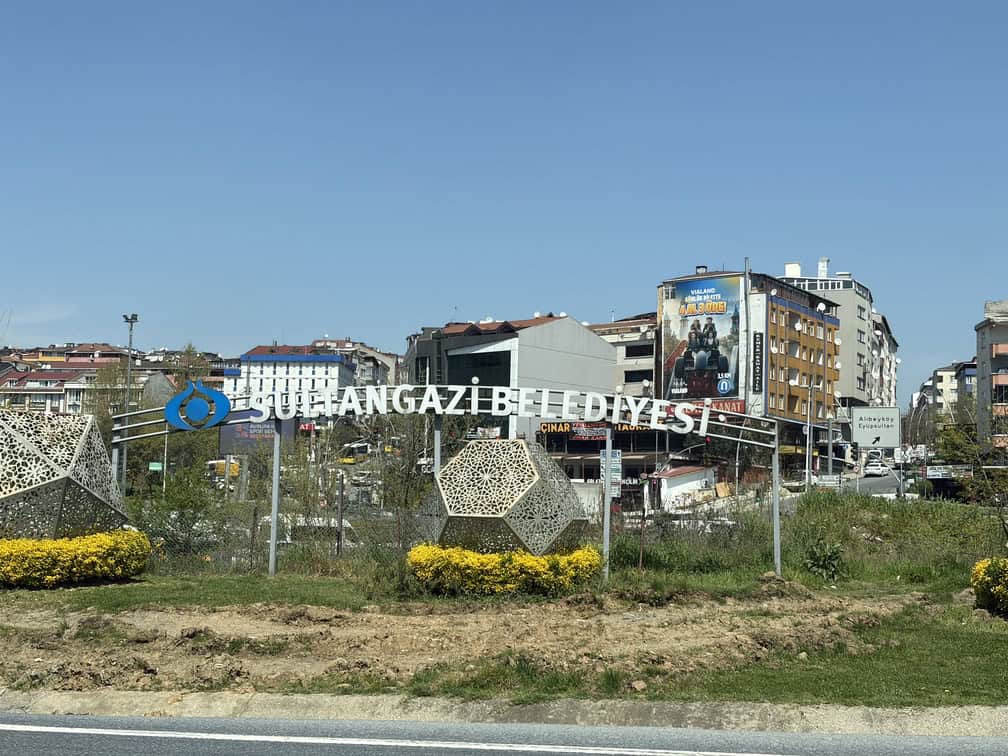
We flagged a cab. The driver’s name was Birol, and Birol — like everyone, apparently — had cat news. There was a blonde cat near a bakery in Zeytinburnu, he said, and a broken-legged kitten the locals had been trying to help. He thought we should know. We thanked him, filed the tip, and pointed the cab toward Sultangazi to meet Ayşe.
Sultangazi — Varoş, and a Clinic Inside a Gated Tower Complex
A word, before we go any further, about Sultangazi.
In Turkish, we have a word — varoş — for the working-class districts that ring Istanbul’s center. It is a word with weight. I grew up in Esenler, another varoş, and I will not let any visitor leave Istanbul thinking the city is only the postcard core. Sultangazi is real Istanbul, and the cat networks here are some of the most stubbornly generous in the city.
Ayşe was on clinic duty when we arrived. The clinic — Filius Veteriner Kliniği, owned by a Palestinian man and run on the day by a vet named Süleyman — sits inside a gated high-rise community called Avrupa Konutları. Getting in is its own little ritual: we pulled up to the entrance gate, the security guard looked at us politely, and we waited while Ayşe called down from inside to vouch for us. Then the gate opened.
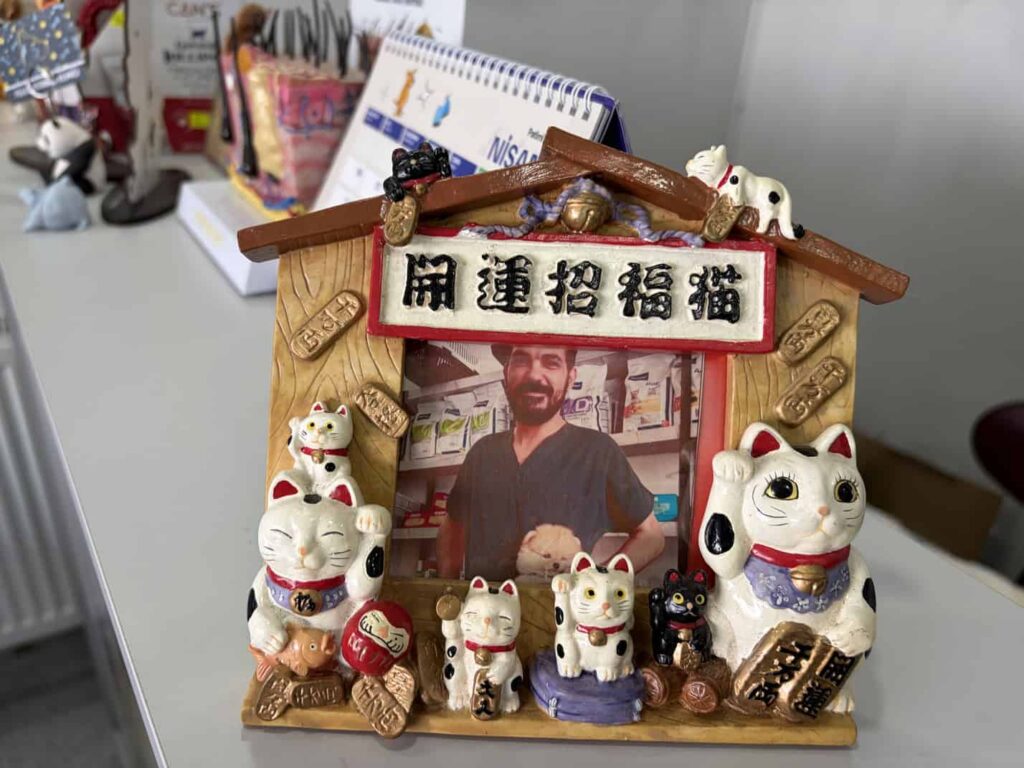
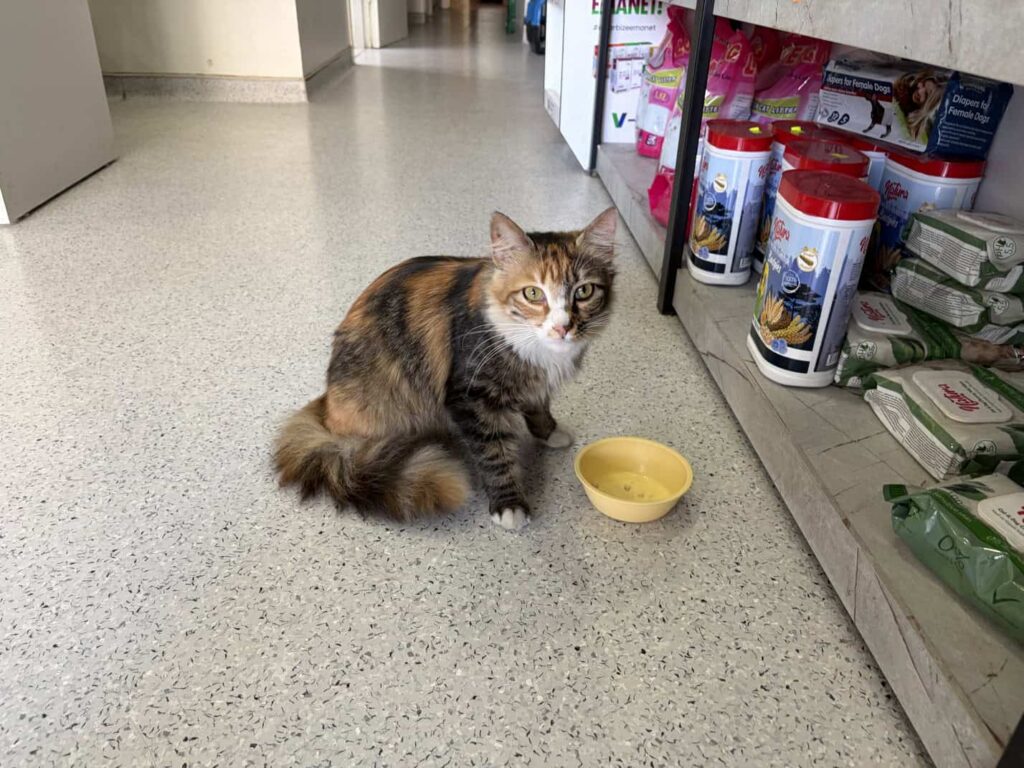
The clinic itself is busy and warm. Süleyman and his team look after a remarkable number of neighborhood cats. Ayşe was right at home there.
Canan, and the Drive to Zeytinburnu
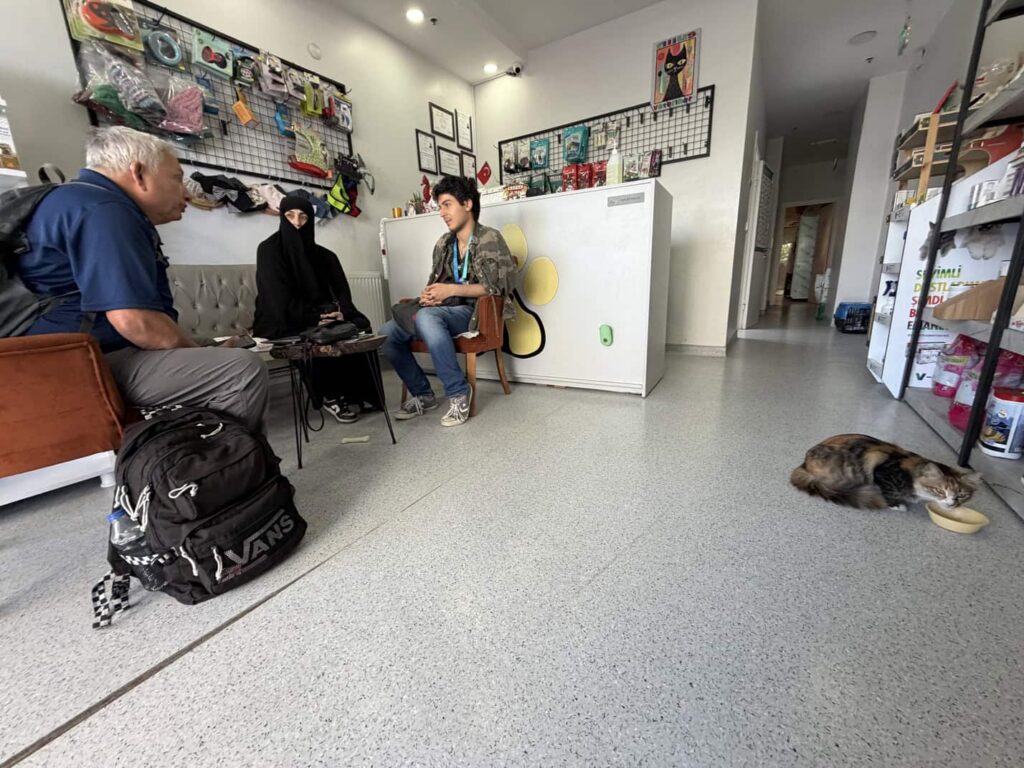
At the clinic, we also met Ayşe’s close friend Canan — a caretaker in a burka, soft-spoken, with the kind of unhurried confidence you only earn after years of doing the work nobody pays you to do. Canan offered to drive us. So the four of us — Ayşe, Jim, Tolga, and me — climbed into Canan’s car and drove down to Zeytinburnu to look for the broken-legged kitten Birol had told us about.
We set up at Müdür Pastanesi, a neighborhood patisserie, and ordered a few small things — snacks, drinks, the universal language of let’s regroup. The bakers shook their heads: they hadn’t seen the kitten since the morning. So we did the only thing left to do: we walked.
Somewhere in the side streets, a blonde cat crossed our path — and for a moment I let myself believe she might be the mother of the broken-legged kitten. I followed her. She slipped into a building, I went after her, and I lost her in the stairwell. No trace.
We didn’t find the kitten. But the blonde cat got something out of the day: Tolga, our guide, was carrying his own cat’s fancy food in his bag — the good stuff he buys for his own cat at home — and we fed her right there on the street. There is something about a guide who travels with premium cat kibble in his backpack that tells you everything you need to know about who he is.
Ali, the Taxi Driver Who Is Friends With a Crow
We hailed another taxi to head to the Yedikule Animal Shelter. The driver this time was Ali, and within about ninety seconds of pulling away from the curb, Ali was telling us — completely unprompted — about his birds.
Ali feeds the city. Specifically, he has built, over years, a real friendship with a crow that recognizes him by the license plate number on his yellow cab. As we drove past a flock of birds, he pointed and said, plainly: “They’re waiting for me. After I drop you off, it’s their feeding time.”
I want you to understand: he wasn’t performing. He was just running late.
Yedikule Animal Shelter
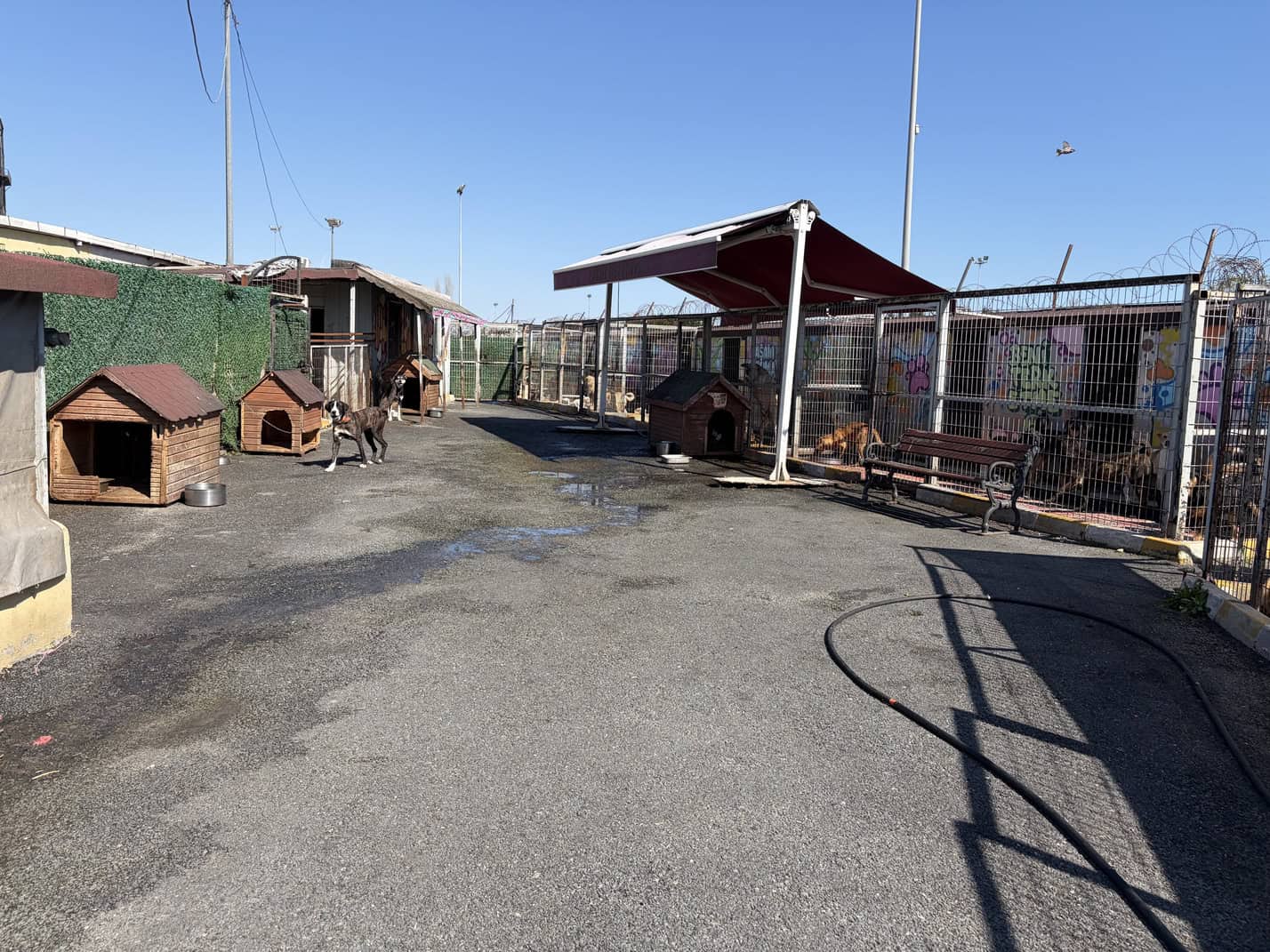
When we pulled up at the Yedikule Animal Shelter — sitting against the 5th-century Theodosian Walls, the very walls that once held off armies — Ali lived up to every word he’d said in the cab. He stepped out and was immediately surrounded by dogs. (There are about two thousand dogs at Yedikule, and they were all, with admirable consistency, barking from the moment we walked in.) Ali knew exactly how to be with them.
We moved over to the cat side and met hundreds of them. Many were amputees. Many had ongoing medical conditions. All of them were being fed, watered, sheltered, and looked after.
We were met by Ebru, who manages the shelter and gave us each a calendar to take home. She told us the origin story, and I’m going to repeat it because it deserves to be told:
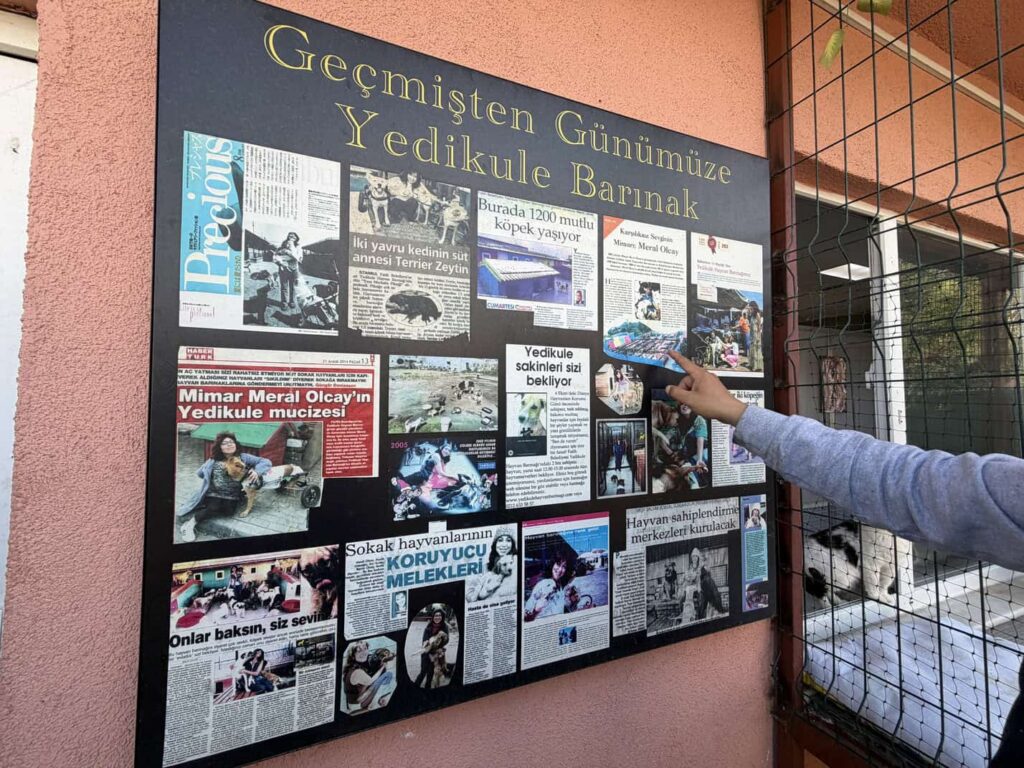
The shelter was founded by a lawyer. One day, trying to dodge traffic, she cut through a back street that runs along the Theodosian Walls and saw an old man feeding stray dogs. She didn’t keep driving. She stopped, asked questions, kept asking questions, and within a few years — with the help of the municipality and, more than that, the help of ordinary people across the city — what had been one old man and his strays became one of the largest animal shelters in Istanbul.
Sometimes the city changes because somebody decides not to take the highway.
Down to Sultanahmet — Ümit and the Tree of Life
From the 5th century Theodosian walls we drove into the heart of ancient Constantinople itself: Sultanahmet, between the Hagia Sophia and the Blue Mosque. Tourist territory by day, but with quiet, beautiful corners that locals run on entirely their own logic.
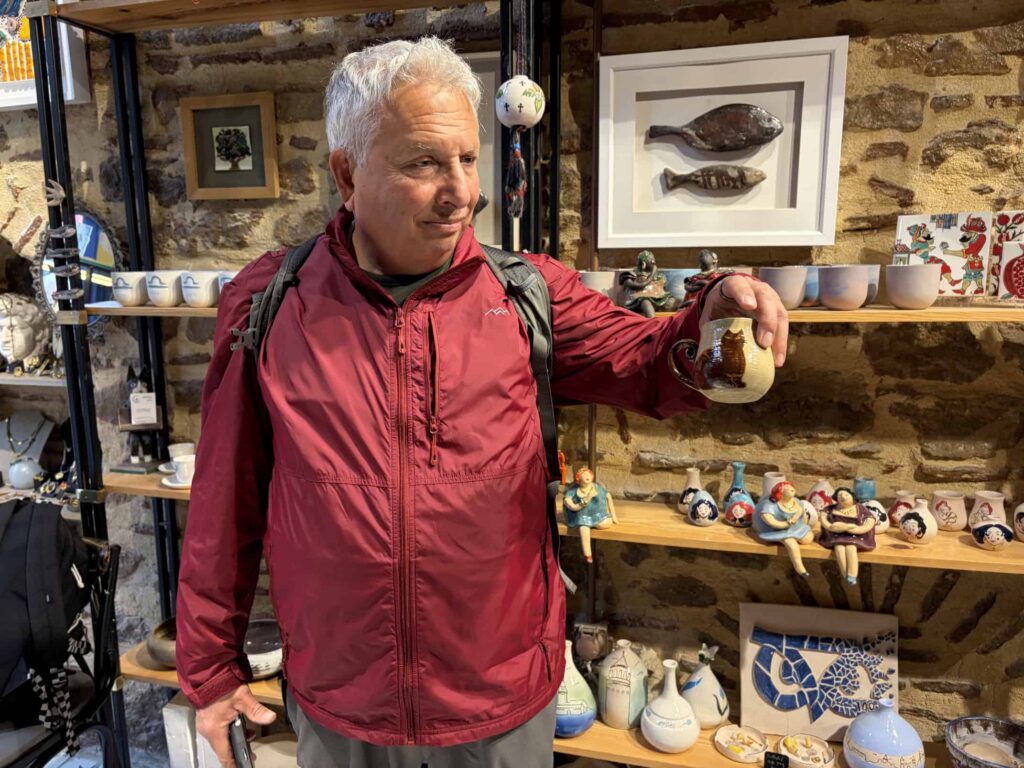
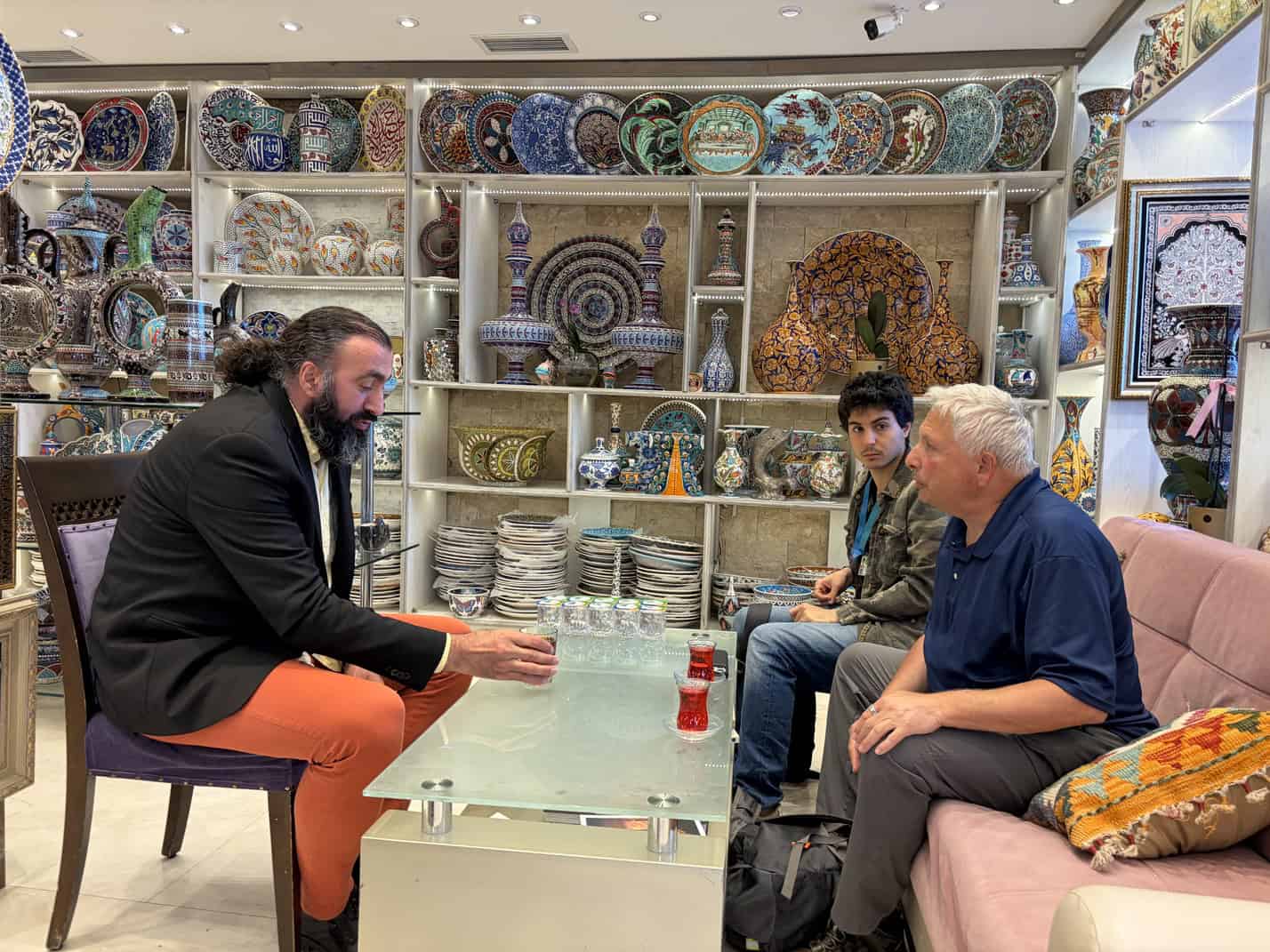
The key character of this stretch was Ümit, who runs Tree of Life Ceramics — a small, gorgeous shop tucked into Sultanahmet. Jim and Ümit fell into conversation immediately, and that conversation lasted a full hour. Ümit told Jim about his cats — he and his neighbors feed dozens of them in a special corner of Sultanahmet — and Jim, charmed and educated in equal measure, ended up buying a couple of beautiful pieces from the shop on his way out.
Ümit, brother — where’s our cut? Still waiting on you. (I’m joking. Mostly.)
Pus Pus at Kirkit, Then Dinner on a Roman Palace
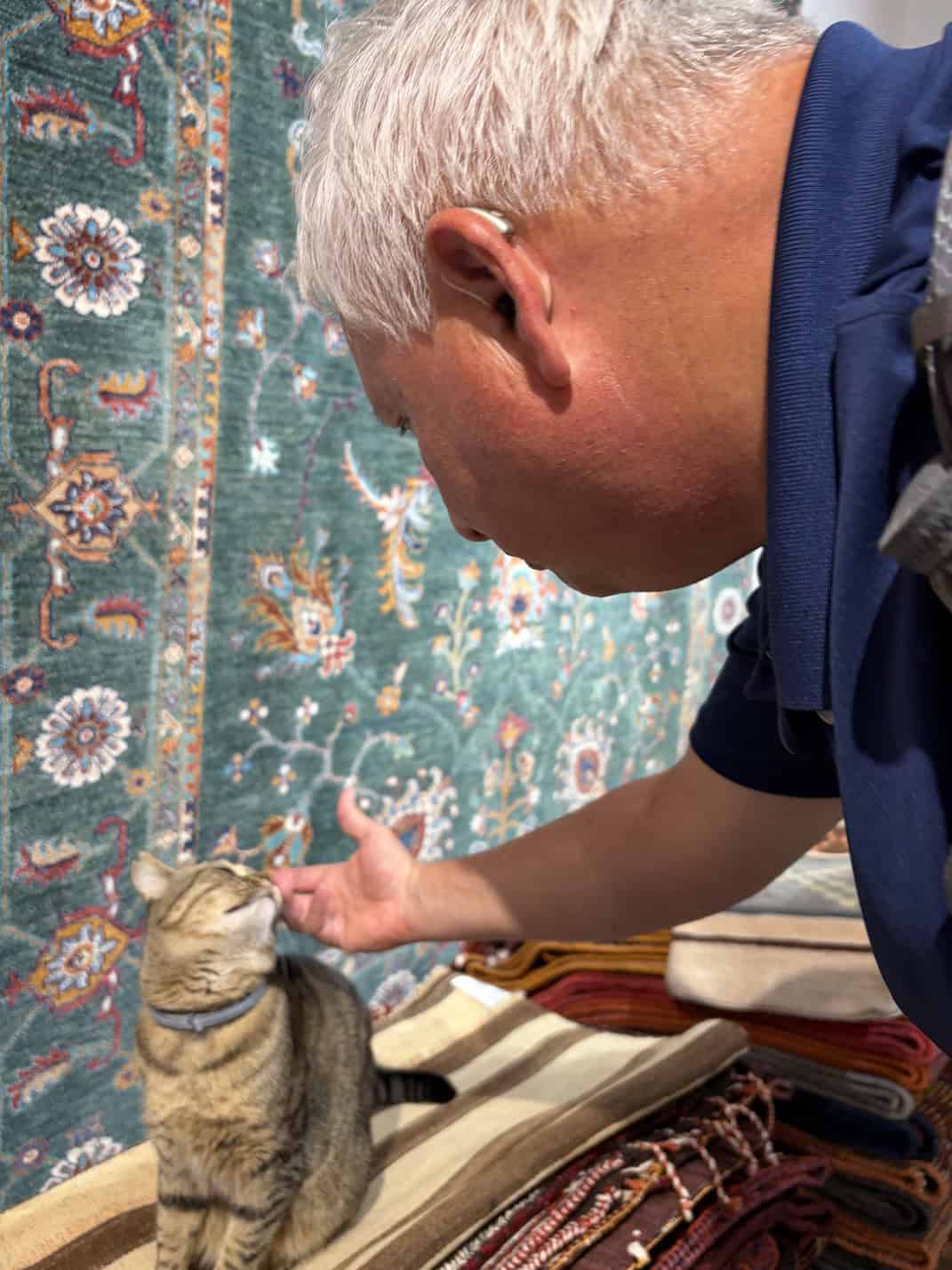
A few doors down from Tree of Life is Kirkit Rug Store, home to my favorite cat in the entire city of Istanbul: Pus Pus. I will not write a love letter about her here because we’d never get to dinner, but I will say this: she is dignified, she is a little judgmental, and she is correct in her judgments. We petted her. Briefly. We were starving.
We walked next door to Palatium Café for an early dinner. Palatium serves a proper lamb casserole — slow-cooked in a clay pot — and we ordered it without discussion. The casserole was extraordinary. But the location was the real twist:
Palatium sits on top of the ruins of the 4th-century Magnaura — one of the great halls of the Byzantine imperial palace, where emperors received foreign envoys. Constantine’s city, Justinian’s city, the city of receptions and ceremonies — and now, a thousand seven hundred years later, an American writer, a Turkish founder, a professional guide, and a clay pot of lamb sitting directly on top of it.
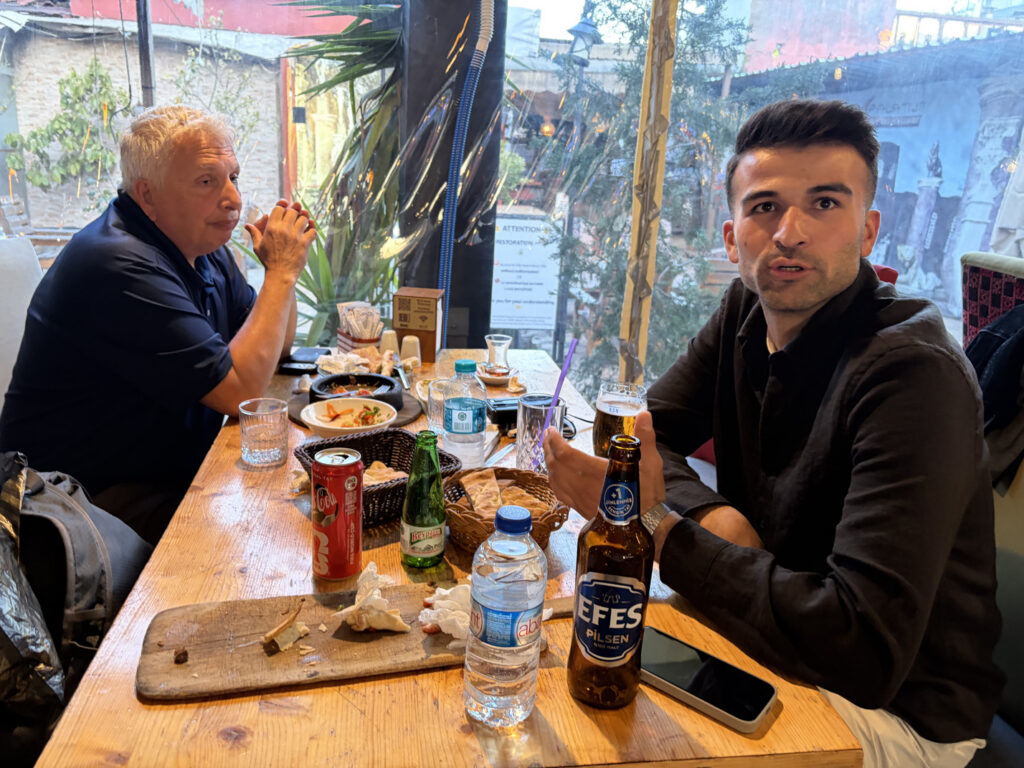
That is the kind of moment Istanbul gives you when you’ve earned the day. Time to drive home for an another big da tomorrow!
Day 3 (April 25) — A Best Friend, a Baby, and the Heart of the Whole Trip
If Day 2 was about the breadth of Istanbul’s cat network — how it spans the whole city — Day 3 was about depth. About the people you don’t put on the public itinerary, because they are not “stops.” They are family.
This is the day Jim met some of the most important people in my life.
Galata Tower — Trevor, Selda, and Mila
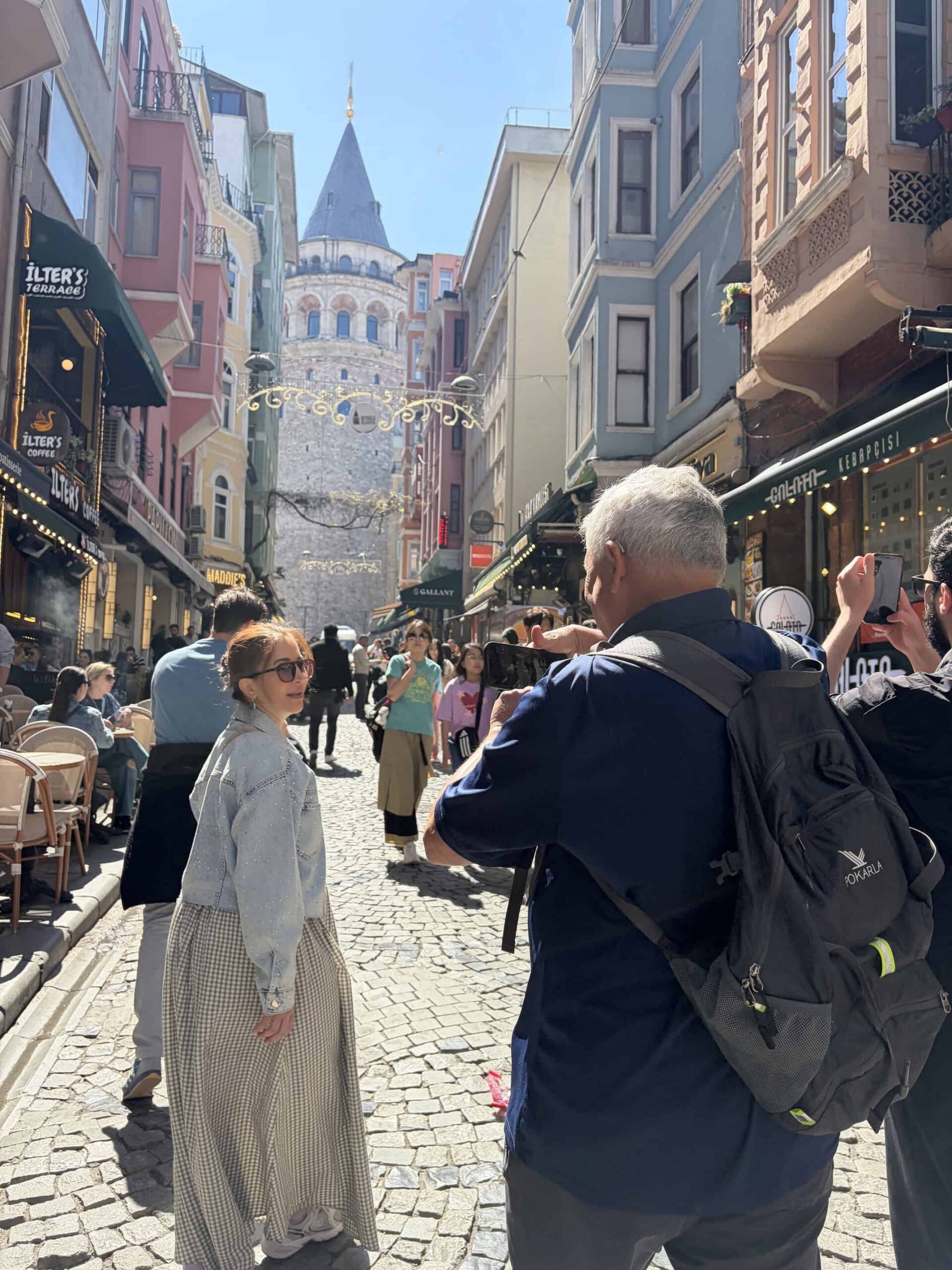
As always, Tolga picked Jim up in the morning and brought him to the foot of the Galata Tower, where my best friend Trevor lives with his wife Selda.
Some context, because Trevor is not a footnote.
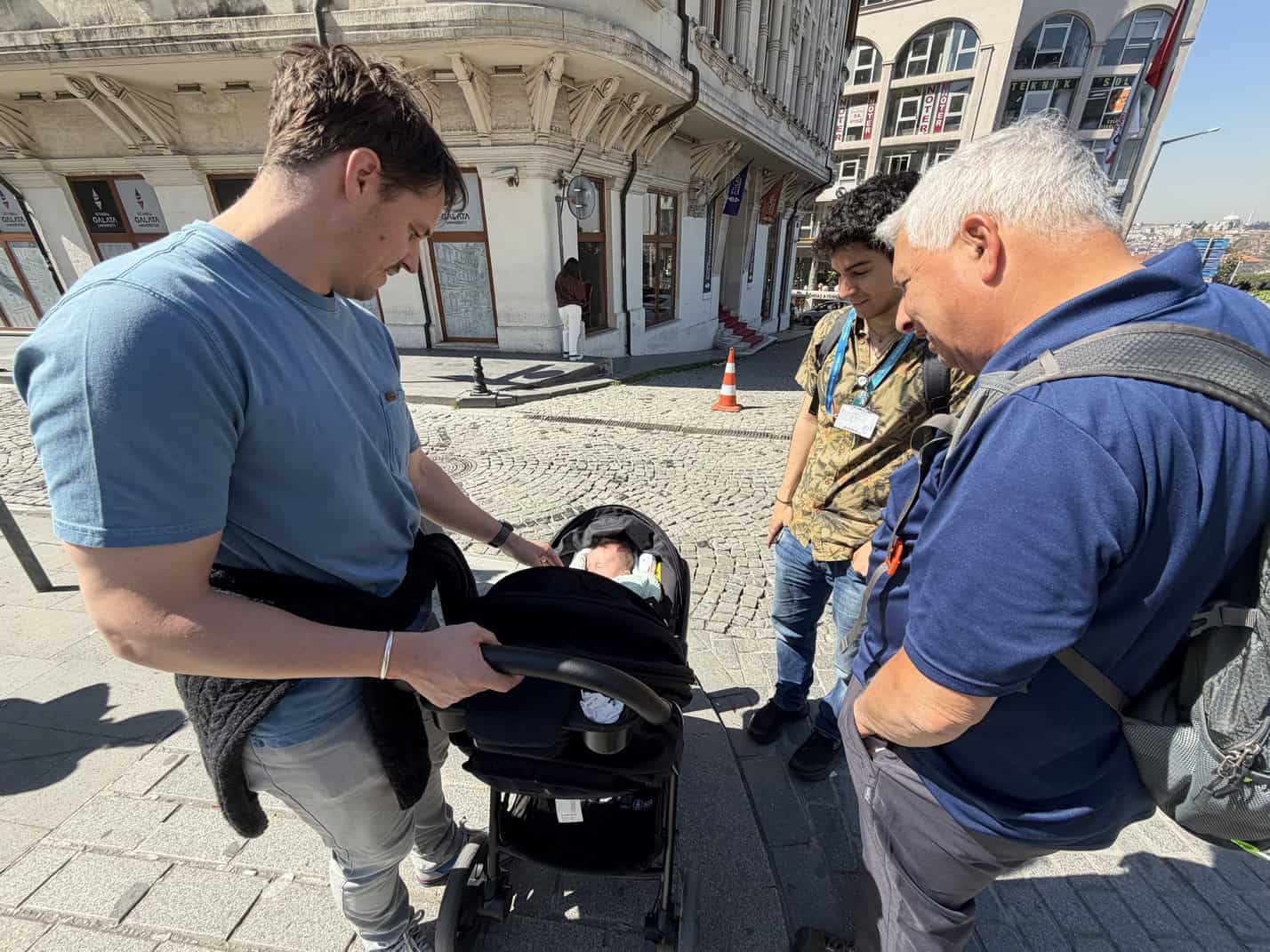
I met Trevor in 2012. Soon after, he moved in with me, and for a full year he co-guided The Other Tour alongside me — back when this whole thing was still small and finding its feet. Then he went back to the United States for graduate school, became a psychologist, and now works as a therapist. A few years later, he moved back to Istanbul, fell in love with Selda, a Turkish woman, and married her. Today, they live right by Galata Tower with their three-month-old baby, Mila.
And — to my delight, and to Jim’s — all three of them joined us for the morning of the tour.
Selda Feeds Galata
Selda is Galata’s cat hero. There is no contest. She feeds the cats of this neighborhood every single day, knows them by sight, and has a route the way a postal worker has a route. The cats know her too.
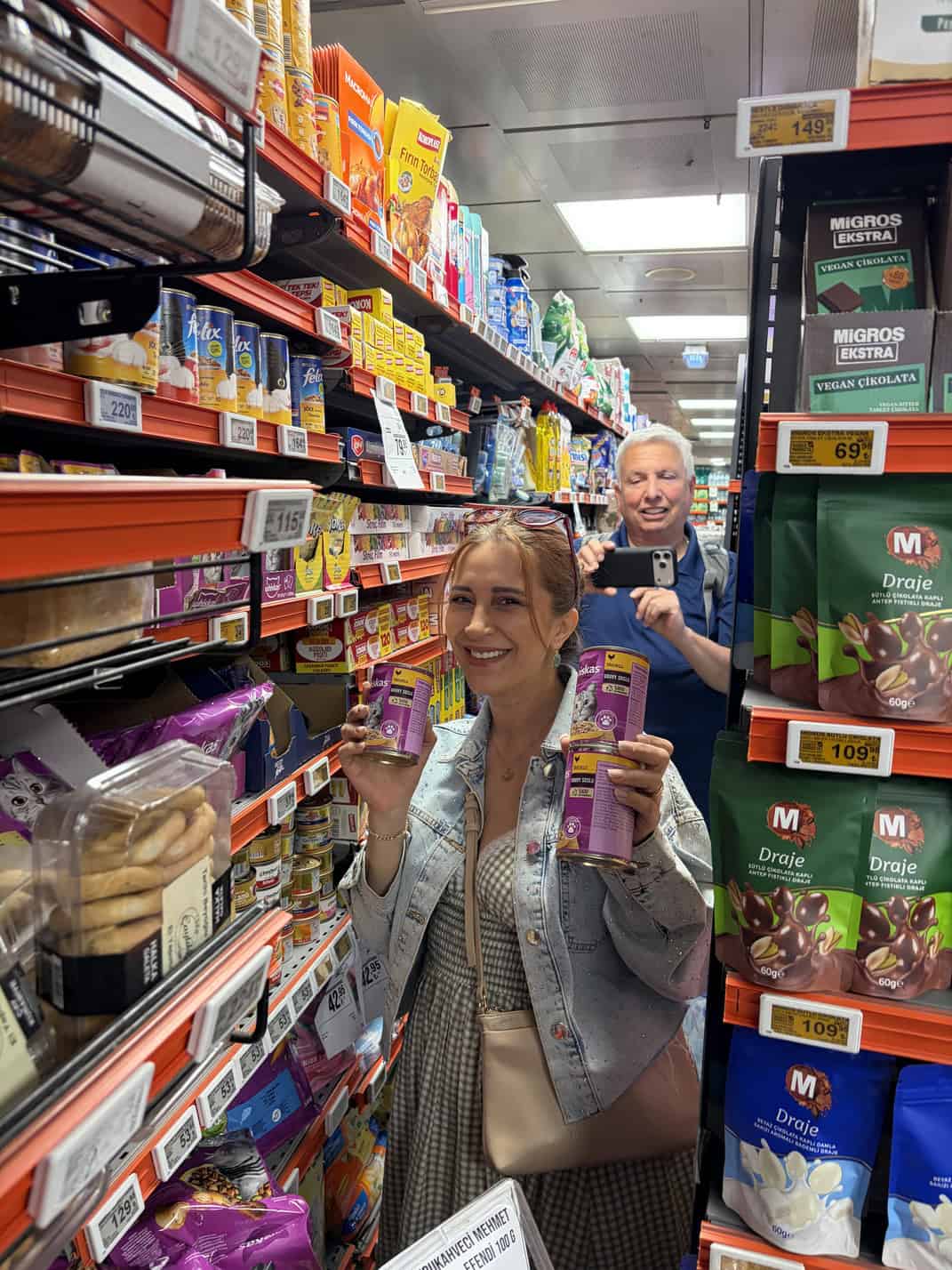
We made one stop first: a butcher, where we bought a serious quantity of chicken liver — the gold standard for this kind of work — and then started walking. Selda led, the rest of us followed, and street by street we fed her cats. By the end of an hour, I think we had fed most of Galata. Trevor pushed the stroller. Mila, three months old, slept through most of it, completely unimpressed by the cat heroism unfolding around her.
The Cat Museum on Serdar-ı Ekrem
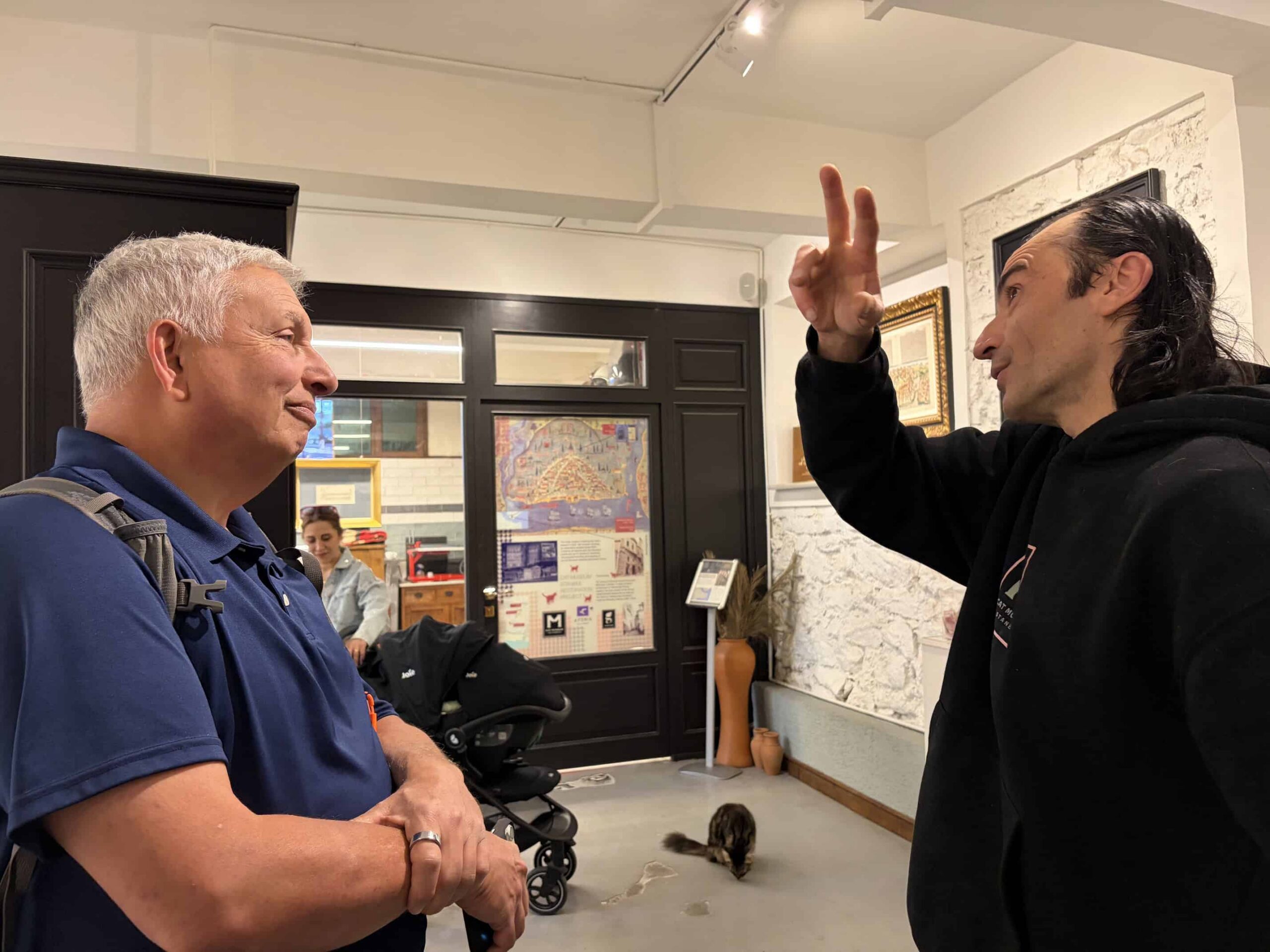
A few minutes from Selda’s route is Serdar-ı Ekrem Sokak, one of the most beautiful narrow streets in all of Galata. Tucked along it is something that did not exist on Jim’s previous visits: the Cat Museum (Kedi Müzesi), opened in 2024.
We went in, and Jim ended up in a long, easy conversation with the founder, Fatih Dağlı. Fatih has spent years building what he hopes will become the world’s largest collection of cat-themed art — works by artists ranging from Bedri Rahmi Eyüboğlu and Fikret Otyam to Louis Wain and Joan Miró — and the project is, at its core, a fundraising engine for Istanbul’s street animals. Half of the museum’s profits go directly to stray-cat causes. So it is not just a museum about cats — it is a museum that works for them.
Jim, of course, was thrilled. A whole museum for the subject of his book.
Maçka Park, and the Long Walk to Taşkışla
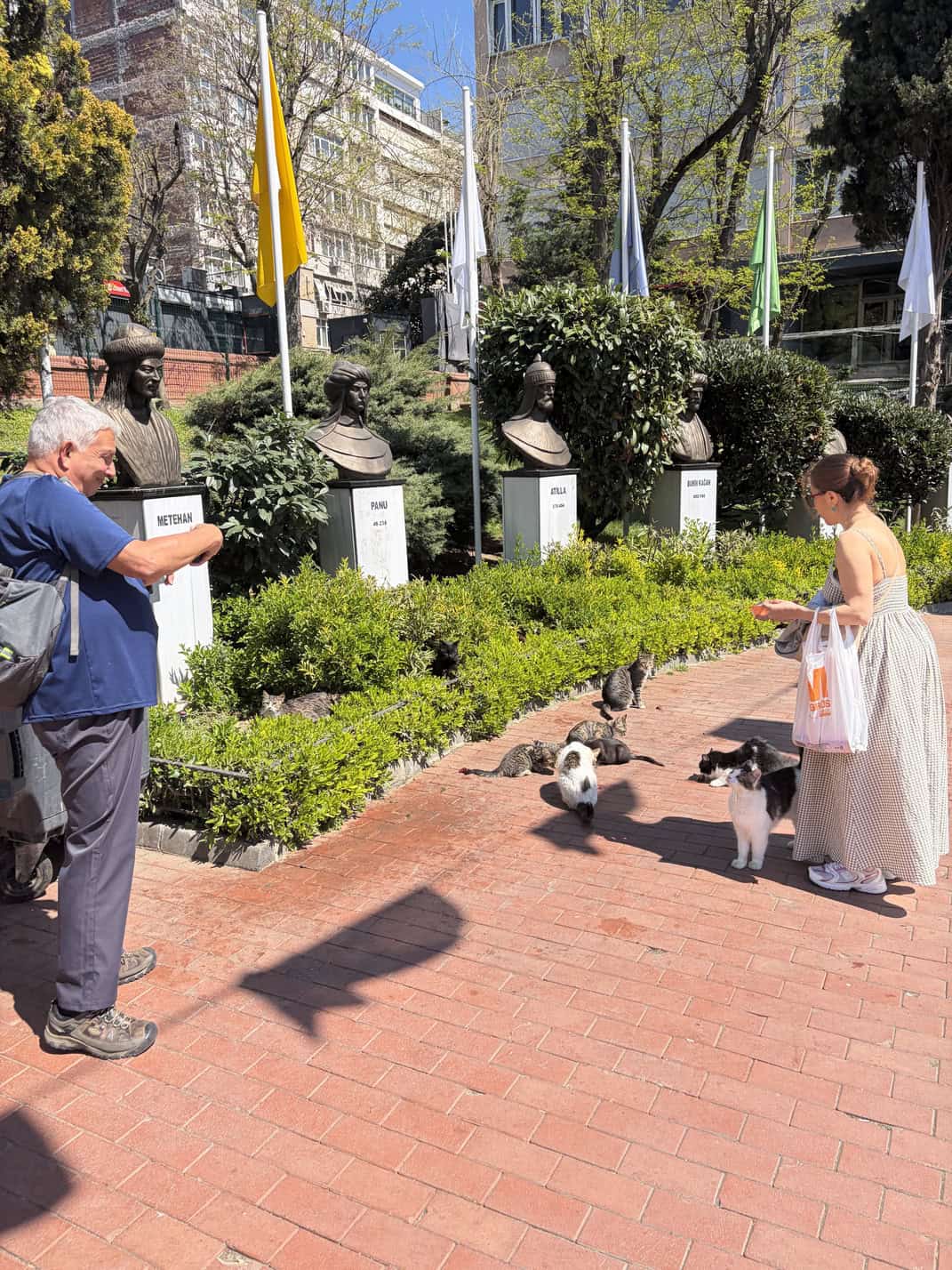
From Galata we taxied across to Maçka Park, near Nişantaşı. Maçka is Istanbul’s quietly beloved central green space — a long, sloping park that drops down into the valley between Nişantaşı and Beşiktaş — and on a spring afternoon, it is full of cats.
We walked the whole length of it, Selda still leading, and I genuinely think we fed more than a hundred cats. Selda is amazing. She just is.
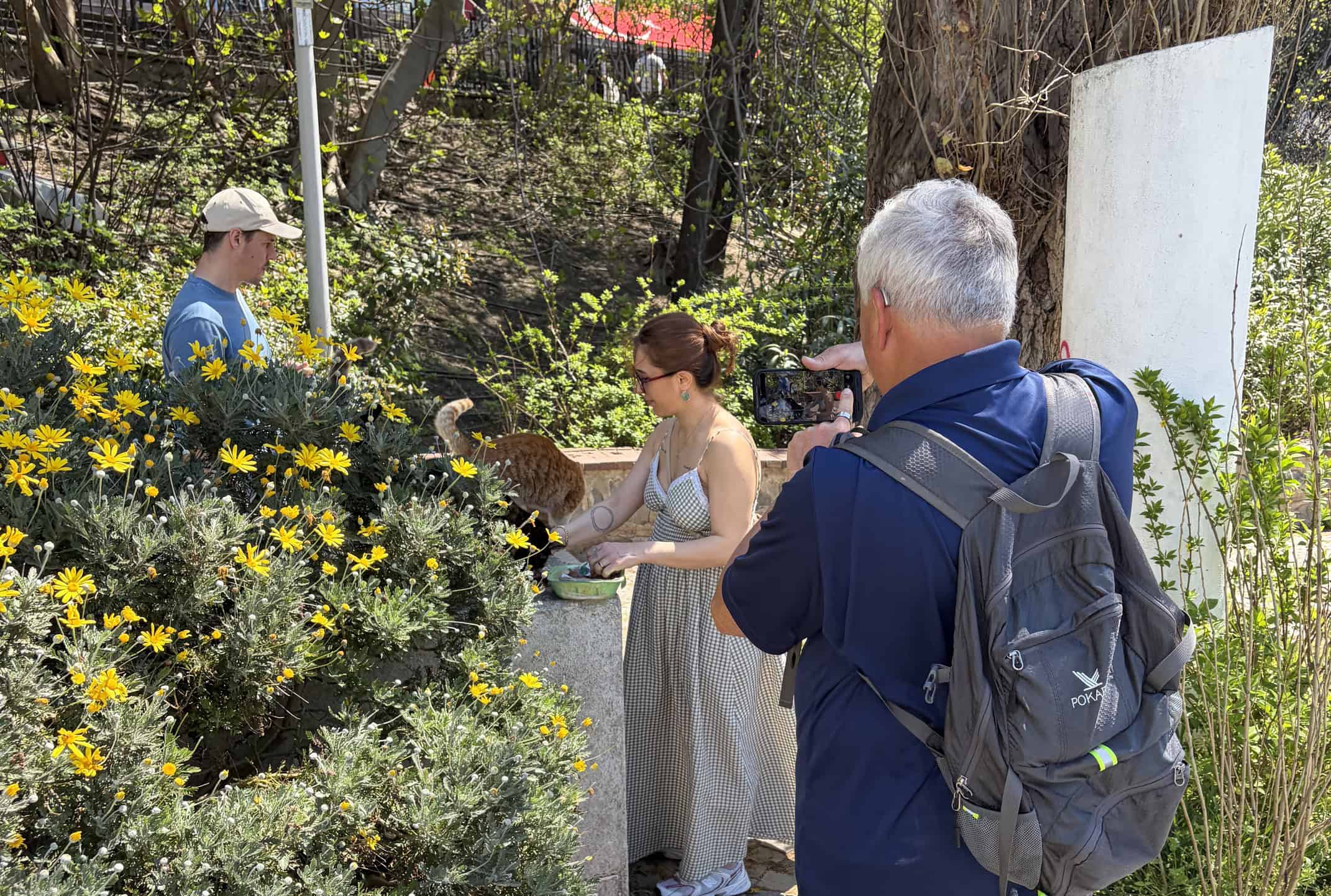
By the time we reached the upper end of the park near Taşkışla — the historic building that now houses Istanbul Technical University‘s architecture faculty, with the Grand Hyatt just up the slope — we had earned a sit-down. We grabbed snacks and coffee. Mila slept some more. Trevor and I caught up the way old friends do when the conversation has fifteen years of furniture in it.
And then it was time to say goodbye to the morning.
Taxi West — Back to Sultangazi, This Time to Ayşe’s Home
We hugged Trevor, Selda, and Mila, climbed into a taxi, and drove all the way west — back to Sultangazi.
We had met Ayşe the day before, on her clinic duty. Today, she was hosting us at her home, and that is a different kind of invitation entirely.
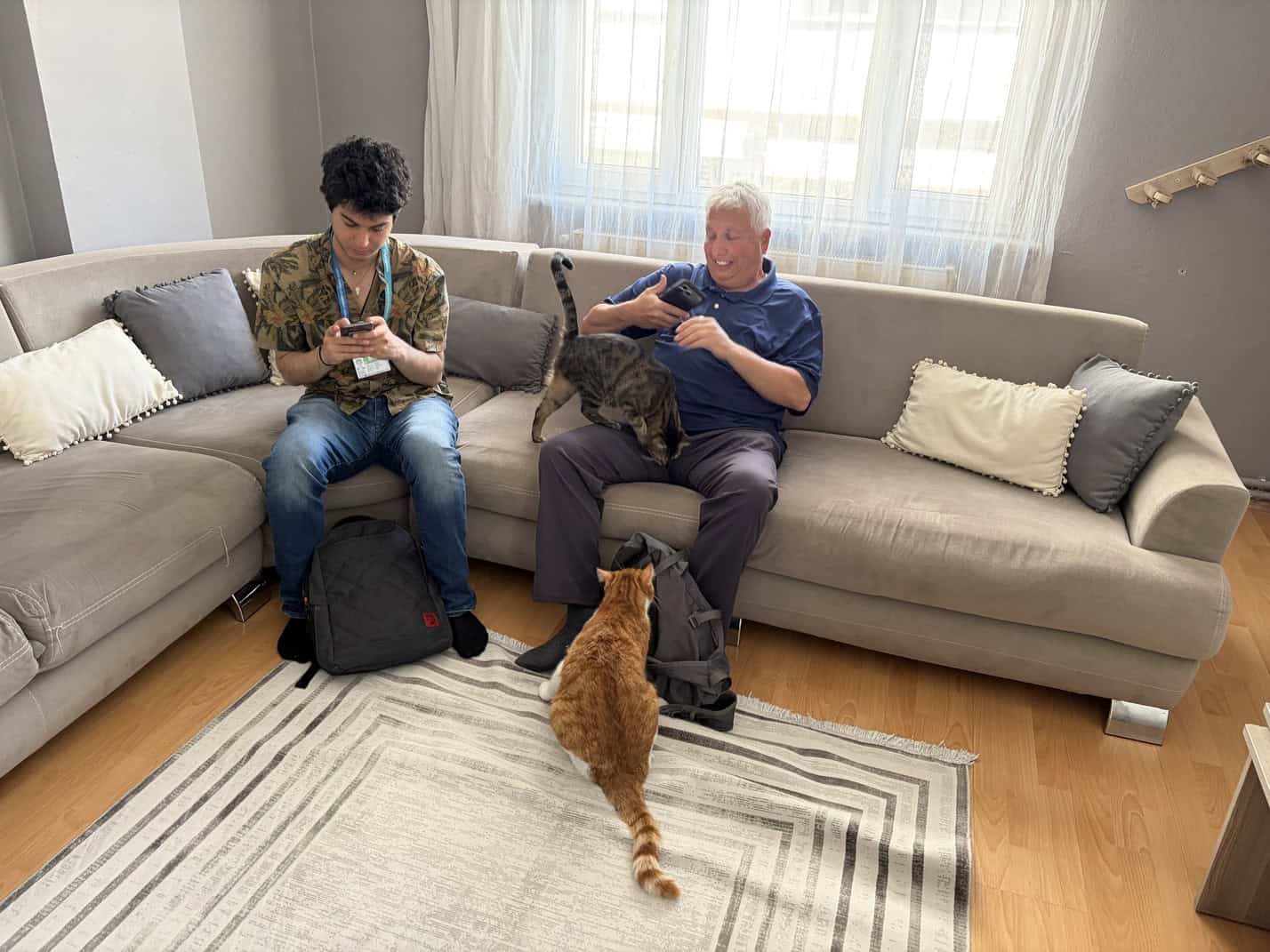
Ayşe lives with twenty cats. Twenty.
When we walked in, Ayşe’s daughter was there, along with her school friend. Canan — Ayşe’s friend from the day before, who had driven us out to Zeytinburnu — joined us inside the house. And Ayşe, who had clearly been preparing all morning, cooked for us. A full Turkish home-cooked meal. The kind that says you are not a tourist, you are a guest, and there is a difference.
I’ll say it plainly: this was, for me, the highlight of the entire four-day tour.
Over lunch, Ayşe told us about the part of her work that doesn’t make it into Instagram captions. She is a fighter. She protects the neighborhood’s cats not just by feeding and neutering them, but by standing up to neighbors who try to harm or remove them — and when those disputes escalate, she takes them all the way to Turkish court. She doesn’t back down. Some of these cases drag on for months. She fights them anyway.
Jim and I made donations to her cause on the spot. It was the easiest decision of the trip.
We are still in regular touch with Ayşe. She is a lifelong friend now. There is no other word for it.
A Small Aside on How I Met Ayşe
Here’s a detail I want to put in the post, because it’s how Istanbul actually works:
I only met Ayşe a month ago — and I met her through Selda.
About four weeks before Jim’s arrival, Trevor, Selda, my girlfriend, and I had dinner together. Ayşe was there with her husband, and Selda — who somehow knows everyone who is doing real work for the cats of this city — introduced us. One dinner. Four weeks later, Ayşe is helping us host an American writer at her home, cooking for him, and explaining her court cases.
That is the network this tour is built on. It is not a list of “stops.” It is a circle of people who introduce each other, and trust each other, and pull each other into the work.
Çırağan, the Bosphorus, and Zeliha at the Shelter
After Ayşe’s house — and saying goodbye to her many cats, who watched us leave with the polite indifference of cats who know there will be more guests next week — we drove east, all the way to the Bosphorus.
We pulled up near the Çırağan Palace and Kempinski Hotel in Beşiktaş, where the water meets the old marble retaining walls of a 19th-century Ottoman palace, and walked to a small, low-key shelter run by Çevre ve Sokak Hayvanları Koruma Derneği — “The Association for the Protection of the Environment and Street Animals.”
There we met Zeliha, who walked us through what the NGO does: rescues, fosters, medical care, public education, and the patient, daily, unglamorous coordination that lets a city of fifteen million people share its sidewalks with its animals.
It was a quiet way to end a loud, full day.
Home for the Night
We drove Jim home in the early evening. Day 4 — the final day — was tomorrow, and there was still more city to walk.
But tonight, the city was easy with itself. Selda was in Galata, Trevor was rocking Mila, Ayşe was probably feeding her twenty cats, Canan was probably driving someone somewhere, and Lucky — back in Balat, two days into her FIP treatment — was sleeping in her cage at Berşan’s clinic.
That is, in the end, what these four days were really about. Not “cats” as a topic. People who love cats, who love each other, and who are quietly, daily, building a city that takes care of its animals because they are part of the city.
One more day to go.