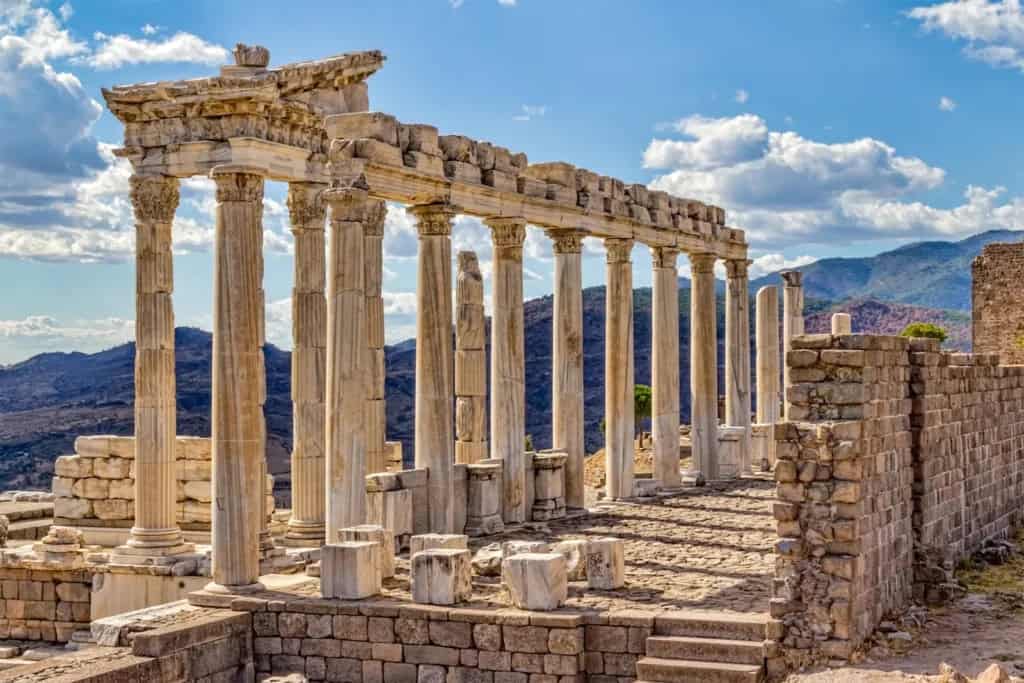
Yes, and ten days is what it takes. All seven cities of Revelation stand in western Türkiye, an hour’s flight from Istanbul, and a private route that begins and ends in Istanbul reaches every one of them without turning the trip into a coach marathon. Starting in Istanbul also gives you the two council cities an Aegean itinerary has to skip.
Yes. The seven cities are not near Istanbul, though. They lie across the Aegean and the valleys behind it, roughly a thousand kilometres of driving end to end. Istanbul is where almost every long-haul flight lands, and İzmir is an hour further on, so the trip starts here and works west.
Most operators selling this route start you in İzmir or Kuşadası instead, because that is where the seven cities are. If you are already on the Aegean coast, a shorter circuit from there will serve you better than flying to Istanbul first.
What Istanbul adds. Two cities that are not among the seven but sit underneath everything the seven letters became: Chalcedon, now Kadıköy on the Asian shore, and Nicaea, now İznik. The councils held there settled the creed these churches were still arguing about. From an İzmir circuit both are a long detour. From Istanbul, one is a ferry ride.
Every one of the seven is a place you can stand in today, under a modern Turkish name. Two of them have a living town built straight over the ruins.
| The city in Revelation | Where it is today | How the letter is known |
|---|---|---|
| Ephesus | Selçuk | The Loveless Church |
| Smyrna | İzmir | The Persecuted Church |
| Pergamon | Bergama | The Compromised Church |
| Thyatira | Akhisar | The False-Teaching Church |
| Sardis | Sart | The Spiritually Dead Church |
| Philadelphia | Alaşehir | The Faithful Church |
| Laodicea | Denizli | The Lukewarm Church |
Why each letter says what it says, city by city, is in our guide to the Seven Churches of Revelation.
Ten, if you want to see the seven properly and add the council cities. Seven or eight if you skip the councils and fly straight into İzmir. Below that you are choosing which of the seven to drop, and the honest answer is that the ones people drop first, Thyatira and Philadelphia, are the two where the modern town has grown over the ruins and a guide matters most.
The distances are the reason. Pergamon sits well north of İzmir, Laodicea is far inland to the south east, and Sardis and Philadelphia are strung out along the valley between them. Nobody drives that in three days and remembers any of it.
We build each trip around the people travelling rather than selling fixed departures, so this is the shape a journey like it takes. The councils come first, while you are still in Istanbul, then the route works west and south through the seven.
The order is fixed by geography, not by us. Everything else about it moves, and that is the next section.
Ten days is the version that reaches everything. It is not the only version, and it is not a fixed departure you either buy or do not. We build each trip around who is actually coming: how long you have, how far you want to drive in a day, whether there are children or a wheelchair in the group, and which of these places you came for in the first place.
Most groups take a part rather than the whole. A church group with a week wants the seven and nothing else. A couple who came for Istanbul want the councils and one Aegean city. A cruise passenger has a single morning. All of those are the same planning conversation, and none of them needs the full ten days.
Tell us which of those sounds like your trip, or describe the one that is not on the list. The answer decides the route, not the other way round.
You can. All seven are open archaeological sites with tickets and gates, and a hire car reaches every one of them. Plenty of people do exactly that.
What you lose is the reason each letter says what it says. The warning to Sardis about a thief in the night lands differently once you have seen the cliff the city thought made it safe. Laodicea being called lukewarm is a joke about its water supply. Philadelphia’s promise of a pillar that never falls was written for a town that kept being shaken apart by earthquakes. Without someone to put the letter beside the ground it was written about, the seven can blur into seven fields of broken marble.
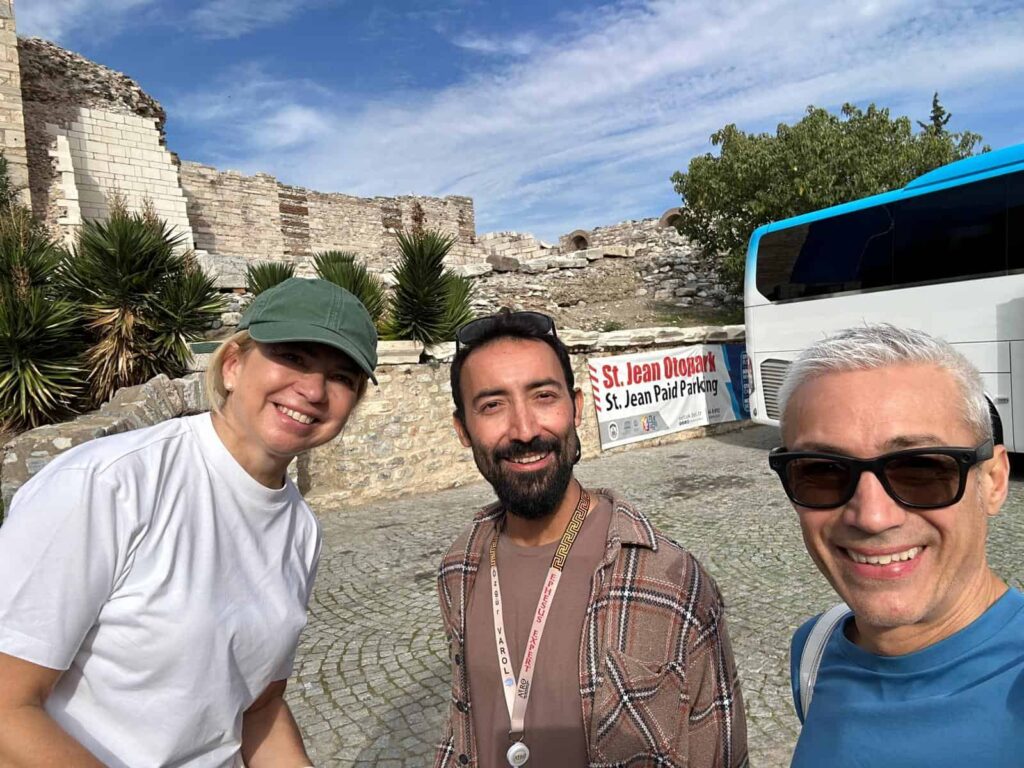
Özgür Varol grew up in Selçuk, the town beside Ephesus, and guides the Aegean as home ground. He read Travel Management and Tourism Guidance at Adnan Menderes University and holds the national kokart licence.
He connects Ephesus north to Pergamon and outward across the whole Seven Churches region, which is exactly what this trip needs, and he reads the Greek off the stones while you are standing at them.
Ask for him by name when you write to us, or meet the rest of our guides in Ephesus and our licensed guides in Istanbul.
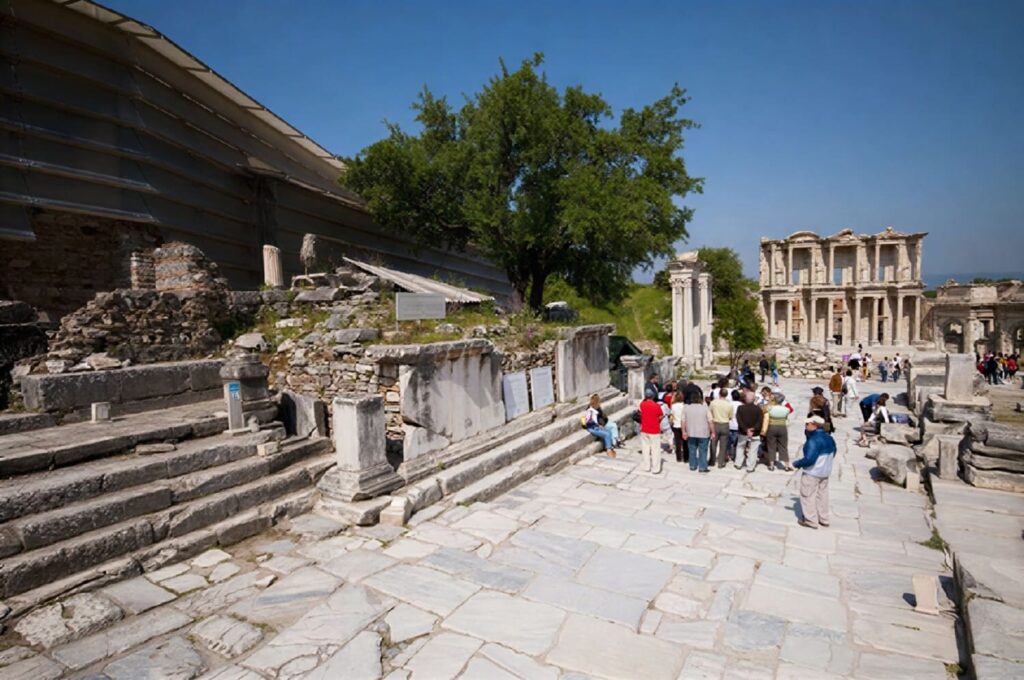
Ephesus is the largest of the seven and the one most people come for. It works as a single day, flown out and back from Istanbul.
Because a courier had to carry the letters. Roman Asia held more Christian communities than seven, but these seven sit in sequence on the province’s postal roads, the same roads the teaching had spread along from Ephesus a generation earlier. Read the order in Revelation as a delivery run: north from Ephesus up the coast to Smyrna and Pergamon, then inland and south through Thyatira, Sardis, Philadelphia and Laodicea, and back towards where it started. It is still close to the sensible driving order today, which is why our route follows it rather than fighting it.
Less than most people expect, and it is worth knowing before you stand there. The vision on Patmos is dated to about 95 AD, under Domitian, but a great deal of the marble you will walk past was cut afterwards, in the prosperous second century or later under Byzantine rule. What is genuinely contemporary is the shape of the places: the street plans, the harbours, the theatres, the civic pride and the money. The letters were written about cities, and the cities are what survive.
They did not end so much as move. Ephesus went on to host the Third Ecumenical Council at its Church of Mary, and in the sixth century Justinian raised a monumental basilica at Philadelphia whose brick pillars are still the landmark of modern Alaşehir. What emptied the sites was geography and disruption rather than doctrine: trade routes shifted, Arab raids came, and the harbours at Ephesus and Pergamon silted until both cities were left inland. People walked a few kilometres and rebuilt, which is why İzmir, Bergama and Akhisar now sit beside or on top of the ruins.
In Istanbul, yes. The Church of St George at the Ecumenical Patriarchate in Fener is a working church and the seat of Orthodoxy, and we time that visit around its own schedule rather than ours. On the Aegean leg the honest answer is that working congregations are few and small; the seven are archaeological sites, not parishes. Groups who want to read or pray at them do, and nobody minds, but tell us in advance so we build the day around it instead of around opening hours.
Outside Türkiye, which surprises people. The island John was exiled to is Greek territory, so it sits in another country with its own border and its own ferries, and it cannot be folded into a Turkish itinerary the way Pergamon or Sardis can. Plenty of travellers do both on one trip by treating them as two legs. Say so early if that is your plan and we will shape our half to end where the Greek half starts.
No, and a good share of the people who ask us about this route are here for the archaeology or the Roman history. The letters happen to be unusually good evidence: seven short, pointed descriptions of named cities, written by somebody who knew what each was proud of and what each was afraid of. You can read them as scripture or as a first-hand source on provincial life, and the ground supports both readings.
Pamukkale is the easy one: Laodicea sits just below it, and Hierapolis stands on the terraces themselves, so both cost almost no extra travel. Cappadocia is a real detour in the other direction and usually wants two or three days of its own. Tell us if it matters and we will shape the route around it.
Tell us when you want to travel, how many of you there are, and whether the councils matter to you or only the seven. That last answer is what decides whether this is a ten-day route or a shorter one.
We reply within a day with a shape for the trip and the name of the licensed guide who would run it. If you would rather read first, there is the Seven Churches guide, our write-up of the Christian churches of Istanbul, and what travellers said about their days with us.
Tell us your dates. We reply within a day.
The Other Tour is an immersive way to experience Istanbul and the rest of Turkey, led by licensed local guides who take you beyond the tourist spots into the lived culture and quiet corners of Cappadocia, Antalya, Ephesus, Bodrum, and the Mediterranean. We also build personalized travel planning, private tours, and custom itineraries — crafted around what you’re actually curious about, in any region of the country.