
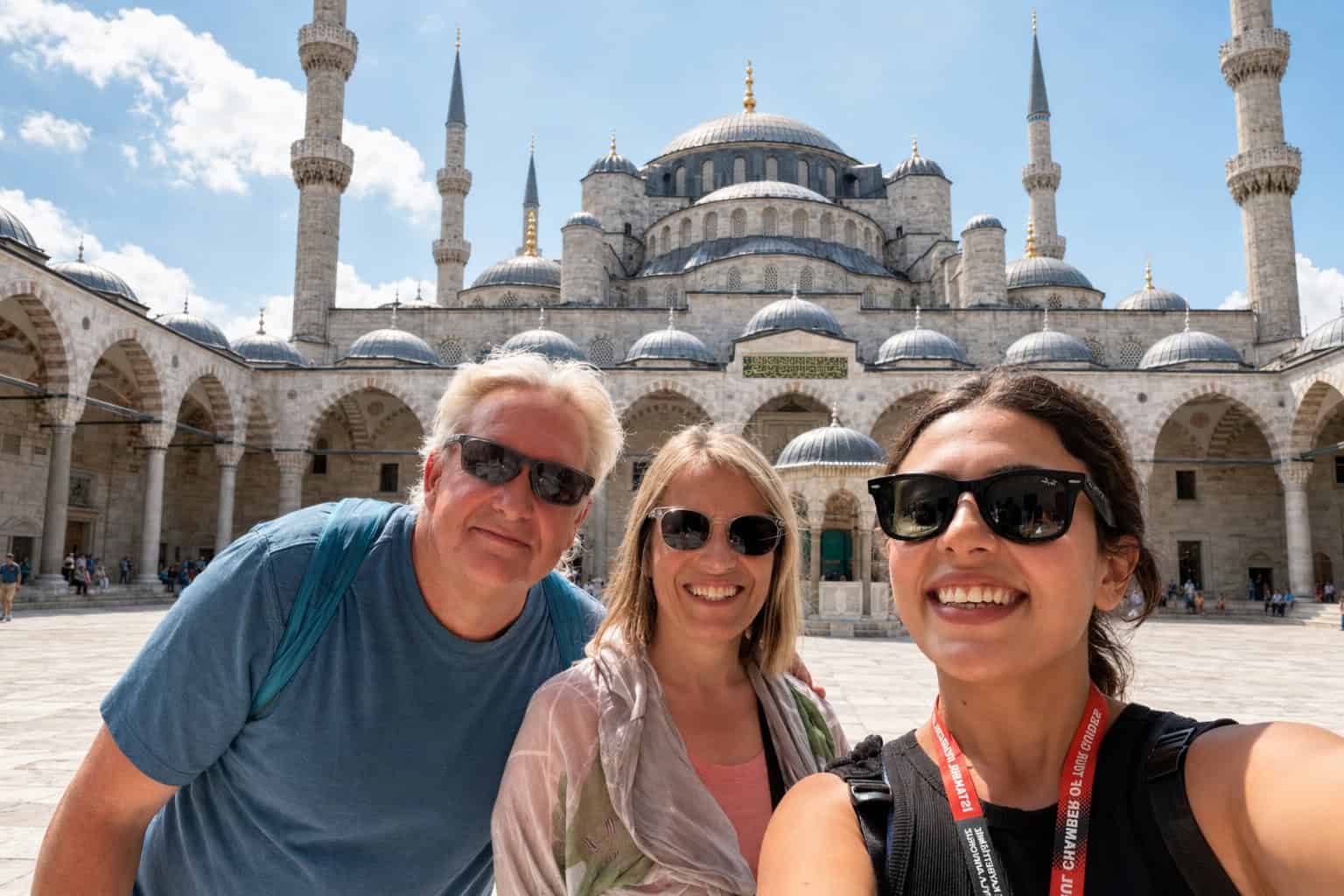
Sapienza-trained mind, archaeologist’s eye, Istanbul soul: Hazal Aydoğan is the rare guide who can decode a mosaic, trace a family story to an Anzac grave and read your fortune over Turkish coffee—all with effortless class, infectious energy and a warmth no itinerary can manufacture.
Table of Contents
Quick facts
She brings natural elegance, infectious energy and an exceptional gift for communication. Based in Istanbul, she knows that the moments guests treasure most are rarely the ones printed on the itinerary.
- Licence: National guiding licence in English, held since 2019 — valid anywhere in Turkey.
- Experience: Seven years.
- Works mostly in: Istanbul, and travels for longer itineraries.
- Education: Tourism Guidance, Akdeniz University; MA in cultural heritage, Sapienza University, Rome.
- Specialisms: Archaeology, art and gastronomy.
- Also available for: Evening and night tours in Istanbul.
The Grave She Found at Gallipoli
Most visitors walk the cemeteries above the landing beaches, read three or four headstones, and get back on the coach. Her guest wanted one name. They arrived with a family name, a war he had only read about, and no idea where the man was buried. Hazal Aydoğan found the headstone for him, in an Anzac cemetery on the Gallipoli peninsula.
Hazal worked the registers and the rows with him until the letters on the stone matched the ones he had grown up hearing at family dinners in a country twelve thousand kilometres away.
He stood there for a long time. She stood back and let him. That is the part of the job no audio guide performs and no app returns — knowing which silence belongs to the traveller, and staying out of it.
It also offers the clearest answer to the question people ask before hiring anyone: Do I really need a guide? At the Istanbul Archaeological Museums or Topkapı Palace, the answer is yes—but only if it is the right guide. The difference is between someone who recites a memorized script at you and someone who draws you into a genuine conversation, follows your curiosity, connects the dots and makes the place come alive.
From Ağrı to a Guiding Licence
She was born in 1997 in Ağrı, in the far east of the country, the middle child of three. Her older brother taught her the first English words she ever spoke, and the language stuck early — long before anyone told her it could become a profession.
When the family moved to Istanbul, she chose the foreign-language track at high school—the first deliberate step towards a life built around travel, history and cultural exchange.
Her first trip abroad came through a school social-responsibility project in Slovenia. She came back certain: travel and other people’s cultures were going to be the work, not the holiday. A history teacher pointed her towards the Tourism Guidance programme at Akdeniz University in Antalya, four years, and she went.
An exchange semester took her to Warsaw, and most of Europe followed on student budgets and night trains. Back in Antalya she mentored the incoming exchange students, smoothing their first weeks and running small trips around the region — a rehearsal for the licence she earned in 2019, on graduation, to work in English.
A Master's Degree in Cultural Heritage
The licence was the beginning. She went on to Sapienza University in Rome for a master’s in the cultural heritage of the Near East, the Middle East and Africa, which is why an archaeology question on her tours tends to get an answer with a bibliography behind it.
That regional perspective lets her place Anatolia where it belongs: not at the edge of several worlds, but at the charged centre where they met, traded, fought and transformed one another.
Her chosen figure is Homer — the poet whose geography still sits under half the coastline she guides. Art and archaeology run through everything she does, from a mosaic pavement to a nineteenth-century apartment façade, and she is straightforward about what is known, what is argued over, and what is simply a good story the guidebooks keep repeating.
Why Lycia Keeps Calling Her Back
Ask her for a favourite corner of Turkey and she names Lycia without pausing. The stones of Kekova lie beneath clear water, forming a street plan you can still read from a boat. At Xanthos and Tlos, inscriptions survive in a language nobody speaks.
The rock-cut tombs at Myra hang above the theatre like windows in a cliff wall, but the city’s most startling recent discovery could fit in the palm of your hand.
Pottery recovered during the 2020–21 excavations was identified as Middle and Late Chalcolithic—material reaching back roughly 5,000 years. One fragment reportedly preserves the pressure of its maker’s fingers in the clay.
It does not yet prove the existence of a complete prehistoric city beneath Myra. It does something subtler and, in a way, more powerful: it pushes the human story of this landscape thousands of years beyond the Lycian metropolis visible today. Before the theatre, before the tombs and before the name Myra entered written history, somebody sat here shaping wet clay with their hands. That fingerprint changes the scale of everything.
Mantı, Turkish Coffee & Coffee Reading
Gastronomy is the third of her specialisms and the one that ends up on the table. Her own order is mantı — the small Turkish dumplings under garlic yoghurt and hot butter, a dish that takes a family an afternoon to fold and four minutes to eat.
Then Turkish coffee, which is less a drink than a length of time you agree to spend with someone.
When the cup is empty she will turn it over, wait, and read your fortune in the grounds. She will also tell you, cheerfully, that she is making it up. Guests keep asking anyway.
Istanbul After the Day Crowds Leave
Istanbul is her base and most of her working year. Her licence is a national one, so she travels for the right itinerary, but the city is where she has done her longest thinking, and she says so plainly.
Istanbul is where I found my path.
She also works evenings, which changes the city more than most people expect. The Basilica Cistern late in the evening is a different room from the one in the queue photographs, and a night tour through the old town gives you back the streets the day-trip coaches borrow between ten and five. This is the other Istanbul, the version most visitors miss, and she prefers it.
Who Travels Best With Hazal
She takes all kinds — couples, families, small groups, first-timers and people on their fifth trip. What she asks for is a little curiosity in return. Her own summary of the difference is short: real experience, and connecting with people.
Book Hazal Aydogan Now
Some guides recite a site. Hazal reads the person standing in front of it — which is how an Australian visitor ended up at a headstone he had only ever heard about, and how a wet afternoon in Istanbul turns into the hour you describe when you get home. Seven years, a national licence, a master’s in cultural heritage, and a genuine appetite for the company.
Tell us your dates, who is travelling, and what you are hoping to see — and mention Hazal in your inquiry. We will write back with an itinerary shaped around your interests and preferences.