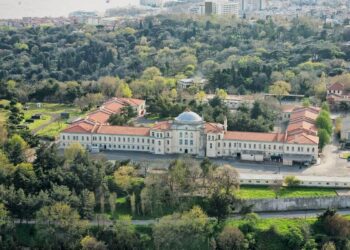
Meet Ebru Gökteke, an expert Istanbul tour guide specializing in Byzantine history, Christian iconography, and Greek Orthodox heritage.
Table of Contents
Introduction to Ebru Gökteke
A native of Istanbul, Ebru is one of those rare guides whose knowledge feels both scholarly and alive. She is not simply someone who can explain a monument. She is someone who can place it inside a much larger world — a world of theology, iconography, imperial culture, liturgy, urban transformation, and the long, complicated afterlife of Byzantium in modern Istanbul.
For travelers who want more than a surface-level experience, she is an extraordinary person to walk with.
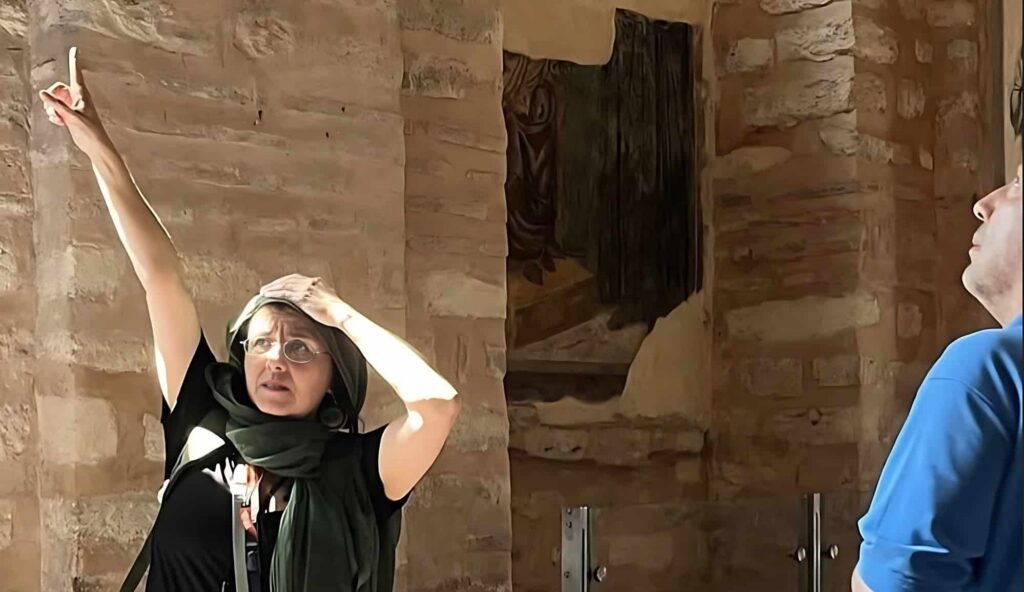
A Strong Academic Foundation
Ebru’s intellectual path already tells you a lot about the kind of guide she is.
She studied English Literature at Boğaziçi University, one of Turkey’s most respected universities. That literary formation matters. It gives her a command of language, nuance, and interpretation that not every guide possesses. She does not merely pass along information — she knows how to shape it, frame it, and communicate it with clarity.
After university, she worked as an arts correspondent for a local newspaper, then continued into travel publishing, serving as a managing editor for travel magazines including Gezi / National Geographic Traveler. She prepared Gezi magazine’s guide to ancient sites and that she has been working as a professional tourist guide since 2002.
In other words, she brings more than two decades of serious professional experience to the field.
It means Ebru did not arrive in guiding from a narrow or accidental path. She came to it through literature, journalism, editing, travel writing, and cultural observation. She learned how to research, how to ask questions, how to edit meaning, and how to build narratives that help others see more clearly.
And then she went even deeper.
She pursued graduate work in the History of Religions at Marmara University, and also completed an MA in Art History at Istanbul University, specializing in Christian iconography. Istanbul University’s Art History department explicitly includes Byzantine studies among its main fields of postgraduate work, which fits perfectly with her specialization.
That combination is unusually powerful. She also brings an independent and critical mind to the past. Rather than repeating simplified narratives, she is willing to question long-standing assumptions — including the old, reductive idea that men shaped the world outside while women remained confined to the home. In Ebru’s reading, history is far more complex than that, and her perspective invites people to see the past with greater intelligence and nuance.
Very few guides can move comfortably between religious history, art historical interpretation, Byzantine visual culture, and the practical craft of leading real people through a real city. Ebru can.
Why Ebru Stands Out in Istanbul
There are many knowledgeable guides in Istanbul. There are also many charming guides. But the overlap between deep academic seriousness and real-world guiding maturity is much smaller.
Ebru belongs firmly in that overlap.
Her special interests include history of art, architecture, and religions, with a particularly strong emphasis on Greek Orthodoxy and Byzantine history. Public profiles and event listings connected to her work also show a long-standing focus on Early Christianity, Christmas traditions, the Varangian Guards, Chora and iconography, and other highly specialized subjects.
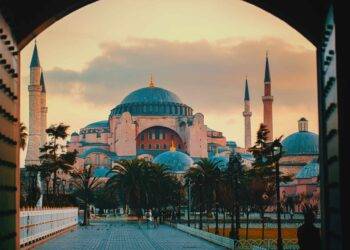
In practical terms, this means that when she stands with guests inside or near places such as Hagia Sophia, Chora, Fener, Balat, or the wider Byzantine landscape of Istanbul, she is not improvising from a memorized script.
She is drawing from years of reading, study, seminars, and sustained thought.
- She understands that a church is not just a building.
- An icon is not just an image.
- A liturgical tradition is not just “background information.”
- A district like Fener is not just picturesque — it is a layered world of theology, memory, communal survival, and shifting urban identity.
That is the difference between seeing a place and actually beginning to understand it.
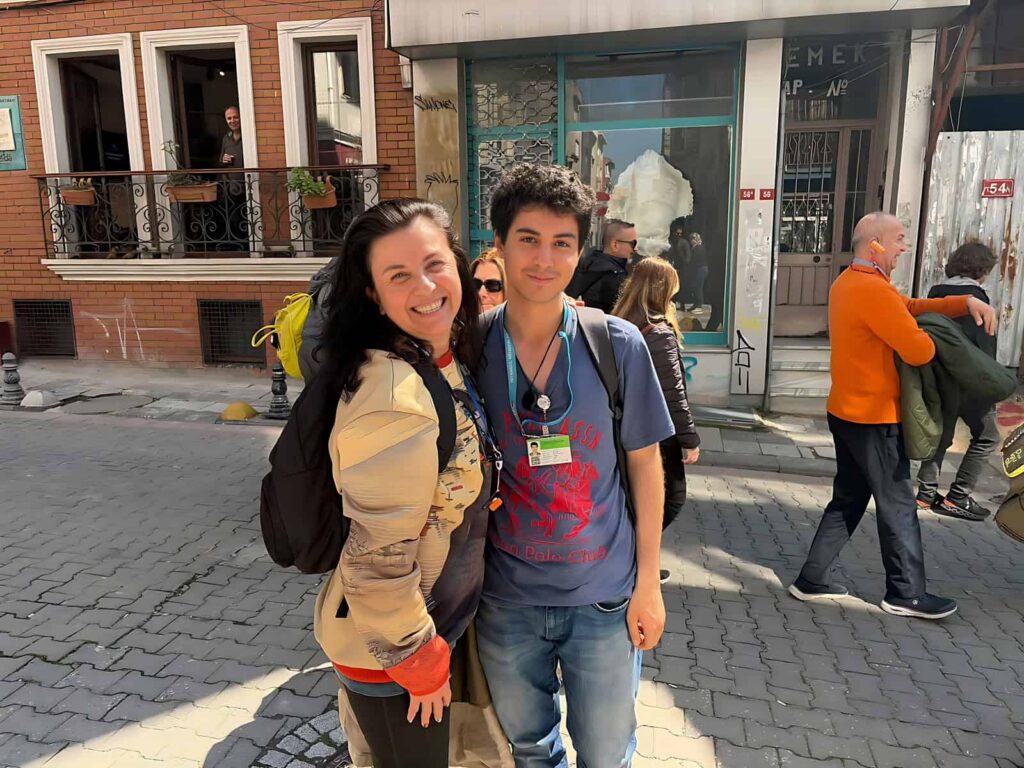
A guide who teaches far beyond the tour itself
Another sign of her caliber is that Ebru’s knowledge does not remain confined to private guiding.
She also gives seminars and public talks on subjects such as Early Christianity, the origins of Christmas, the Varangian Guards, and the Chora Church and its iconography. Public listings show her delivering talks and tours on Christmas history, Chora and iconography, women in antiquity and Byzantium, and Varangian themes.
That matters because it reveals something essential about her personality:
Ebru is not just working in tourism. She is engaged in an ongoing life of study and teaching.
She is clearly one of those people who genuinely loves learning — not for status, but for its own sake.
That spirit also comes through in smaller details. Her CV notes that she has been studying Ancient Greek and Ottoman script. That tells you a lot. It tells you she is still pushing herself, still sharpening her tools, still trying to get closer to original worlds through original languages.
That kind of intellectual discipline cannot be faked.
Byzantium, Christianity, and the Deeper Layers
For many travelers, Istanbul is introduced as a city of grand monuments: Hagia Sophia, Topkapı Palace, the Blue Mosque, the Basilica Cistern.
Those places are important, of course. But with the right guide, they become more than famous stops. They become entry points into larger questions.
- How did Christian imagery develop?
- What exactly were icons doing in Byzantine religious life?
- Why did iconoclasm matter so much?
- How did Greek Orthodox tradition evolve within Constantinople and then continue under Ottoman rule?
- What does Chora reveal that Hagia Sophia does not?
- How should we read a mosaic, a dome program, a saint cycle, or a funerary image?
These are exactly the kinds of questions that Ebru is equipped to handle.
Her background in Christian iconography and history of religions makes her especially valuable for travelers who care about Byzantine art, Orthodox Christianity, theological history, and the transition from Roman and Byzantine Constantinople into Ottoman and modern Istanbul.
Her role as a participant in the 2026 Boğaziçi University roundtable on “The Case of Chora: Acting as a guide to Byzantium” is another strong public sign that she is taken seriously in this field.
In other words, she is not simply interested in Byzantium as a decorative subject. She works within the subject with real seriousness.
An Istanbul Native with Breadth, Polish and Maturity
Some guides know the facts but do not know how to host.
Others know how to host but lack depth.
Ebru seems to bring both cultural polish and substantial knowledge.
Because she is a native of Istanbul, her relationship with the city is not abstract. It is lived. And because she has worked across writing, editing, and public presentations, she brings an unusual level of refinement to the act of interpretation.
She can help guests move not only through the city’s streets, but through its mental worlds: the Byzantine world, the Orthodox world, the late antique world, the symbolic world of images, and the long continuity of sacred spaces in Istanbul.
This is especially valuable for thoughtful travelers — people who do not want a hurried checklist, but a day shaped by insight.
For whom is Ebru Gökteke the right guide?
Ebru is an excellent match for travelers who want:
- a serious English-speaking guide in Istanbul
- deeper understanding of Byzantine history
- nuanced interpretation of Greek Orthodox heritage
- rich conversations about Christian art and iconography
- intellectually satisfying visits to places like Chora, Hagia Sophia, Fener, Balat, and the wider historic peninsula
- a guide who can connect architecture, religion, ritual, and historical memory
- someone mature, experienced, and genuinely dedicated to lifelong learning
She is particularly ideal for guests who are curious, well-read, or academically inclined — but she is equally valuable for anyone who simply wants to experience Istanbul with more depth and less cliché.
Book Ebru Now
At The Other Tour, we care deeply about working with guides who are not only licensed and professional, but also genuinely capable of opening Istanbul in meaningful ways.
Ebru Gökteke is exactly that kind of guide.
She combines the mind of a scholar, the instincts of a writer, the discipline of a long-time professional, and the lived sensitivity of a true Istanbullu. Her work shows how guiding, at its best, is not just about moving from site to site. It is about helping people see connections they would never have seen on their own.
If you want to explore Istanbul with someone who can illuminate Byzantine heritage, Christian iconography, Greek Orthodox history, and the city’s many layered identities with real intelligence and elegance, Ebru is one of the finest choices you could make.