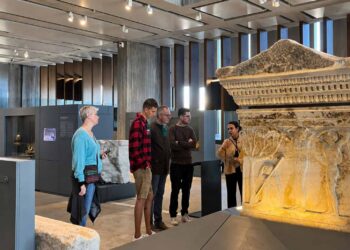
Discovered off the coast of Kaş in Antalya Province, , the 3,300-year-old Uluburun Shipwreck is the world’s premier Late Bronze Age time capsule. Carrying royal treasures and raw materials from seven ancient civilizations, this legendary vessel rewrote history, proving the ancient Mediterranean shared a highly connected, globalized economy.
Table of Contents
The Discovery of the Uluburun Shipwreck
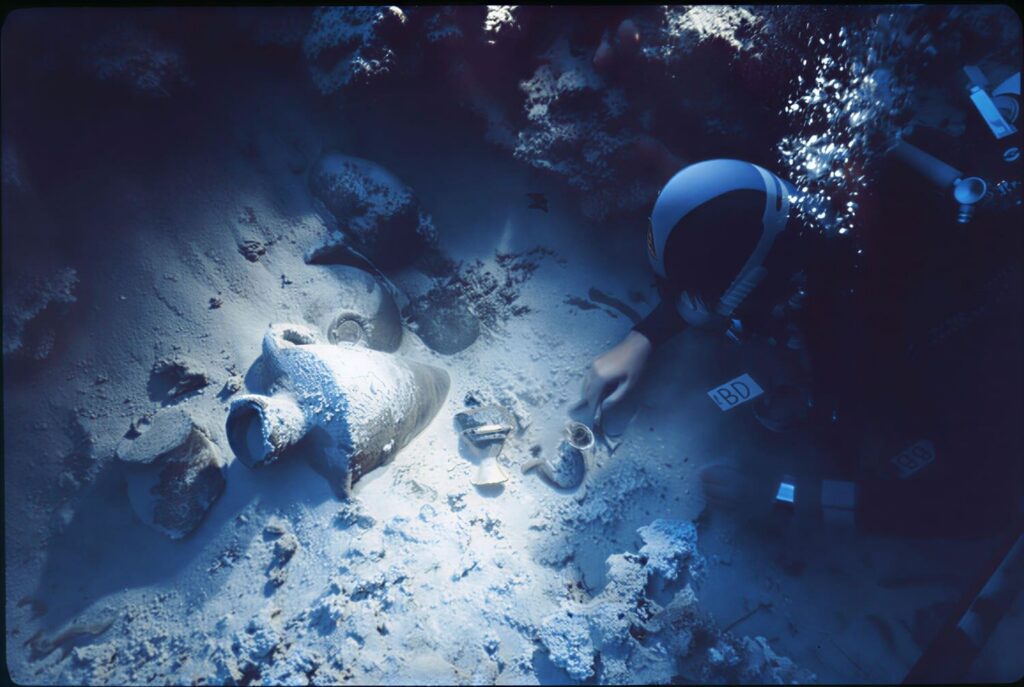
In 1982, Turkish sponge diver Mehmed Çakır was exploring the seabed off Cape Uluburun, a rocky headland just southeast of Kaş in Antalya Province, when he noticed a group of unusual objects resting on a steep underwater slope. He described them as
“metal biscuits with ears.”
Those curious objects turned out to be oxhide copper ingots, marking the location of a late 14th-century BCE merchant vessel that had lain undisturbed for over 3,300 years. What followed was one of the most ambitious and technically challenging underwater excavations in archaeological history.
Between 1984 and 1994, the Institute of Nautical Archaeology (INA) directed a team of marine scientists and divers who completed 22,413 dives to depths ranging between 140 and 200 feet.
Working in brief, highly precise shifts to avoid decompression sickness, they successfully recovered the fragile remains of a Lebanese cedar hull and its entire, pristine cargo, providing historians with an unedited snapshot of Late Bronze Age maritime life.
Origin, Destination, and the Fatal Voyage
To understand the magnitude of the Uluburun shipwreck, one must look at the geopolitics of the 14th century BCE. This was the era of the Late Bronze Age—a time when powerful, sophisticated empires dominated the Eastern Mediterranean, Aegean, and Near East. Rather than operating in isolation, these civilizations were deeply interconnected through royal diplomacy and dense commercial shipping lanes.
Geopolitical Landscape of the Late Bronze Age

During this period, the Eastern Mediterranean was a network of competing yet cooperative superpowers. The New Kingdom of Egypt, the Hittite Empire in central Anatolia, the Mycenaean kingdoms of mainland Greece, the Mitanni in Mesopotamia, and the rich trading hubs of the Canaanite coast (modern-day Lebanon and Syria) all relied heavily on maritime trade.
Because no single empire possessed all the raw materials needed to produce bronze—the defining technology of the age—ships like the one found at Uluburun were the literal lifeblood of the ancient world’s military and economic infrastructure.
To manufacture bronze, smiths required a precise 10-to-1 ratio of copper to tin—a metallurgical necessity that forced civilizations thousands of miles apart into a shared, delicate reliance on these specific shipping routes. When the Uluburun vessel foundered, it didn’t just lose a hull; it wiped out a massive royal shipment capable of equipping an entire Bronze Age military vanguard with brand-new weaponry.
Origin and Intended Destination
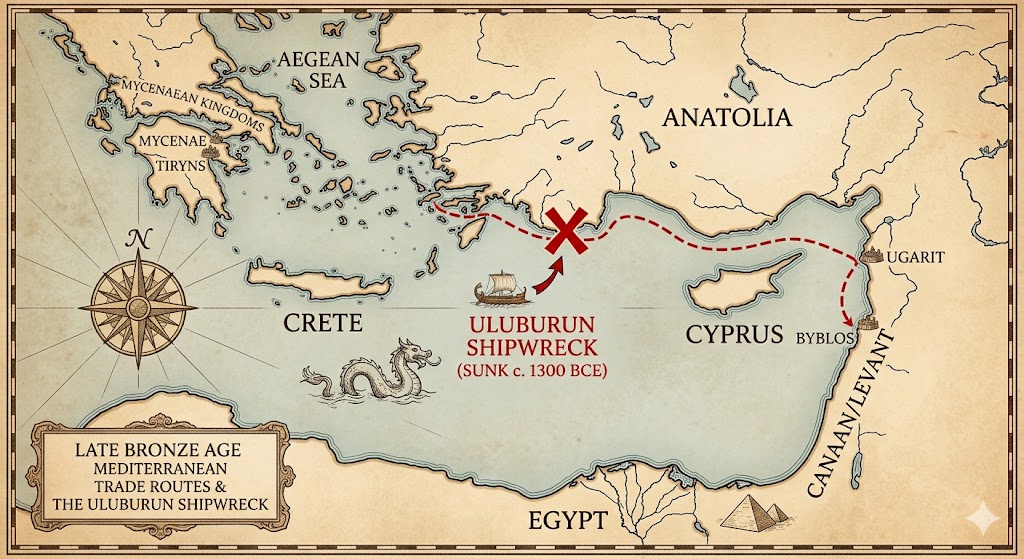
While the precise home port of the Uluburun ship remains a subject of academic debate, the overwhelming consensus points to a Canaanite or Cypriot origin. Dendrochronological (tree-ring) analysis of the Lebanese cedar used to construct the hull, combined with the stylistic origins of the ship’s massive storage jars, strongly suggest the vessel set sail from a port in the Levant (possibly Ugarit or Byblos) or Cyprus.
The ship’s trajectory was moving from east to west, hugging the southern coast of Anatolia. Its likely destination was a Mycenaean palace port on mainland Greece, such as Mycenae or Tiryns.
The presence of two Mycenaean envoys or merchants on board—identified by their unique personal belongings, seals, and weapons found in the wreckage—further supports the theory that this was an elite, palace-directed voyage delivering crucial raw materials to Aegean royalty.
The Sinking of the Vessel
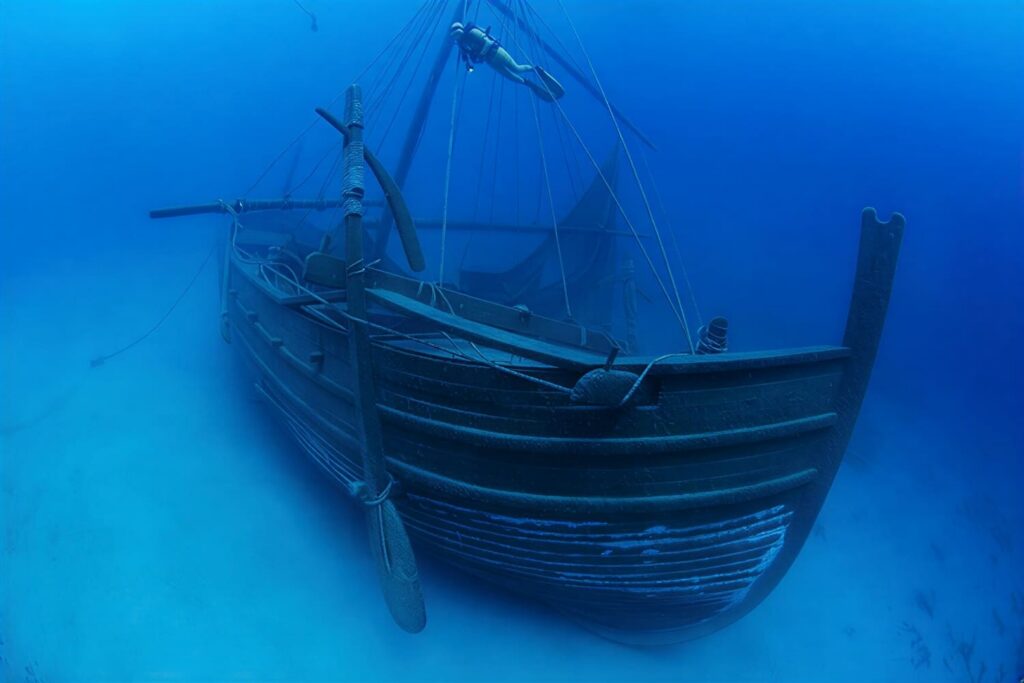
Sometime around 1300 BCE, as the heavily laden merchant ship rounded the treacherous, wind-swept waters of Cape Uluburun near modern Kaş, tragedy struck. While the exact cause of the disaster is lost to history, the position of the wreckage suggests the ship was caught in a sudden, violent Mediterranean storm or suffered a critical structural failure while trying to clear the rocky cape.
Weighed down by over 15 tons of cargo, the vessel foundered and slid down a steep underwater slope, settling at a depth between 140 and 200 feet. The crew and passengers likely perished, and the ship sank into total obscurity for more than three millennia, perfectly preserving the very world it left behind.
The Recovered Sunken Treasures of Uluburun
The sheer variety and sheer volume of items recovered from the seabed make the Uluburun shipwreck the most valuable archaeological find ever pulled from the Mediterranean. Rather than carrying goods from just one region, its hull held wealth amassed from across the known world.
Raw Industrial Materials
The bulk of the ship’s cargo consisted of industrial raw materials intended for large-scale palace production. Marine archaeologists recovered 10 tons of Cypriot copper ingots, primarily cast into a specific four-cornered “oxhide” shape to make them easy to carry and stack securely inside the hull.
To turn that copper into bronze, the ship also carried one ton of tin ingots, which chemical sourcing tracks all the way back to mines in Central Asia. Additionally, the hold contained 175 cone-shaped blocks of raw cobalt-blue, turquoise, and lavender glass—the earliest intact blocks of glass ever discovered—which were highly valued items used by elite craftsmen to mimic precious stones like lapis lazuli.
Royal Luxuries and Exotic Trade Goods
Beyond raw materials, the vessel carried finished luxury items meant strictly for royal elites or religious offerings. The international nature of the cargo is staggeringly diverse:
- From Egypt: Exquisite ivory objects, ebony logs from Nubia, and a unique solid gold scarab bearing the hieroglyphic name of Queen Nefertiti—the only known gold scarab of the iconic queen in existence.
- From the Levant & Cyprus: Over 140 Canaanite storage jars containing resins, almonds, figs, olives, and pomegranates, alongside fine Cypriot pottery safely packed inside massive storage jars.
- From the Baltic Region: Large, polished amber beads that traveled thousands of miles across European river trade networks before being loaded onto this vessel.
Personal Belongings of the Crew and Passengers
Mixed among the commercial goods were the day-to-day items that tell us who was actually on board. Archaeologists found balanced scale weights shaped like recumbent animals, merchant seals, and practical Bronze Age kitchen tools.
Crucially, the team also surfaced two Mycenaean bronze swords, specialized cloaks, and distinct personal ornaments. These specific items strongly indicate that at least two high-status Mycenaean officials or envoys were traveling with the ship, acting as royal overseers for this massive cross-continental delivery.
Exploring Uluburun Shipwreck Remains
The Uluburun Shipwreck lies off Cape Uluburun, approximately 10 kilometres southeast of Kaş on the Mediterranean coast of Antalya Province. Although the original wreck site is underwater and is not presented as a conventional visitor attraction, its location connects the discovery directly with the ancient maritime landscape of Lycia and the southern coast of Anatolia.
Kaş is one of Antalya’s westernmost districts and stands near several major Lycian sites, including Antiphellos, Patara and Xanthos. This makes the Uluburun story especially relevant to travellers exploring the archaeological heritage of the Antalya region.
But the remains aren’t there!
Bodrum Museum of Underwater Archaeology
The spectacular artifacts recovered from the deep do not sit hidden away in private academic archives. Today, you can stand face-to-face with this ancient time capsule by visiting the Bodrum Museum of Underwater Archaeology, housed inside the historic, coastal walls of the Castle of St. Peter in Bodrum, Turkey.
The museum features a dedicated, climate-controlled exhibition hall specifically built to showcase the Uluburun find. Inside, a life-sized, meticulous reconstruction of the ancient merchant vessel’s hull allows visitors to visualize exactly how the 10 tons of oxhide copper ingots, tin blocks, and massive Canaanite storage jars were systematically stacked over 3,300 years ago.
Surrounding the reconstructed ship are secure display cases housing the pristine luxury items, including the raw glass ingots, intricate jewelry, and the world-famous solid gold scarab of Queen Nefertiti. It is widely considered one of the most significant and immersive maritime museum displays in the world.
Pro Tour Guide in Bodrum
Unlock the secrets of Bodrum and Ephesus and the Lelegian Way with Dr. Selda Özhan, the expert scholar guide in Bodrum.
Plan Your Guided Trip to Bodrum

The story of Uluburun connects two remarkable destinations in Türkiye: the Mediterranean coastline near Kaş, where the vessel sank, and Bodrum, where its recovered cargo is displayed today.
The Other Tour can arrange private, historically focused journeys in Kaş, Antalya and Bodrum, complete with licensed local guides, private transportation and itineraries built around archaeology, maritime history and the ancient civilizations of Anatolia.
Let us handle the logistics, skip-the-line ticketing, and expert historical storytelling while you immerse yourself completely in the ancient world.