Imperial Squares of Constantinople
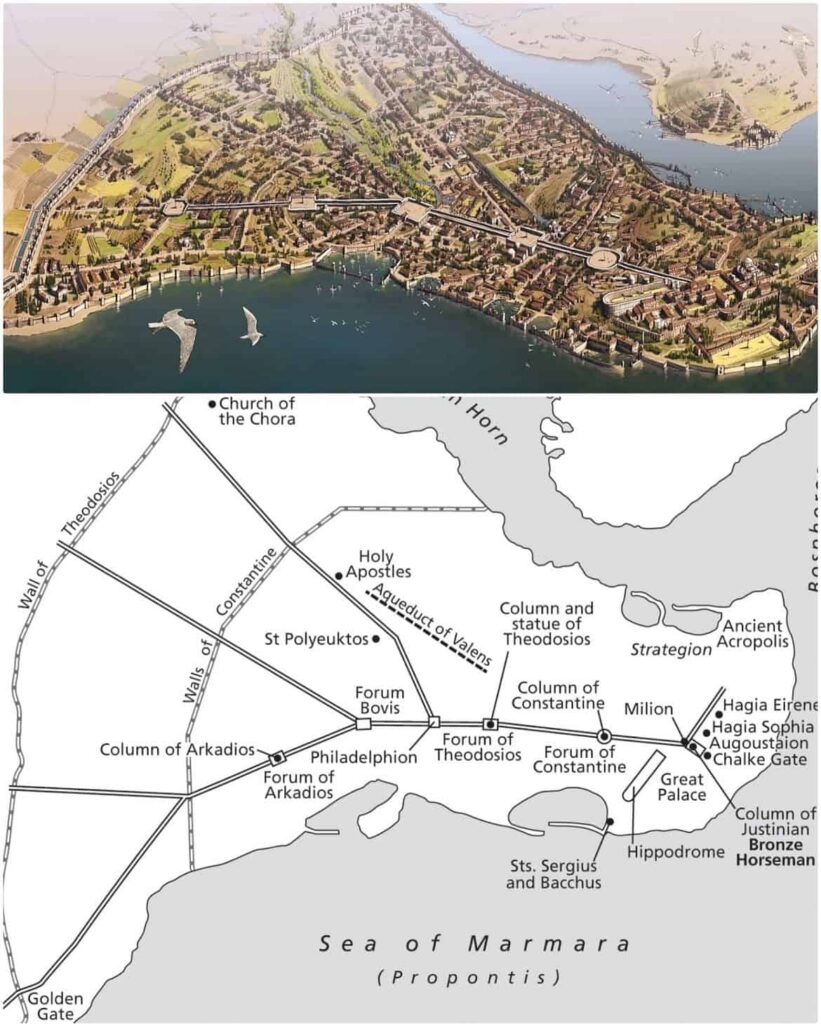
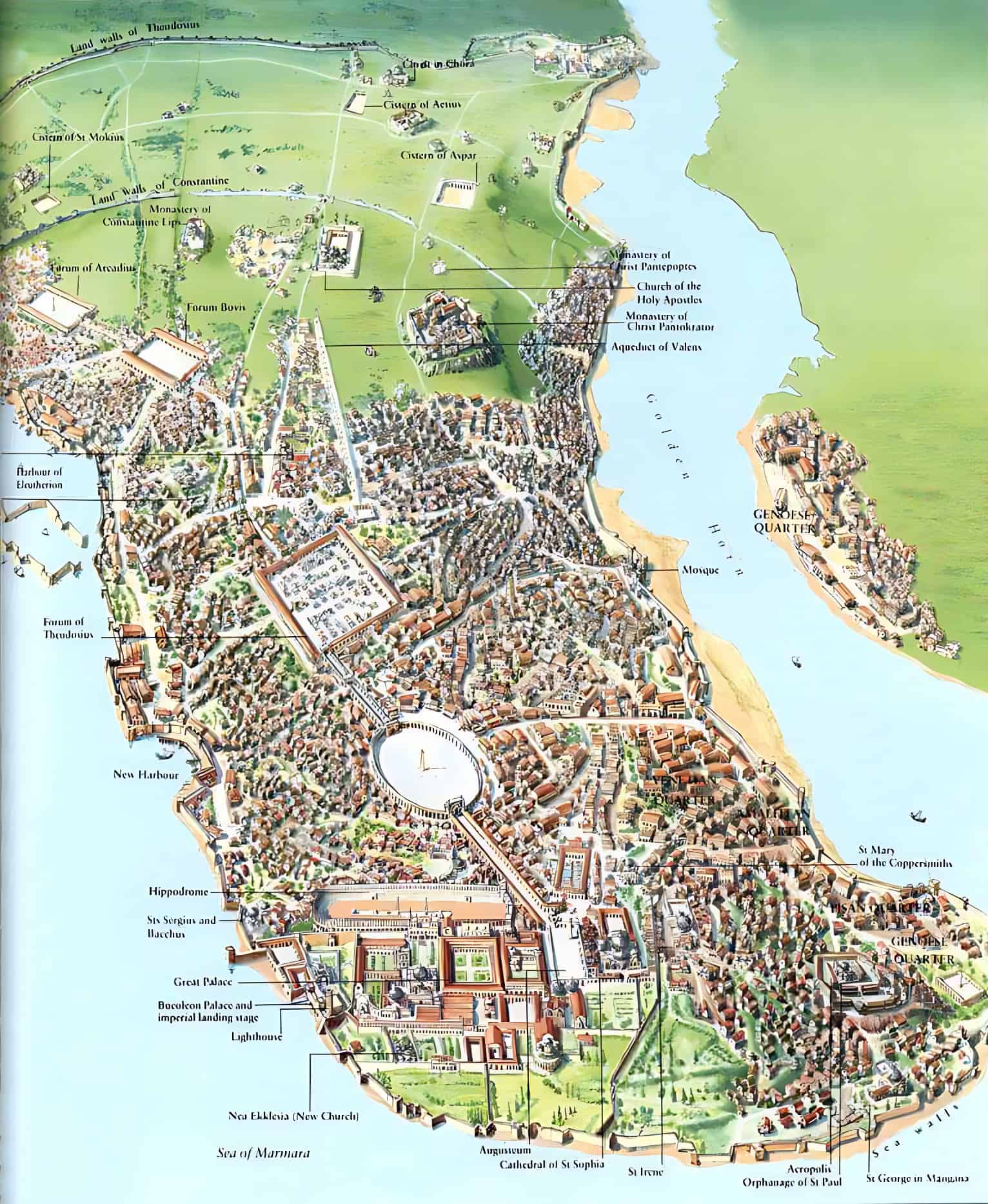
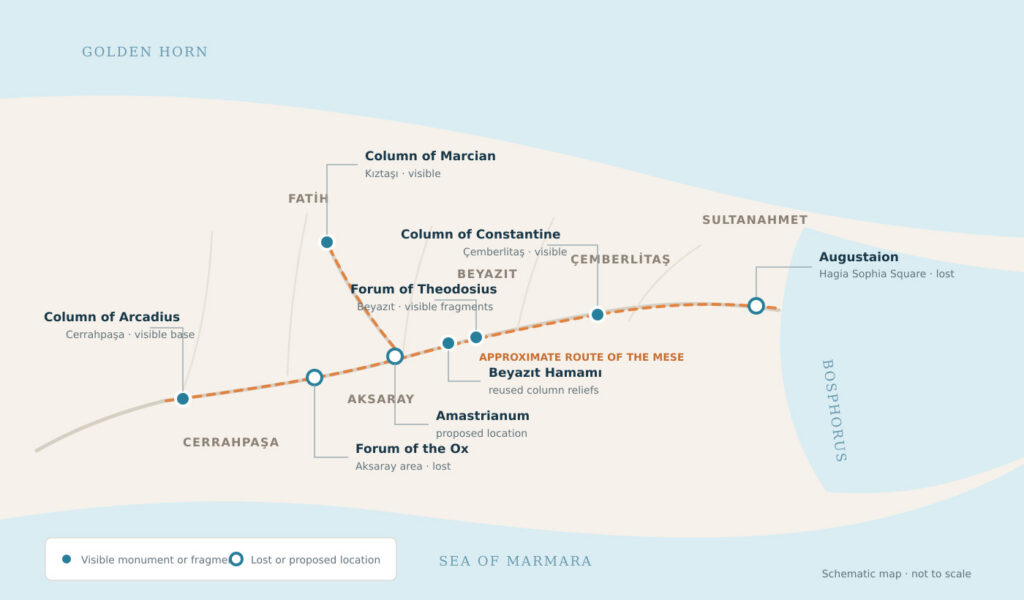
Constantinople did not revolve around a single civic center. Public life unfolded across a sequence of monumental forums linked by the Mese, the capital’s principal avenue. Beginning near Hagia Sophia, it ran west through the city before dividing into two branches leading toward the land walls.
These forums combined commerce, ceremony, and imperial propaganda. Emperors filled them with triumphal arches, statues, fountains, basilicas, and commemorative columns, transforming the city into a stage for the authority of the Byzantine Empire and its claim to Rome’s imperial inheritance.
What Was a Roman Forum
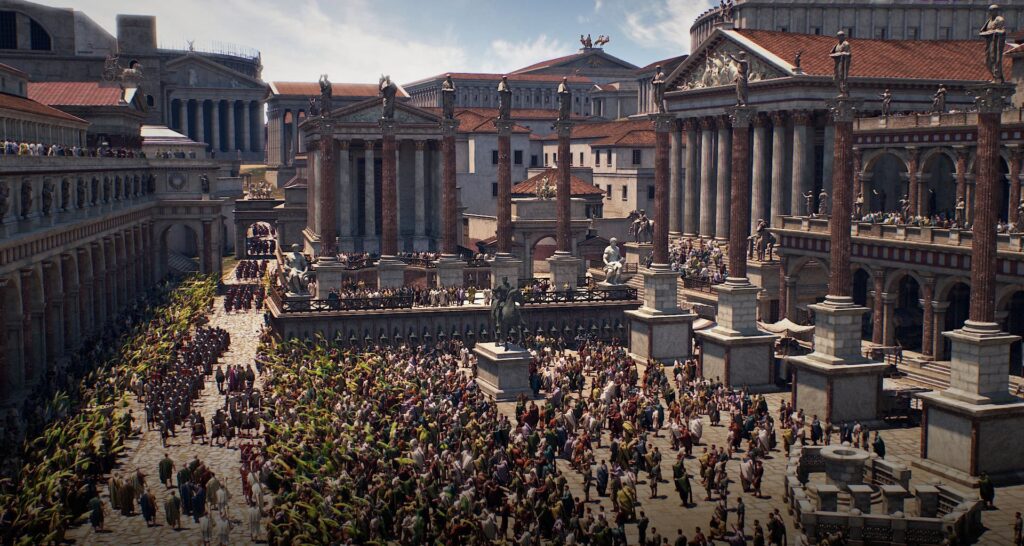
A Roman forum was an open public space surrounded by the buildings that organized civic life. A typical forum could include porticoes, temples, basilicas, fountains, monuments, shops, and government offices. Its design brought political, commercial, religious, and social activities into one carefully planned setting.
People came to a forum to hear official announcements, attend legal proceedings, conduct business, join religious ceremonies, or watch an emperor’s arrival. Statues and inscribed monuments also reminded visitors of military victories, imperial benefactors, and the values promoted by the state.
A forum was therefore more than a marketplace. Unlike an ordinary commercial square, it served as a carefully staged center of public authority and collective memory. This distinction helps explain the surviving remains of Constantinople: columns such as Çemberlitaş originally stood within much larger architectural complexes rather than in isolation.
The Augustaion: The Imperial Forecourt
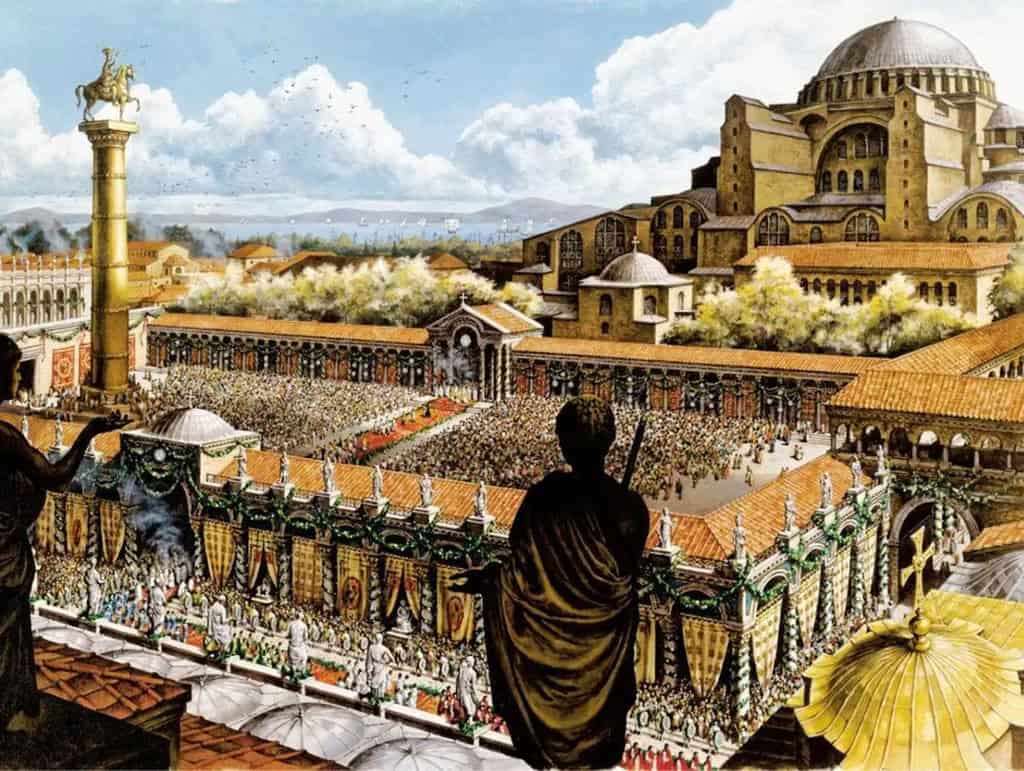
The Augustaion stood at the ceremonial heart of Constantinople, beside Hagia Sophia and close to the Hippodrome. Although it began as a public market, it gradually became a controlled imperial forecourt surrounded by the city’s most important religious and administrative buildings.
After the Nika Revolt of 532, Emperor Justinian rebuilt the square and raised a monumental column crowned by his equestrian statue. The emperor faced east with his right hand extended, a gesture interpreted as commanding the empire’s enemies—particularly the Persians—not to advance. Neither the column nor the original buildings survive, but the open area around Hagia Sophia still preserves the Augustaion’s central position within the former imperial district.
“Extending his right hand toward the rising sun, he orders the barbarians in that place to remain at home and not to advance.”
Procopius, On Buildings, Book I
The Forum of Constantine
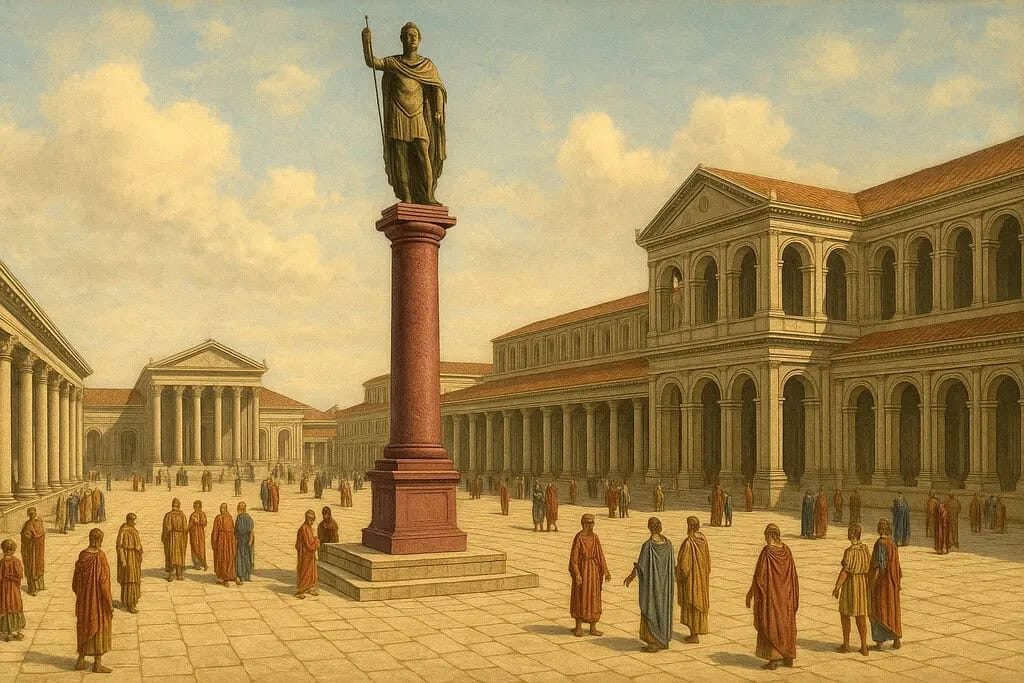
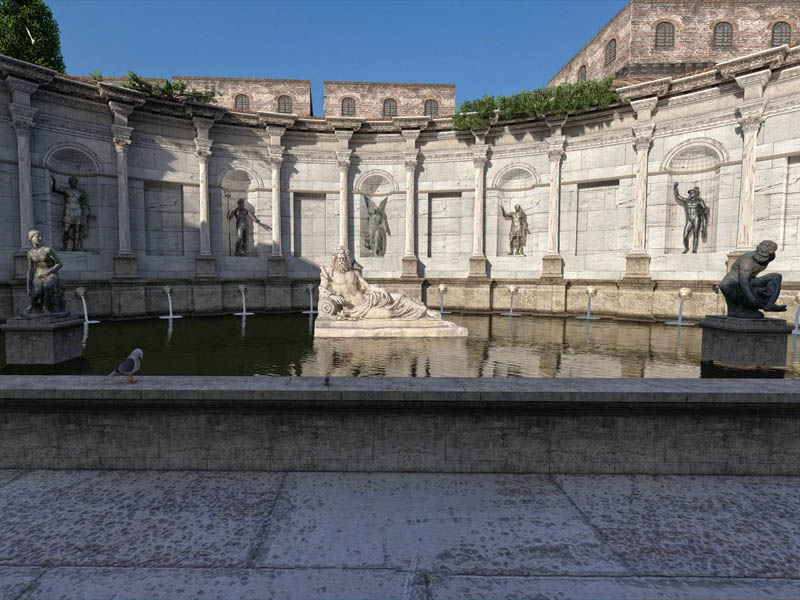
Constantine the Great built this forum just outside the walls of ancient Byzantion while expanding the city into his new Roman capital. Two monumental gates opened onto its circular plaza, where a Senate House, fountain, shops, and two-storey colonnades surrounded the Column of Constantine.
“Faithful Manuel restored this sacred work, worn by time.”
Inscription of Manuel I Komnenos, Column of Constantine
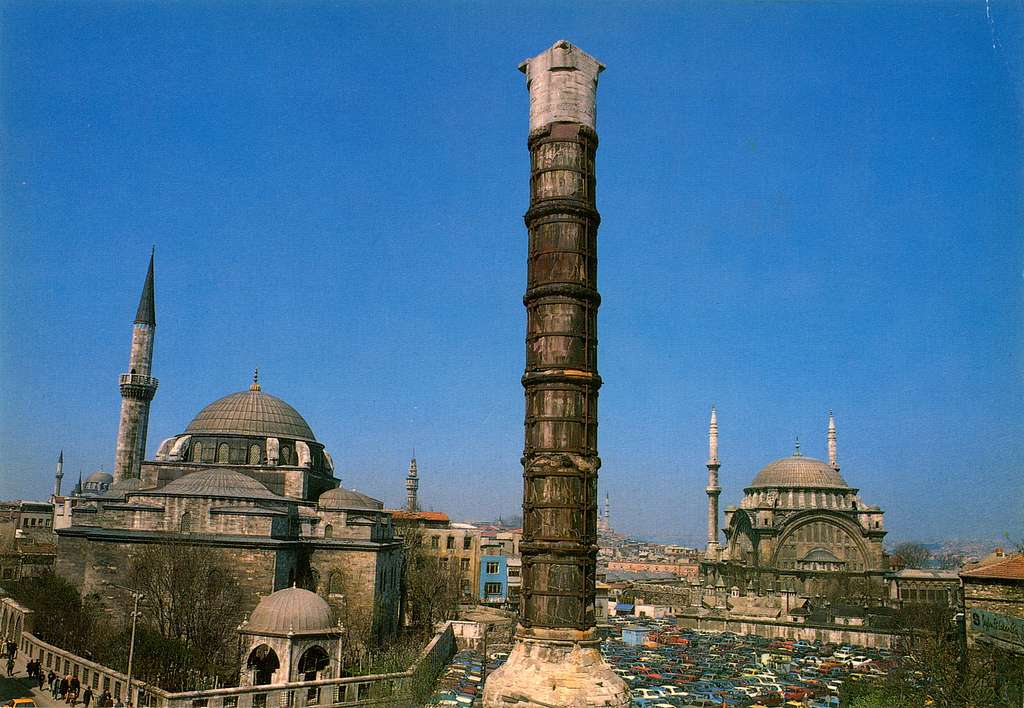
The square also displayed ancient statues brought from different parts of the empire, using the artistic heritage of Greece and Rome to give the new capital an imperial past. The column originally supported a colossal statue portraying Constantine with the radiate crown of a solar deity. Although the forum has disappeared, its central monument still stands at Çemberlitaş.
The Forum of Theodosius
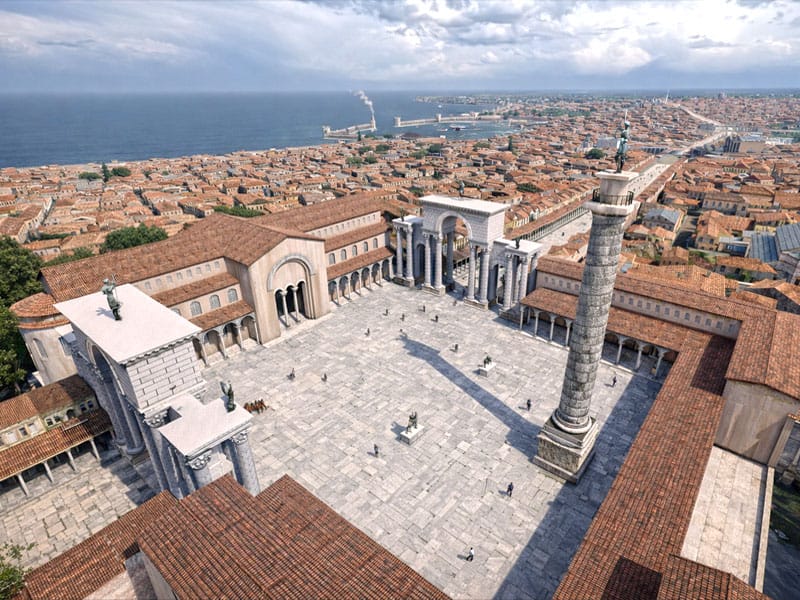
Theodosius I transformed the earlier Forum Tauri into a monumental imperial square in 393. Designed to recall Trajan’s Forum in Rome, it became the largest forum in Constantinople, with a triumphal arch, public buildings, and a towering commemorative column.
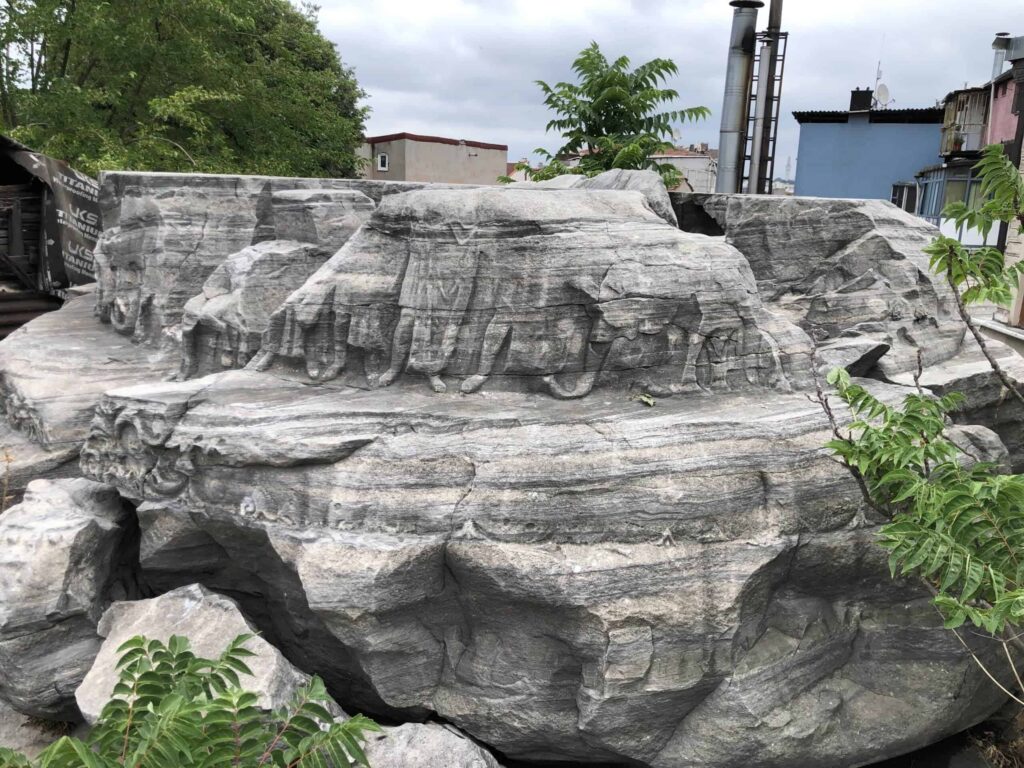
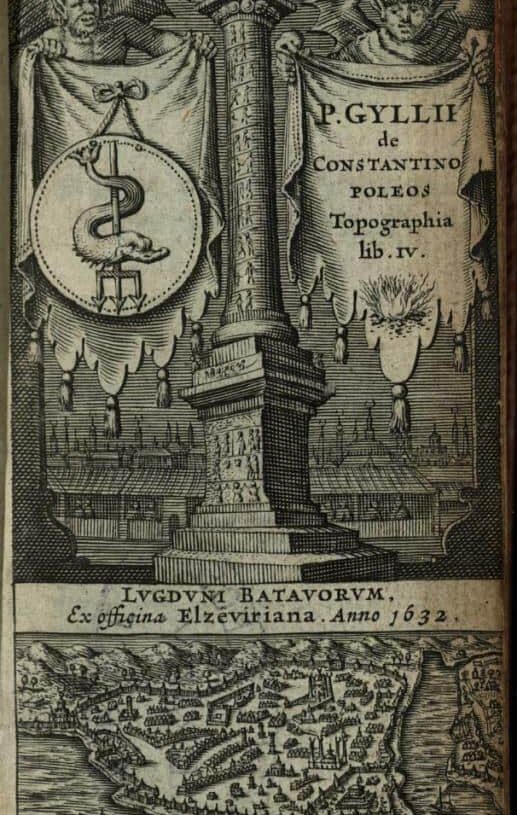
Spiral reliefs covering the column depicted soldiers and imperial victories, reinforcing Constantinople’s connection to the traditions of the Roman Empire. Most of the complex vanished beneath modern Beyazıt, but fragments of its triumphal arch remain beside Ordu Caddesi. Parts of the monumental column were later reused in Beyazıt Hamamı, where carved Roman soldiers can still be seen in the building’s exterior walls.
The Amastrianum
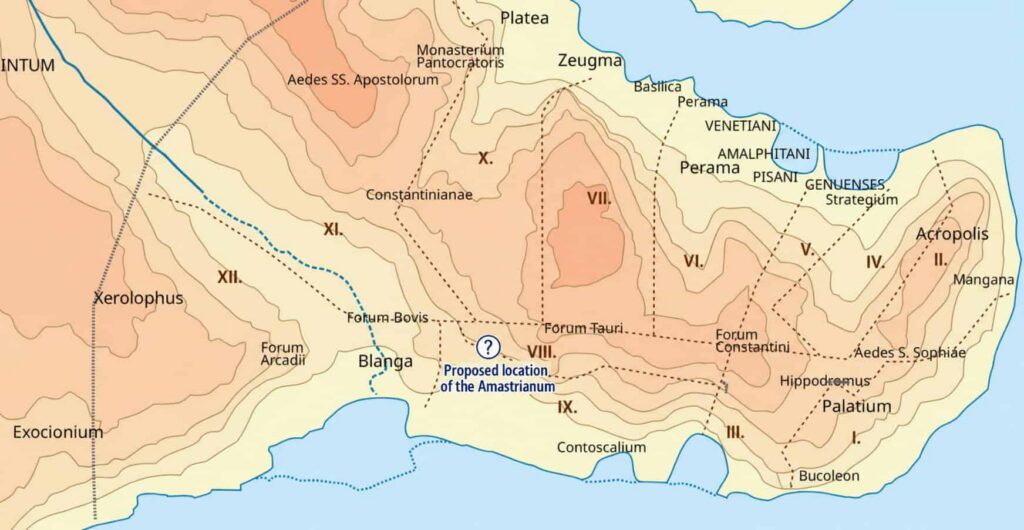
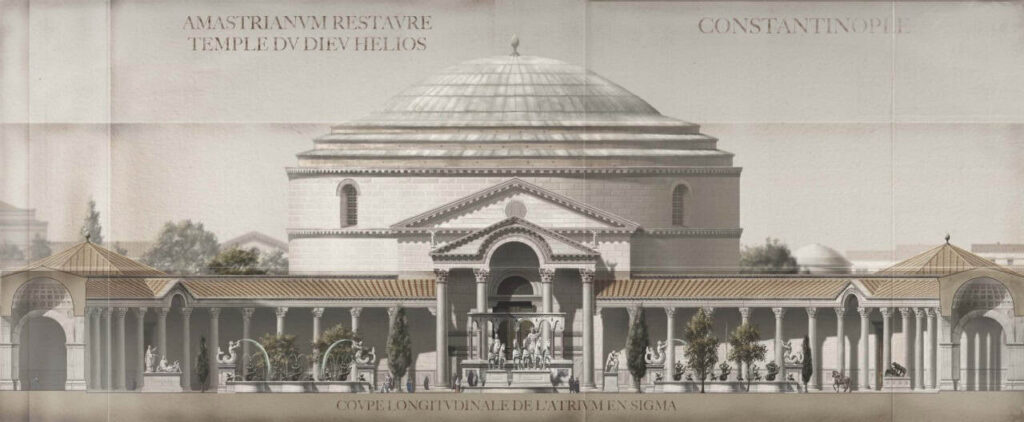
The precise location and original appearance of the Amastrianum remain uncertain. Byzantine descriptions place this public square along the southern branch of the Mese, between the Philadelphion and the Forum of the Ox, probably near modern Aksaray or Şehzadebaşı.
Unlike Constantinople’s monumental imperial forums, the Amastrianum combined ceremony, horse trading, ancient statues, and public punishment. Later tradition also placed the Modion, a monument displaying the official grain measure, here—although no archaeological evidence confirms its location or appearance.
Serif Yenen: The Pioneer of Turkish Guiding
Author, travel guide, and cultural researcher. Meet the man who spent decades uncovering the hidden layers of Istanbul for travelers worldwide.
The Forum of the Ox
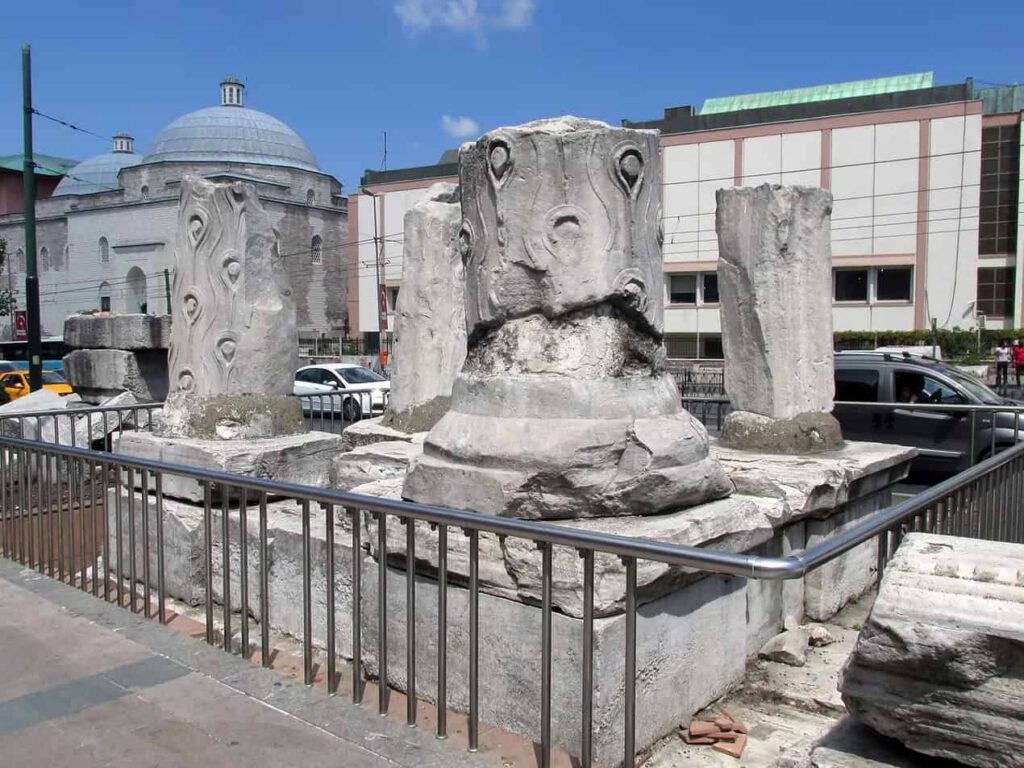
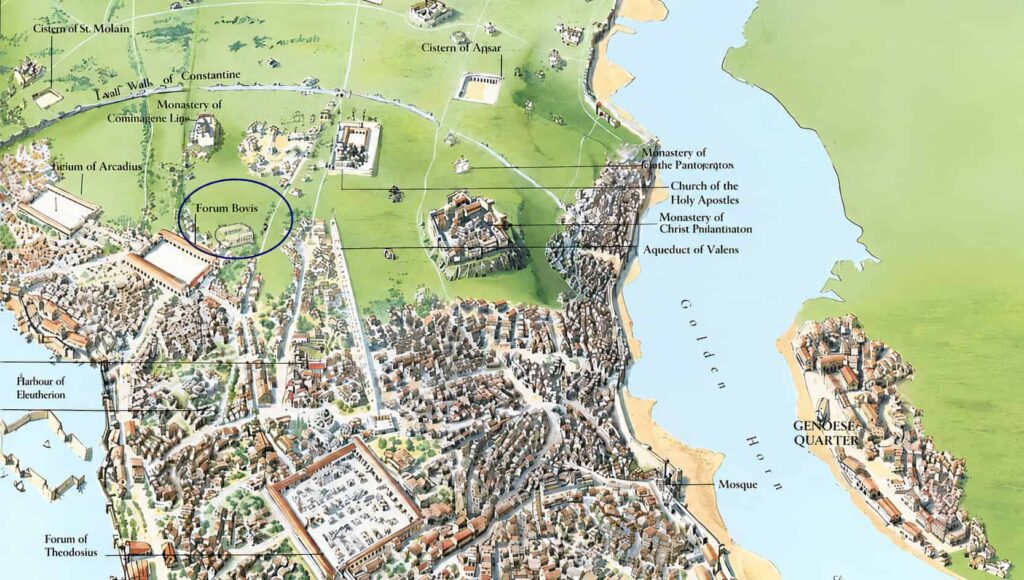
The Forum of the Ox, also known as the Forum Bovis, stood along the southern branch of the Mese near modern Aksaray. Porticoes, workshops, and monuments surrounded the public square, which also served as a stop during imperial processions through Constantinople.
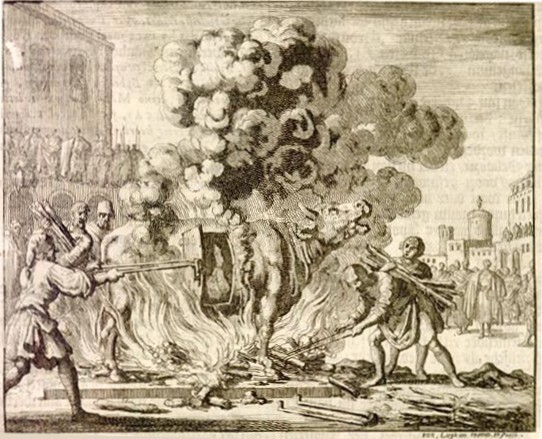
The forum took its name from a large hollow bronze ox traditionally associated with public punishments and executions. Byzantine accounts describe several executions in the square, giving it a darker reputation than the ceremonial forums farther east. The forum has disappeared, and archaeological work has not established its precise boundaries beneath modern Istanbul.
The Forum of Arcadius
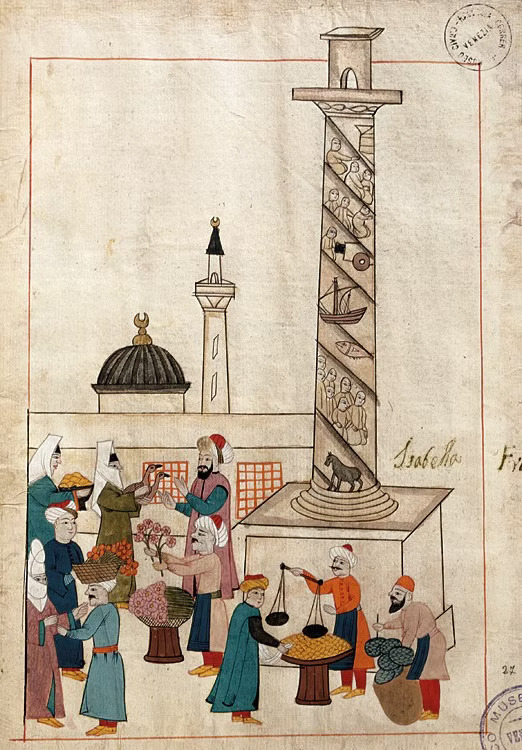
Emperor Arcadius established his forum in 403 on the Xerolophos, the seventh hill of Constantinople. At its center stood a monumental column wrapped in spiral reliefs depicting imperial victories over the Goths. A colossal statue of Arcadius crowned the completed monument.
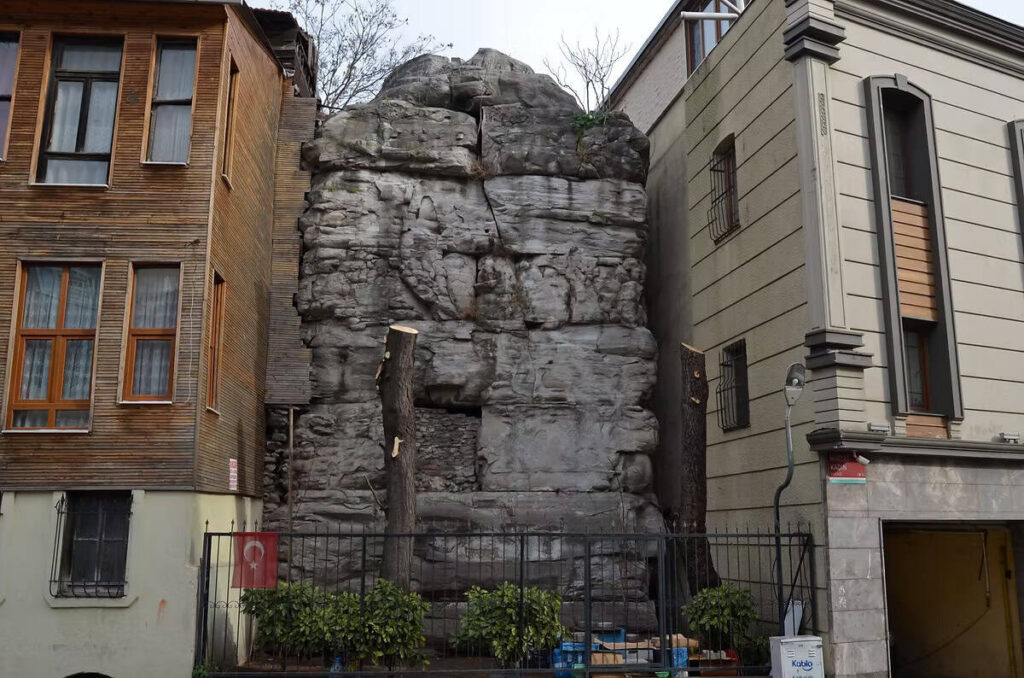
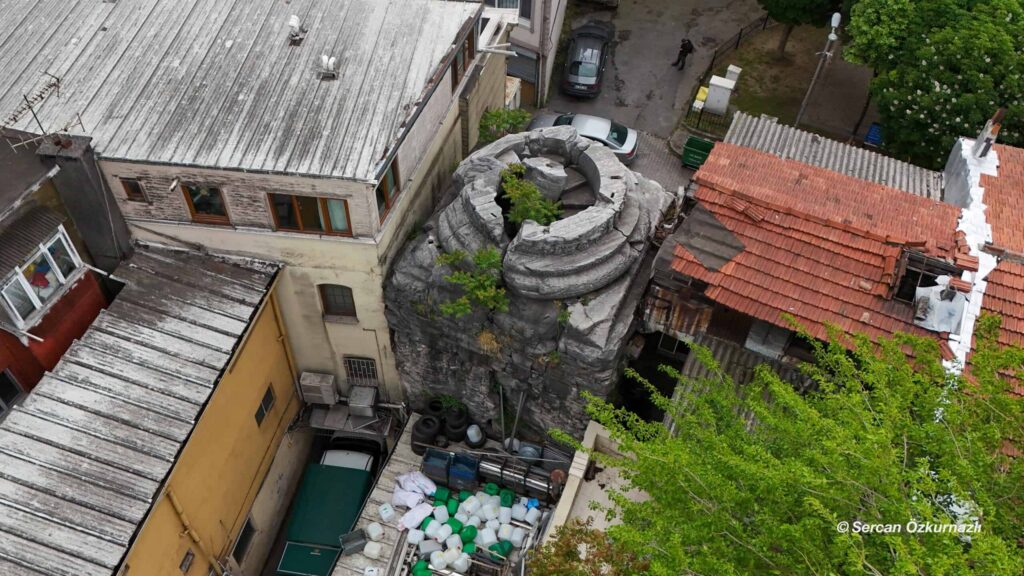
During the Ottoman period, the former forum became part of a market district known as Avrat Pazarı, or the “Women’s Market,” and the monument acquired the popular name Avrat Taşı. The market is sometimes confused with Istanbul’s historical slave market, but the two were separate places. Most of the column was dismantled in 1719 after it became dangerously unstable, while its weathered base still survives between buildings in Cerrahpaşa.
The Forum of Marcian
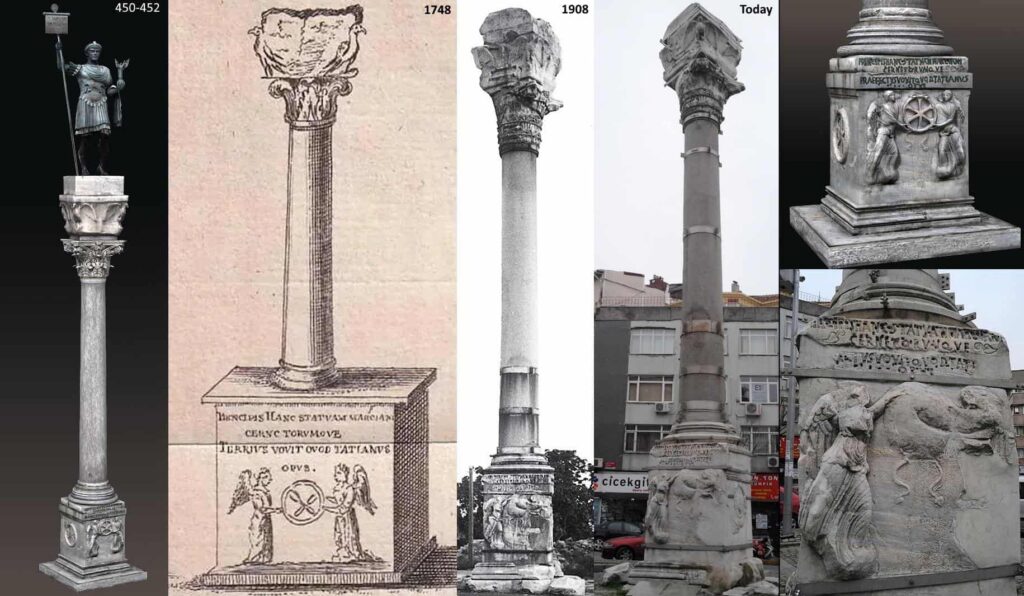
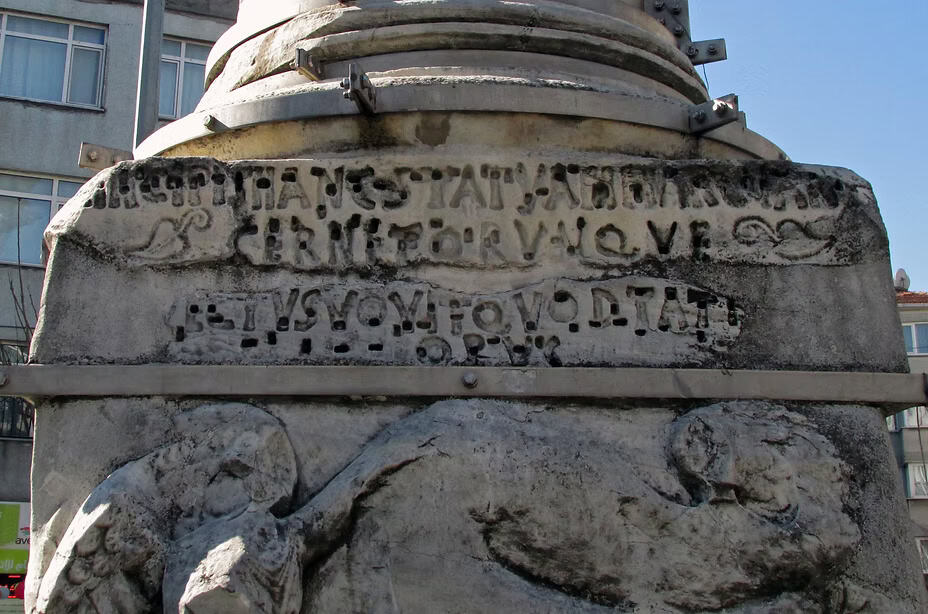
The Forum of Marcian probably occupied a relatively small public square on the northwestern branch of the Mese. Little is known about its original layout, but the surviving inscription confirms that the urban prefect Tatianus erected both the forum and its honorific column for Emperor Marcian between 450 and 452.
“Behold this statue of Emperor Marcian and its column, a work dedicated by the prefect Tatianus.”
Dedicatory inscription on the Column of Marcian, c. 450–452
Known today as Kıztaşı, the column is exceptional because it remains almost entirely intact in its original location. Its Latin inscription, Christian symbols, and winged Victory figures combine classical Roman imperial imagery with the Christian identity of fifth-century Constantinople. During the Ottoman period, local tradition reinterpreted the monument as one of the protective talismans of Istanbul.
What Can Still Be Seen Today?
Most of the forums have vanished beneath modern
Istanbul, but several columns and architectural fragments still mark their former locations. The table below shows what survives and where each remnant can be found today.
| Ancient Site |
What Survives? |
Where Is It? |
| Forum of Constantine |
The Column of Constantine |
Çemberlitaş |
| Forum of Theodosius |
Parts of the triumphal arch and column reliefs |
Beyazıt and Beyazıt Hamamı |
| Forum of Arcadius |
The column’s pedestal and lowest section |
Cerrahpaşa |
| Forum of Marcian |
The nearly complete Column of Marcian |
Kıztaşı, Fatih |
| Amastrianum |
No confirmed remains |
Proposed location near Aksaray or Şehzadebaşı |
| Forum of the Ox |
No confirmed visible remains |
Near Aksaray |
| Augustaion |
No original structures survive |
Hagia Sophia Square |
Walking the Forums of Istanbul
The most practical route begins near Hagia Sophia, where the Augustaion once formed the forecourt of the imperial district. Follow Divanyolu west to the Column of Constantine at Çemberlitaş, then continue toward Beyazıt to see the surviving fragments of the Forum of Theodosius.
From Beyazıt, the route continues through Aksaray toward the proposed locations of the Amastrianum and Forum of the Ox, although nothing remains visible at either site. The base of the Column of Arcadius survives farther west in Cerrahpaşa. Reaching Kıztaşı requires a separate turn north into Fatih, since the Forum of Marcian stood along the northwestern branch of the Mese.
Hagia Sophia
Çemberlitaş
Beyazıt
Aksaray
Cerrahpaşa
Kıztaşı





I never realized that walking through modern Istanbul could follow the same route as the ancient Mese. It is amazing to imagine these grand Roman forums beneath today’s streets, markets and neighborhoods. Seeing the Column of Constantine and Kıztaşı now feels much more meaningful Istanbul has so many hidden layers of history