
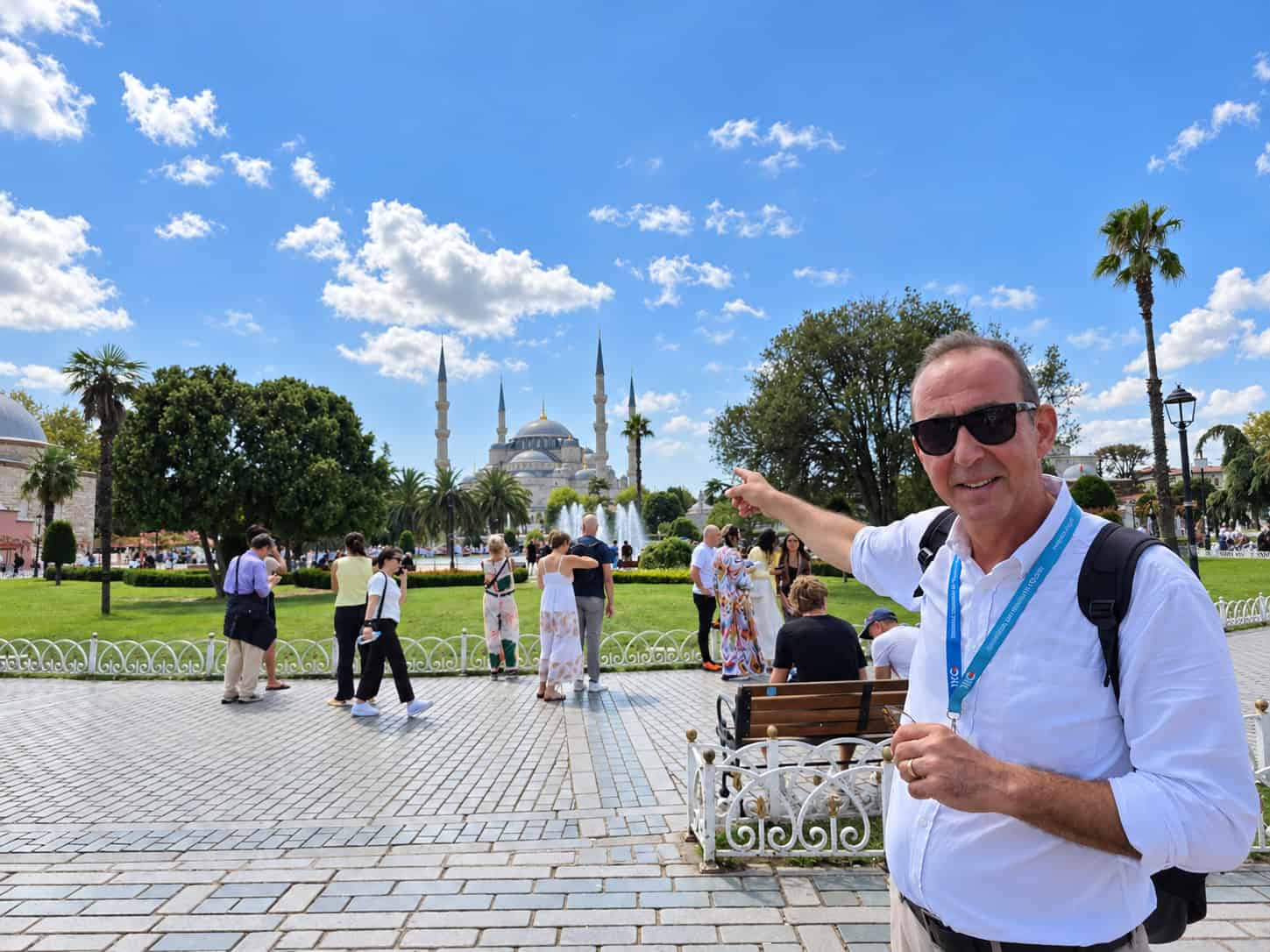
Meet Ahmet Can Gürel—the engineer who turns Istanbul into a living storybook, connecting imperial monuments, hidden neighborhoods and modern Turkish life with razor-sharp insight, infectious curiosity and the spontaneity to let the city surprise you.
Table of Contents
Guiding Istanbul With Ahmet Can Gürel
Some guides build a tour around a checklist. Ahmet Can Gürel builds one like a story.
His days have a beginning, a direction and a sense of discovery—but never a rigid script. The route changes according to the people walking it: their interests, energy, questions and curiosity. For Ahmet Can, a private tour should feel thoughtfully designed while remaining spontaneous enough for Istanbul to surprise you.
That balance may owe something to his unusual background. Before becoming a professional guide, Ahmet Can earned a master’s degree in engineering. He later completed the two-year Tourist Guidance Programme at Kapadokya University and has now been guiding Istanbul for seven years.
The engineer in him understands structure. The guide in him knows when to abandon it.
Ahmet Can at a Glance
- Languages: English and Turkish. His English carries humour, nuance and a difficult question without strain.
- Experience: Seven years guiding Istanbul.
- Education: Master’s degree in engineering, plus a two-year tourist guidance programme at Kapadokya University.
- Home ground: The historical peninsula, İstiklal Avenue and Taksim, Kurtuluş in Şişli, Beşiktaş and Kadıköy.
- Format: Private tours by preference, designed as a sequence and rebuilt around the guests.
- Especially good with: American travellers, after years living in the United States.
- Also lived in: Russia, with wide travel across Europe.
- Guest privacy: He publishes no photograph of a guest, on any platform, without their permission.
- Joined: The 57th guide on our roster — see how we build our guide team.
The Engineer With a Storyteller’s Instinct
Ahmet Can describes his tours as “little storybooks” created around his guests.
It is an apt description because Istanbul rarely makes sense as a collection of isolated monuments. The city becomes much more interesting when its places are connected: the underground reservoirs that sustained Constantinople, the imperial ambitions embodied by Hagia Sophia, the ceremonies of Topkapı Palace and the commercial life that continues inside the Grand Bazaar.
Ahmet Can gives these places an order and a relationship. Rather than delivering the same memorised commentary at every stop, he considers what his guests have already seen, what they are curious about and which parts of the city’s story deserve more time.
A family travelling with children may need a livelier pace and more room for discovery. Visitors deeply interested in architecture may want to examine how domes, courtyards and public spaces evolved across different empires. Others may care less about dates than about contemporary Turkish life.
The itinerary is therefore a framework—not a cage.
From Monumental Istanbul to Everyday Istanbul
Ahmet Can knows the famous sites of the Historical Peninsula extremely well. Sultanahmet is one of his principal areas, encompassing the monuments most travellers associate with imperial Istanbul: Hagia Sophia, the Blue Mosque, the Hippodrome, the Basilica Cistern and Topkapı Palace.
But his Istanbul does not end at the gates of the Old City.
He is equally comfortable along İstiklal Avenue and around Taksim Square, where the story turns toward the late Ottoman period, the Turkish Republic and the complicated modern identity of the city.
He also guides in Kurtuluş, historically known as Tatavla. This hillside neighbourhood in Şişli retains traces of the Greek, Armenian and Levantine communities that helped shape Istanbul. Its churches, bakeries, apartment buildings and neighbourhood traditions reveal a more intimate layer of the city—one that most first-time visitors never encounter.
In Beşiktaş, palaces and imperial memory meet football culture, universities, markets and the energy of everyday street life. Across the Bosphorus, Kadıköy introduces guests to an entirely different rhythm: ferries, food markets, cafés, neighbourhood bars and the distinctly local character of Istanbul’s Asian side.
An afternoon exploring Kadıköy’s food culture can explain contemporary Istanbul just as vividly as another palace or mosque. For returning visitors especially, these neighbourhoods often become the most memorable part of the journey.
A Cultural Bridge for Western Travellers
Ahmet Can has lived in the United States and considers Pittsburgh his second hometown. He has also lived in Russia and travelled extensively around Europe.
That experience matters—not simply because he speaks excellent English, but because he understands what it feels like to encounter another country from the outside.
American guests, in particular, tend to find communication with him very natural. He understands their cultural references, their style of humour and the direct questions they may have about Turkish society, religion, politics and everyday life.
This allows conversations to move beyond simplified tourist explanations. Guests can ask why a neighbourhood has changed, how secular and religious identities coexist, what the founding of the republic meant for Istanbul or how ordinary people experience the city today.
Ahmet Can does not treat these questions as interruptions. They become part of the tour.
Four Districts & One Peninsula
His ground is specific rather than city-wide, which is the honest way to answer the question of what a guide actually knows. On the European side he works the historical peninsula—Sultanahmet and everything inside the old walls—along with İstiklal Avenue and Taksim, the Kurtuluş quarter of Şişli, and Beşiktaş.
Kurtuluş is the one that separates him from a standard old-city guide. It was Tatavla for most of its life, a Greek and Armenian neighbourhood on a hillside above Dolapdere, and it still keeps churches, bakeries and street names from that city rather than this one. Almost no visitor to Istanbul is taken there, which makes it the other Istanbul in the plainest sense—the version most visitors miss—and it pairs naturally with our Armenian heritage tour of Istanbul.
Across the water he works Kadıköy, where the market, the bars and the ferry rhythm answer the question every returning visitor eventually asks—what would living here be like. An afternoon of Kadıköy street food tells you more about the city than another mosque interior, and the evening version runs on into nightlife in Kadıköy.
From the Ottoman Capital to the Turkish Republic
Asked to name his favourite historical figure, Ahmet Can answers without hesitation: Mustafa Kemal Atatürk.
This interest gives his tours a valuable modern dimension. Many Istanbul itineraries devote hours to the Byzantine and Ottoman empires but finish abruptly in the early twentieth century, leaving visitors with little context for the country surrounding them today.
Ahmet Can helps connect these periods.
A walk along İstiklal Avenue can open conversations about the transition from empire to republic, the adoption of the Latin alphabet, changing ideas about religion and public life, and the continuing importance of Taksim Square as a political and cultural space.
This does not mean turning a city tour into a lecture. It means allowing Istanbul’s modern identity to stand alongside its ancient monuments. The city is not a museum preserved behind glass; it is the result of everything that happened before and everything still being debated today.
A Guide Who Genuinely Enjoys the Day
“Guiding is my passion, and I enjoy every moment of it when I am on a tour.”
That enjoyment is visible in Ahmet Can’s easygoing manner. He likes good food—his favourite Turkish food is, cheerfully, “anything and everything”—and he believes that having fun is an essential part of discovering a city.
Even his favourite guiding memory reflects that spirit. During a heavy downpour in Sultanahmet, he and his guests waited for more than an hour at a table outside the Hürrem Sultan Hammam. It was hardly the day anyone had planned, but it became the experience he remembered.
That is Istanbul: ferries are delayed, queues appear, rain transforms the streets and an unexpected conversation over tea can become more memorable than the next scheduled monument.
A good private guide knows the plan. A very good one knows how to preserve the pleasure of the day when the plan changes.
Book a Day With Ahmet Can
A day with Ahmet Can is not a route you could have walked yourself with a map. It is a sequence built for the people in it, in English good enough to carry the hard questions, through the historical peninsula and out into the Istanbul that sits behind it—Kurtuluş, Beşiktaş, Kadıköy, the streets where the twentieth century actually happened.
Email us your dates and we will check his availability and put a day together with him.