

In Ottoman Istanbul, paper was not a neutral surface. It carried authority. That is why ebru appears across the world of documents, collections, and institutions, not only in art. If you want to see it in a living setting, start with Cafer Ağa Madrasa, and for the wider material culture of paper and craft, add the Turkish and Islamic Arts Museum.
Table of Contents

Introduction to Ebru: A Turkish Art That Protected An Empire’s Paperwork
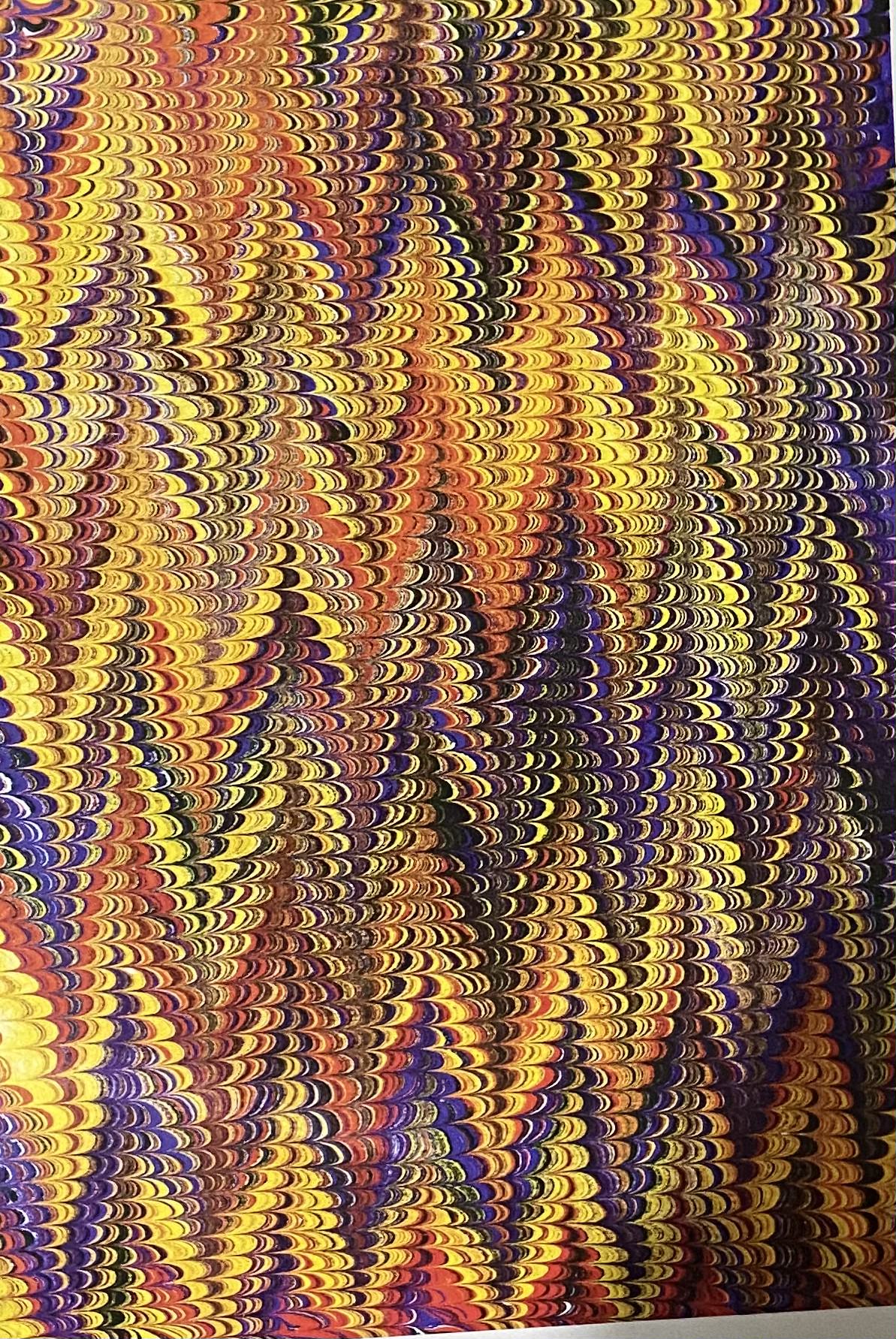
Ebru is Turkish marbling: pigment floated on water, shaped with combs and needles, then lifted onto paper in a single unrepeatable print. It looks like decoration until you notice what it does in real life. Patterns like these are hard to replicate exactly, which made them surprisingly useful anywhere authenticity mattered.

Ebru: a Turkish art that protected an empire’s paperwork
Most people meet ebru as a souvenir. Swirling color on paper. A hypnotic pattern on a bookmark, a bag, or a framed print. But in Ottoman Istanbul, ebru was not only a decoration. In the 19th century, it could quietly do something else: help reveal whether an official document had been tampered with.
This story fits naturally inside Turkey’s wider arts heritage, shaped by Anatolia as a crossroads where ideas traveled alongside trade routes and empires. Ebru sits right on that seam. It is a beautiful, tactile craft, and it also belongs to the world of archives, paperwork, and trust.
If you want the real version of ebru, not the gift shop version, Istanbul still has living places for it. A good starting point is Cafer Ağa Madrasa, and for paper, manuscripts, and the wider material culture around craft, the Turkish and Islamic Arts Museum.
What to call it in English
In English, the most common label is paper marbling, which is the umbrella term for marbling traditions across Europe and beyond.
When you want to be more specific, Turkish marbling is the most accurate everyday label for ebru. The word marbling on its own is a little vague, since it can also describe stone or food patterns, so most writers simply specify paper marbling.
What is ebru, and why is it special

The name ebru is often linked to Persian, a nod to how pigment spreads on water in cloudlike veils. Its deeper origins are debated, with different traditions pointing toward India or Central Asia. But what matters for travelers and readers is the result: a technique refined and popularized in Istanbul and the Ottoman world, now widely recognized in English as paper marbling or Turkish marbling.
Ebru is made by dropping pigment onto thickened water so it floats, then guiding the surface into patterns using simple tools like combs and needles. When the moment is right, a sheet of paper is laid onto the surface and lifted off, capturing the design in a single transfer.
Here is the feature that makes ebru more than a decorative craft. No two sheets are identical. An experienced hand can control the flow, but recreating the same marbling twice is effectively impossible. That non-repeatable quality is the quiet superpower of ebru, and later it is exactly what makes it useful in contexts where authenticity matters.
It also fits a wider Ottoman visual logic. Many traditional Turkish arts leaned into abstraction and pattern, especially in ornament and calligraphy. Ebru belongs to that same language: spiritual in mood, practical in effect, and instantly readable once you see it up close.

Why document security became urgent in the 19th century
By the 1800s, the Ottoman state was modernizing. Central administration expanded, bureaucracy grew, and records mattered more than ever, because paperwork became the state’s memory. If you want a physical anchor for that shift, Gülhane Park sits right in the middle of the modernization story, right next to the old imperial core.
When recordkeeping scales up, the risks scale up too. Ink can be erased or scraped. Numbers can be adjusted. Pages can be swapped, inserted, or quietly replaced. And once documents start deciding money, property, and status, the incentive is obvious.
In short, paperwork becomes power, and power attracts forgery. That is where ebru stops being only beautiful and starts being strategically useful.

How ebru worked like an Ottoman anti-forgery feature
This is where ebru’s non-repeatability stops being a fun fact and becomes brilliant.
When a page or a cover sheet carries a unique marbled pattern, it behaves like a visual fingerprint. Your eye does not need a lab. It just needs continuity. And continuity is exactly what forgery struggles to fake.
Erase the writing: scraping or washing the ink damages the marbling underneath. The surface tells on you.
Replace a page: you cannot reproduce the continuation of the original marbled flow. The pattern break is obvious.
Insert a new sheet: the new marbling will never match the surrounding pages, so the record loses its visual integrity instantly.
Over time, ebru could function like a silent security system, an authenticity check built into the paper itself. In a world of ledgers, signatures, and long administrative chains, that mattered. If you want a physical reference point for where that official world lived, think Topkapi Palace, not only as spectacle but as the kind of place where documents were the spine of power.
That is the twist we love most. A craft celebrated for beauty also helped protect the state’s memory, its registers, continuity, and trust.
Where to experience living ebru culture in Istanbul today
If you want to see this tradition alive—not behind glass—there’s a peaceful place in Sultanahmet that feels like stepping into a quieter Istanbul:
Cafer Ağa Madrasa, Caferağa Medresesi

Built in 1559 and attributed to Mimar Sinan, Cafer Ağa Madrasa sits in Sultanahmet, just steps from Hagia Sophia. It began life as an Ottoman school, but today it feels like something rarer: a working arts courtyard where craft is still practiced instead of only displayed.
Inside, the layout does the emotional work for you. A quiet courtyard. Small domed rooms turned into ateliers. Artists focused on calligraphy, ebru, tezhip, ceramics, and miniature art. You can walk in off one of the busiest tourist corridors in the city and, within minutes, be watching heritage get made in real time.
If you want one calm, human Istanbul moment to balance out the monuments, this is it.
Ebristan Istanbul Ebru Evi

If Cafer Ağa feels like a quiet courtyard tucked inside history, Ebristan feels like a home devoted entirely to marbling. Here, the craft is the main character. You see the working reality of it: bowls, pigments, papers drying, and the calm rhythm of a studio that is actually producing, not posing.
It sits on the Asian side in Üsküdar, close to Salacak. That location is part of the point. You cross the Bosphorus, you slow down a little, and the day starts to feel softer and more local almost immediately.
If you want to understand ebru as a living practice rather than a souvenir aesthetic, this is one of the best kinds of places to do it.

A working ebru workshop in Sultanahmet, hands-on, not just watching
Sometimes, the most alive encounter with ebru is the simplest one. You sit at the table. You watch a short demo. Then you try it yourself. Around Sultanahmet, a few long-running ateliers offer compact sessions where you learn the basics of the craft in real time, not as theory.
You see how the colors behave on thickened water, how a comb turns chaos into rhythm, and how the paper captures one exact moment that you cannot recreate. The point is not to become an expert in two hours. The point is to leave with the physical feeling of how the tradition breathes, and a sheet you made with your own hands.
If you are already doing an Old Town day, this kind of workshop fits naturally into the same area and gives the monuments a different texture. Here is the broader route context if you want it: Istanbul Historic Highlights Tour in Old Town.

Müze Gazhane in Kadıköy, a culture complex with public ateliers
For a completely different Istanbul setting, head to Müze Gazhane in Kadıköy. It is a revived industrial space turned cultural hub, with workshops and community events running throughout the year.
When ebru sessions are on, you will often find locals learning and practicing in a relaxed, contemporary environment. Less Ottoman nostalgia, more craft as a living urban habit. It is a clean reminder that heritage in Istanbul is not only preserved in the old city. It is also practiced in the neighborhoods.

Enstitü İstanbul İSMEK, where Istanbul learns its own crafts
If you want the strongest proof that ebru is genuinely alive, look at Enstitü İstanbul İSMEK, the city’s public learning network. These are not tourist demonstrations. They are real courses where Istanbul residents show up regularly, practice, and build skills over time.
Locations and schedules change by district, so you treat it like a living calendar rather than a fixed attraction. But the bigger point is simple and powerful. Ebru is not surviving as a souvenir. It is sustained as education, discipline, and community. If you want a travel day that leans into that living craft side of the city, our Istanbul culture tours page is the closest match in spirit.

Try ebru yourself: workshops in Istanbul
If you want the craft to feel real, do not just watch it. Sit at the table, see how the pigments move on water, and pull your own sheet from the tray. Ebru makes the most sense when you feel the timing, the tools, and the one-way transfer that makes every piece unrepeatable.
Airbnb Experiences for quick booking

- Learn Turkish marbling in Sultanahmet is the easiest Old City option if you want something short, clear, and close to the historic core. You usually leave with finished sheets you can pack flat. View experience.
- Once in a Lifetime Learn Turkish Marbling Art is a strong pick if you want a more atmospheric setting on the European side, closer to Galata Tower. Some sessions mention keeping multiple works and a certificate, and the vibe leans more toward a studio than a classroom. View experience.
- Learn Turkish marbling is another reliable option that often mentions a view and a private workshop feel. If you are staying near Eminönü or the historic peninsula, it can be an easy fit depending on the host location and the day. View experience.
Good non-Airbnb alternatives
- Highlights in Türkiye offer dozens of different types of workshops in multiple cities across Turkey. Their ebru workshops are streamlined and easy to to do.
- Galatart Ebru Atölyesi is a classic local studio option. Sessions tend to start with a quick grounding in materials and technique, then move straight into making your own pieces. See workshop program.
- Les Arts Turcs Istanbul Ebru Marbling Workshop is a straightforward, direct booking option if you prefer an arts studio provider rather than a marketplace listing. See workshop details.
The bigger takeaway: art does not only decorate sometimes it protects
Ebru is one of those traditions that gets richer the more you learn. Yes, it is beautiful. But it also shows how art can act like practical infrastructure, something that safeguards what a society records and remembers.
In Ottoman Istanbul, marbling could help protect the integrity of documents. In Istanbul today, it protects something else: living cultural continuity. The craft survives because people still practice it, teach it, and carry it forward as a daily habit, not only as heritage display.
Want to explore Istanbul’s living heritage with us
If you’re curious about the human stories behind Ottoman history and Istanbul’s traditional arts, we can build a day around your interests. Not a checklist. A route that actually feels like the city.
That can mean hidden workshops, calm courtyards like Cafer Ağa, and craft stops that are still alive in real neighborhoods. Let us know what you care about and how you like to move through a place, and we’ll shape the pacing and the layers accordingly.
If you want the simplest starting point, see our Istanbul tours page, then use the form below to share your dates and priorities.


