

Long before the postcards and hot air balloons, Cappadocia was the intellectual forge of early Christianity. In the 4th century, three brilliant friends used these rugged hills to argue God into words, defining the Trinity and reshaping the history of Western faith. Let’s explore the birthplace of how a billion people pray together.
Table of Contents
How Three Friends Sculpted Christian Doctrine

Long before Cappadocia became a landscape of fairy chimneys, cave hotels, and hot-air balloons, it was one of the places where Christianity learned how to speak about God. In the fourth century, the Roman world was divided by a question that could not be avoided: how could Christians call the Father, the Son, and the Holy Spirit divine without abandoning belief in one God?
The answer did not arrive fully formed in a council hall. It was argued through letters, sermons, friendships, rivalries, prayer, and long years of intellectual struggle across this rugged corner of Anatolia.
Cappadocian Fathers

At the heart of that struggle stood three men now known as the Cappadocian Fathers: Basil the Great, his younger brother Gregory of Nyssa, and their friend Gregory of Nazianzus. Each brought something different to the task. Basil was the organiser and builder of communities; Gregory of Nyssa was the philosopher who pushed Christian thought into new territory; Gregory of Nazianzus was the brilliant preacher whose words helped give the doctrine of the Trinity its enduring language.
This private journey follows that transformation through the landscapes that made it possible. We begin in the late Roman world of Sobesos, where Christianity was entering the ordinary rhythms of settlement, family, public life, and burial. We continue to Keşlik Monastery, where faith became an organised communal practice of work, hospitality, study, and worship. Finally, at Eski Gümüşler Monastery and a secluded hermit’s chapel, we encounter the visual and contemplative worlds that carried Cappadocian Christianity into later centuries.
This is not a standard church-and-fresco tour. It is an attempt to understand how a difficult idea about the nature of God became a lived civilisation—written into villages, painted onto stone, and sustained in silence among the valleys of Cappadocia.
Detailed Itinerary
This is a full-day journey (9AM to 5PM) through the landscapes where early Christianity moved from the streets of a Roman settlement into the shared discipline of monastic life, and finally into the silent, painted world of Cappadocia’s rock-cut sanctuaries.
- Christianity enters the Roman town →
- Christianity becomes communal monastic life →
- Christianity becomes contemplative and visual in the rock-cut world.
Rather than rushing through a checklist of famous sights, we follow a clear historical and spiritual thread. At Sobesos, Christianity enters everyday civic life. At Keşlik Monastery, it becomes a structured communal rhythm of prayer, labour, learning, and hospitality. At Gümüşler Monastery, it turns inward—expressed through frescoes, carved chapels, and the contemplative imagination that made Cappadocia one of early Christianity’s most distinctive landscapes.
Your guide will connect each stop to the world of Basil the Great, Gregory of Nazianzus, and Gregory of Nyssa, showing how the theological debates of the fourth century were never only abstract arguments. They shaped communities, institutions, artistic traditions, and ways of living that still survive in the valleys of central Anatolia.
Sobesos: When Christianity Entered Everyday Life
Our journey begins at Sobesos Ancient City, a little-known late Roman settlement hidden among the valleys south of Ürgüp.
This is Cappadocia before it became the famous landscape of cave churches and monastic retreats. Here, beneath the open sky, we encounter a real provincial town of the fourth century: a place of homes, bathing structures, meeting spaces, burials, mosaics, and gradually changing religious life.
Sobesos developed during the same age in which Basil the Great, Gregory of Nazianzus, and Gregory of Nyssa were redefining the intellectual and moral horizons of Christianity in Cappadocia. Their arguments about the Trinity were not unfolding in a distant abstract world. They belonged to the same Roman society represented here: communities negotiating power, wealth, sickness, family life, death, and the meaning of belonging.
The excavated remains reveal an important transition. A Roman settlement with baths and richly decorated spaces gradually became part of an increasingly Christian world. Chapels and church structures appeared; burial practices changed; crosses and sacred imagery began to enter the visual language of daily life.
At Sobesos, we begin not with monks hiding in the valleys, but with the ordinary people whose world made Cappadocian Christianity possible. This is where faith entered streets, homes, public buildings, and graves—before it was carried deeper into the rocks through the monastic communities we will encounter later in the day.
Keşlik Monastery: Where Theology Became a Way of Life
Rather than following the standard museum route, we enter Keşlik Monastery—one of Cappadocia’s most atmospheric and revealing monastic settlements.
This is not simply a collection of painted churches. Keşlik was once a complete spiritual world carved into volcanic rock: chapels, communal rooms, refectory spaces, monastic cells, storage areas, and a sacred spring, all arranged around the rhythms of prayer, work, hospitality, and shared life.
Here, the ideas associated with the Cappadocian Fathers become tangible. Basil the Great did not imagine Christianity as a private intellectual exercise or a faith lived in isolation. He envisioned communities shaped by discipline, service, learning, care for the poor, and a deep commitment to one another. In places such as Keşlik, that vision took physical form.
As we move through the complex, we explore how monastic life helped carry the theological world of fourth-century Cappadocia into later centuries. The debates over the Trinity may have begun in imperial cities, councils, and letters between bishops, but they were sustained in places like this: in communities where worship structured the day, scripture was repeated and remembered, strangers were received, and faith became a shared daily practice.
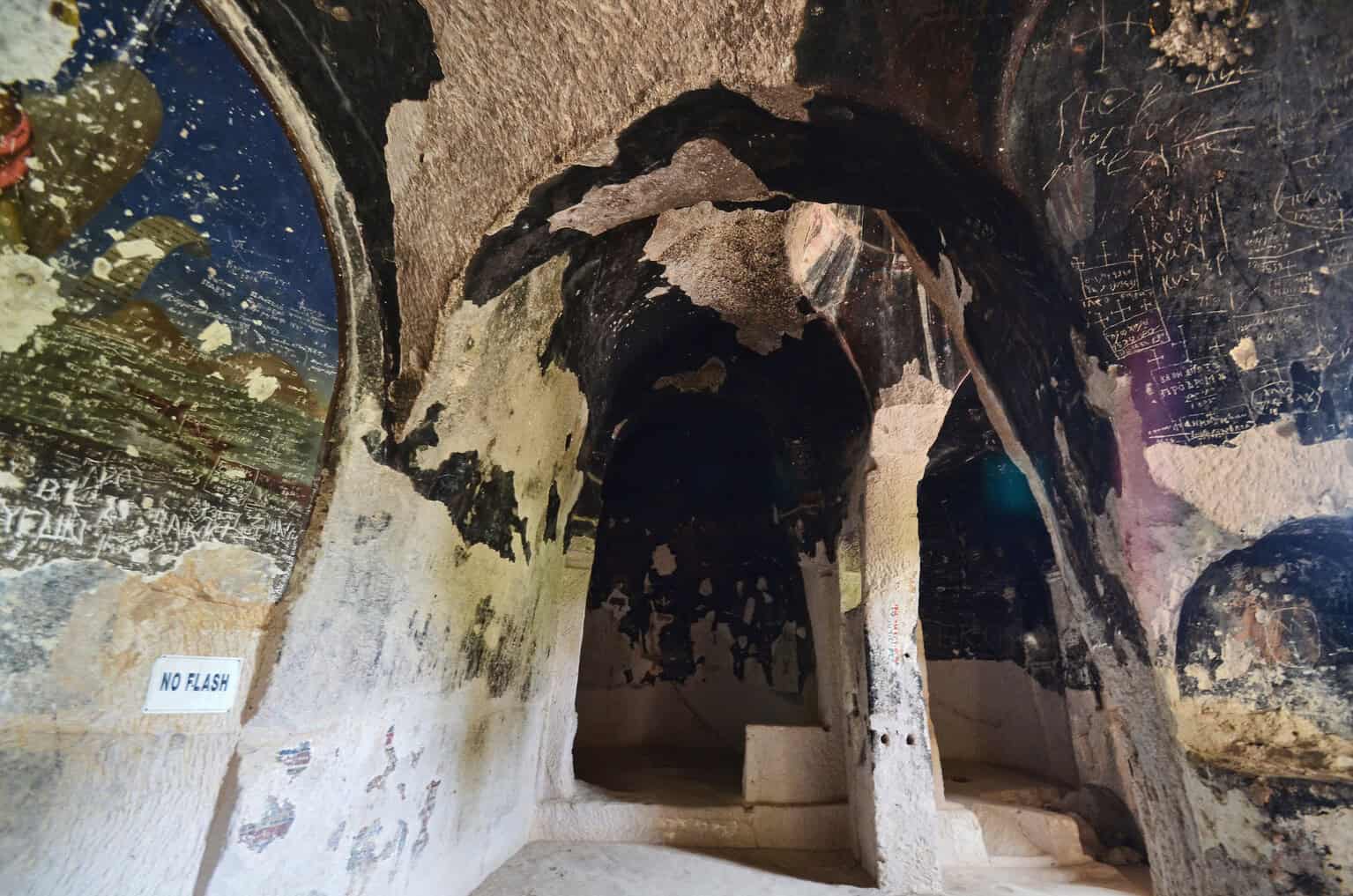
The Church of St. Michael preserves traces of this visual world through its surviving frescoes. Though faded by time, they still reveal how biblical stories, saints, angels, and sacred authority were made visible for a largely non-literate community. They are not merely artworks to admire; they are part of a complete religious language.
Keşlik allows us to step away from the crowds and understand Cappadocia not as an open-air museum, but as one of the great landscapes of early Christian life. Here, theology was not only argued—it was eaten, prayed, sung, worked, and lived.
Gümüşler Monastery
After lunch, we travel south to Gümüşler Monastery, one of central Anatolia’s most remarkable surviving rock-cut monastic complexes.
By this point in the day, the story has moved far beyond the Roman settlement at Sobesos and the communal discipline of Keşlik. Here, Christianity becomes increasingly inward, visual, and contemplative. Carved around a dramatic central courtyard, Gümüşler preserves chapels, living spaces, passageways, and painted interiors that reveal how faith was absorbed into the very architecture of everyday monastic life.
Inside, we encounter some of the region’s most memorable frescoes, including the Annunciation and the celebrated image of the Virgin Mary, whose unusually gentle expression has fascinated visitors for decades. These paintings were not simply decoration. They gave colour, form, and emotional force to the beliefs that theologians such as Basil, Gregory of Nyssa, and Gregory of Nazianzus had helped define centuries earlier.
At Gümüşler, doctrine becomes something that can be seen, remembered, prayed before, and carried into daily life. The carved rooms, quiet courtyard, and surviving sacred imagery show how Cappadocia’s Christian imagination matured: no longer only argued in sermons or organised through community, but experienced through silence, ritual, art, and the transforming power of place.
Reflection at Hermit's Cell

We close our journey in the absolute stillness of a small, secluded rock chapel as the sun begins to dip below the jagged horizon. Here, away from all modern noise, the entire historical narrative comes full circle.
In the quiet of a hermit’s private cell, we take a moment to reflect on the remarkable journey of a single, world-altering idea: words argued passionately in the halls of Caesarea, beautifully painted across the walls of Göreme, and lived out in deep devotion within these very rocks.
It is a peaceful, powerful moment to absorb how these stark hills transformed the spiritual landscape of millions before we make our way back to your hotel.
What's Included
The unstoppable multi-lingual guide who turns every Cappadocia tour into an unforgettable adventure.
Private Expert Guide: Full-day accompaniment by a licensed historian specializing in early Christian theology and Cappadocian history.
Luxury Transportation: Private, climate-controlled vehicle transfers throughout the entire itinerary, including pickup and drop-off at your hotel.
All Entry Fees: Skip-the-line admission tickets to the historic Göreme Open Air Museum, and the Eski Gümüşler Monastery.
Not Included
Premium Lunch Experience: The cost of food, alcoholic beverages, wine pairings, or any a la carte orders during our dining stop at the Michelin-selected restaurant in Uçhisar.
Hotel Accommodation: Lodging in Cappadocia before or after the day tour.
Discretionary Gratuities: Tips for your private guide and professional driver to show appreciation for exceptional service.
Personal Expenses: Souvenirs, bookstore purchases at the museums, or personal shopping during the tour.
Get in Touch to Book

The Cappadocian Fathers did not leave behind a single monument or a simple answer. They left a way of thinking: one that held together intellect and devotion, community and solitude, mystery and responsibility toward others.
Your journey into the deep history and breathtaking landscapes of Cappadocia is just a few details away. Whether you want to book this seamless day trip exactly as detailed or customize the timeline, private vehicle transfers, and premium dining choices to fit your personal travel style, our team is ready to orchestrate your perfect itinerary.
Please fill out the brief form below, and one of our dedicated private travel designers will reach out to you within the hour to begin tailoring your exclusive Cappadocian expedition.


