Standing at the edge of the Hippodrome, the Masonry Obelisk looks like a raw, scarred pillar of stone. But beneath its rugged limestone blocks lies a story of pure imperial pride, a tenth-century bronze makeover that rivaled the Colossus of Rhodes, and the scars of crusader greed. Let’s look closer at Istanbul’s ultimate architectural chameleon.
Table of Contents
The Architectural Illusion of New Rome
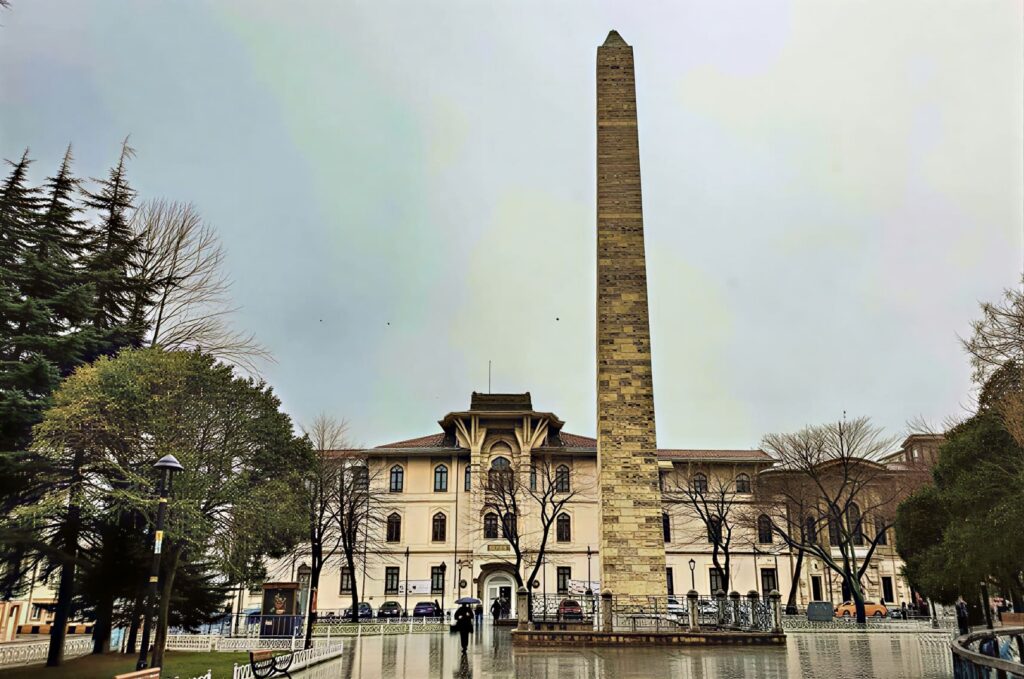
When Constantine the Great dedicated his capital in 330 AD, the Hippodrome was built to be the axis of the Roman world. Its spina—the central barrier—demanded grand monuments to project imperial power. In Roman tradition, nothing asserted dominance like an Egyptian obelisk. Yet, transporting a fragile monolith across the Mediterranean was a logistical nightmare that could take years.
Faced with an empty slot at the track’s southern end, Constantine refused to compromise on scale. If he could not import a mountain, he would build one. The result was a 32-meter facsimile constructed from limestone ashlar blocks. Matching the grandest monoliths of Rome, this masonry column was a masterclass in structural illusion.
It proved that New Rome would not wait for history to deliver its monuments—it would forge them from its own soil. For centuries, this stone pillar stood as a triumph of willpower, anchoring the chariot races through earthquakes and political transitions.
From Weathered Stone to Gilded Masterpiece
While raw limestone sufficed in the fourth century, six hundred years of weathering left the pillar degraded. By the tenth century, it was a fading shadow of Constantine’s vision, requiring far more than a simple restoration. Emperor Constantine VII Porphyrogenitus ordered a transformation that shifted the monument’s identity from a stone illusion into a blinding display of wealth.
He had the 32-meter structure sheathed in glittering plates of gilded bronze. The result was so dazzling that an inscription on the marble base, still readable today, boldly compared it to the Colossus of Rhodes. This golden age ended violently in 1204.
During the Fourth Crusade, Western forces breached the city walls and systematically stripped its wealth. The brilliant bronze plates were ripped from the Obelisk and melted down for currency, leaving behind the scarred, bare ashlar core that stands in the square today—a silent witness to imperial grandeur and wartime plunder.
Architectural Propaganda in Imperial Verse
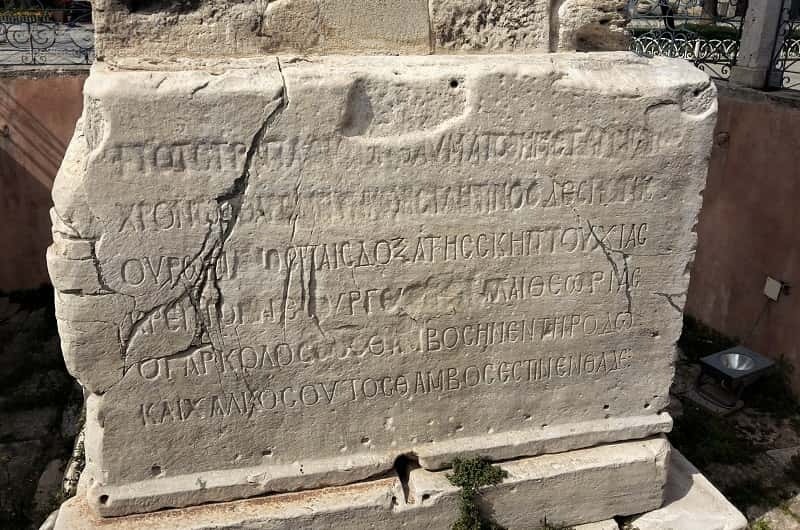
To ensure no spectator missed the political weight of his restoration, Constantine VII had an inscription carved directly into the marble base. Written in elegant iambic trimeter—the prestigious verse meter of classical tragedy—the text reads:
The four-sided marvel of the uplifted, wasted by time, now Constantine the Emperor, whose son is Romanus, the glory of the kingship, restores better than the ancient spectacle. For the Colossus was a wonder once in Rhodes, and this is now a brazen wonder here.
Constantine VII
That closing couplet is the core of the monument’s message. The Colossus of Rhodes—the legendary bronze giant that fell during a third-century BCE earthquake—was one of the Seven Wonders of the Ancient World. By branding the sheathed Masonry Obelisk a “brazen wonder,” Constantine VII executed a daring piece of architectural propaganda.
The claim was clear: Rhodes had a bronze man, but Constantinople has a bronze pillar. The pagan wonder belongs to the past; the imperial wonder stands proud in the present. It remains one of the most confident assertions of cultural dominance ever carved into stone, still legible on the base eleven centuries after the bronze itself vanished.
The Plunder of the Brazen Wonder
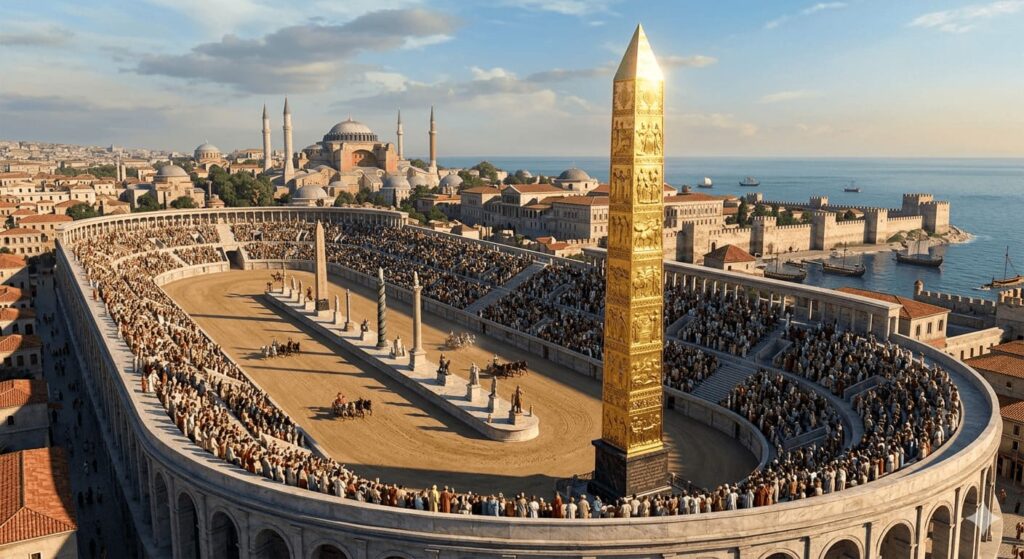
The brilliant bronze exterior that rivaled antiquity stood for just over two centuries before the city faced its darkest catastrophe. In 1204, the armies of the Fourth Crusade turned their weapons against the Byzantine capital, initiating a brutal, systematic sack of the metropolis.
Standing prominently at the southern end of the racetrack, the gleaming Masonry Obelisk became an immediate target for the invaders’ greed. To the crusaders, the masterful artistic sheathing was not a cultural marvel to be preserved; it was simply bulk bullion. Soldiers scaled the 32-meter tower, violently ripping the gilded plates from the limestone core.
The bronze sheets were thrown into furnaces and melted down into crude coins to fund the Latin occupation. When the fires finally cooled, the monument was left utterly naked. This structural violence left behind the deeply scarred, pitted ashlar tower we see today—a raw skeleton of stone standing as a permanent witness to wartime plunder.
Engineering Marvel Hidden Below the Surface

The story of the Masonry Obelisk does not end at its base; its very survival depends on the ground beneath it. Placing this massive monument at the far southern end of the racetrack presented a severe engineering crisis for the original Roman builders.
While the northern end of the Hippodrome sat on stable, level ground, the topography shifted toward the south, sloping sharply down toward the Marmara Sea. Because the racetrack had to remain perfectly level and adjoin the Great Palace, building along the natural contour of the hill was impossible. The Roman solution was a masterpiece of structural engineering: the Sphendone.
The Sphendone is an enormous, curved retaining superstructure built to extend the hillside, creating a massive artificial plateau for the racetrack. Initially constructed as an open colonnade of brick vaults, it underwent a dramatic evolution after an earthquake threatened its stability.
Engineers walled up the arches and added heavy buttresses, transforming the hollow space inside into a colossal, hidden cistern. Capable of holding up to 10 million liters of water, this subterranean reservoir kept the city hydrated while safely anchoring the roaring stadium above.
Discover the Hidden City
Today, the Masonry Obelisk stands as a stark, weathered column at the edge of Sultanahmet Square. Stripped of its gilded bronze plates, its bare limestone blocks bear the deep scars of the Fourth Crusade—a raw, architectural notebook detailing both the peaks of imperial ambition and the violent realities of history.
It stands as a powerful monument to survival, anchoring the ancient racetrack and the memory of a city that built its own wonders. Yet, walking past these ruins alone only tells half the story; to truly connect the surface monuments with the engineering triumphs hidden below, you must look beneath the standard tourist narrative.
We explore these deep layers, the obelisk’s long history, and forgotten political dramas on The Other Sultanahmet Tour. If you want to experience the authentic history of old Constantinople with us, please get in touch with us by filling out the form below.