Imagine standing on the walls of Constantinople in 1204, watching fellow Christians breach the city you thought was invincible. The Fourth Crusade was history’s ultimate bait-and-switch: an army sworn to reclaim Jerusalem that ended up burning the heart of the Byzantine Empire for Venetian gold. This is the story of how debt shattered Christendom.
Table of Contents
The Mirror of Heaven: Constantinople in 1204

For over eight centuries, Constantinople was the center of the known world, a metropolis of nearly 400,000 people at a time when Western capitals were dark, muddy outposts. To step through its gates in 1204 was to enter a living golden age. The skyline was dominated by the impossible dome of the Hagia Sophia, a cathedral so massive it seemed suspended from heaven itself, while bronze statues and marble forums lined the grand avenues.
Every luxury on Earth flowed into the bustling harbors. The air smelled of Egyptian spices, and the markets overflowed with Chinese silks, Persian tapestries, and piles of gemstones. Gold coated the holy icons in thousands of churches, filled the massive Hippodrome where chariot races still electrified the masses, and adorned the mechanical wonders of the Great Palace, where automated lions roared beside the imperial throne.
Protected by the triple-layered Theodosian Walls, the Byzantines believed their home was guarded by heaven. It was the “Queen of Cities,” a monument of Roman continuity and cultural brilliance. But this concentration of unimaginable wealth had a dangerous side effect: it made Constantinople the ultimate prize, an irresistible eye candy for an army of broke, desperate crusaders.
The Bill Comes Due: A Crusade Built on Debt
The Math Problem in Venice

The road to Constantinople began with a catastrophic miscalculation. In 1201, Crusader leaders contracted the Republic of Venice to build a colossal fleet capable of carrying 33,500 knights to Egypt.
The Venetians halted their entire economy for a year to construct the armada, demanding a staggering 85,000 silver marks. It was a flawless logistics plan on paper, but it relied entirely on every soldier showing up.
Stranded and Broke

When the army finally gathered in the summer of 1202, disaster struck. Only about a third of the expected knights arrived, the rest having sailed from other ports. They could only scrape together 51,000 silver marks, leaving them hopelessly short.
The Venetians refused to let the ships stir without full payment, leaving the Crusaders effectively stranded as hostages to their own astronomical debt on the swampy island of Lido.
The Venetian Hijacking
Enter Doge Enrico Dandolo, the blind and fiercely pragmatic leader of Venice, who saw an opportunity to weaponize this desperate, heavily armed debt.
Dandolo offered a chilling compromise: Venice would defer the bill if the Crusaders helped them sack Zara, a rebellious Christian city on the Dalmatian coast.
Broke and desperate, the knights accepted. The crusade was officially hijacked by its own ledger, setting a terrifying precedent.
The Fugitive Prince: An Offer Too Good to Be True
While the Crusaders reeled from the fallout of sacking Zara, a golden lifeline arrived in the form of a royal refugee. Prince Alexios Angelos, son of the deposed Byzantine Emperor, had escaped Constantinople in disguise. He tracked down the Crusader leadership with a desperate plea: help him overthrow his usurping uncle and reclaim the throne, and he would solve their mounting financial disasters.
The deal the prince laid on the table was breathtaking. If they placed him on the imperial throne, Alexios promised to pay them a staggering 200,000 silver marks—more than enough to clear their debt with Venice. Furthermore, he pledged 10,000 Byzantine soldiers to join their crusade, swore to maintain 500 permanent knights in the Holy Land, and promised to place the Orthodox Church under papal authority.
To the broke knights, this wasn’t an invasion; it was a holy mission of restoration. They convinced themselves that helping the rightful heir would secure the ultimate backing for Jerusalem. Doge Dandolo and the Venetians saw a brilliant opportunity to install a puppet emperor who would owe Venice his crown. With the stroke of a pen, the fleet turned away from Egypt and set sail for Constantinople.
The Breach and the Great Betrayal
The tragedy reached its breaking point when the Crusaders successfully placed young Alexios on the throne—only to find the imperial treasury completely empty. When Alexios tried to heavily tax his citizens to pay the foreigners, the locals revolted and assassinated him. Stranded outside the walls with no puppet ruler, no money, and no supplies, the Crusaders’ greed turned to raw desperation. They decided to take the city by force.
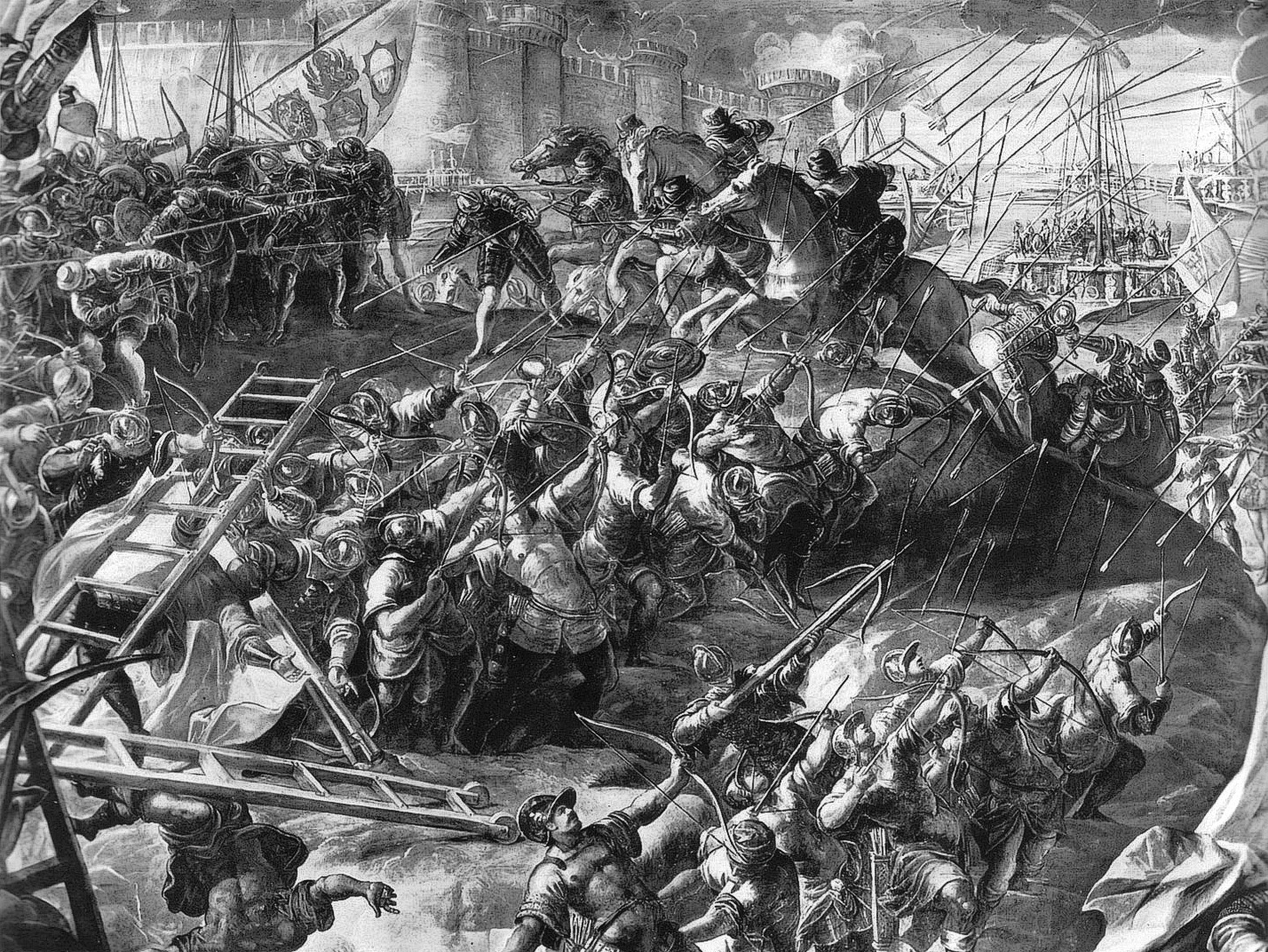
On April 12, 1204, the unthinkable happened: Venetian ships and French knights breached the northern sea walls along the Golden Horn. For three horrifying days, the army unleashed a brutal sack on the greatest Christian metropolis on Earth. A millennium of accumulated treasures was destroyed or looted; the Hagia Sophia was desecrated, golden icons were smashed for bullion, and priceless ancient statues were melted down into coins.
The Fourth Crusade never reached the Holy Land. Instead, the conquerors carved up the Byzantine Empire into a short-lived “Latin Empire” built on ashes. Though Byzantium eventually recaptured its capital decades later, the fatal wound was already delivered. The ultimate bait-and-switch of 1204 permanently fractured Christendom and left an irreversible scar on the history of the Bosporus.
The Aftermath: A Scar on History

The ripples of 1204 were felt long after the fires in Constantinople died down. The looted treasures of the Byzantine Empire quickly spread across Western Europe; most famously, the magnificent bronze horses that once adorned the Hippodrome were shipped back to Venice, where they were mounted on the facade of St. Mark’s Basilica as a permanent trophy of their triumph. Meanwhile, the displaced Byzantine elite fled to regional strongholds like Nicaea and Trebizond to plot their eventual return.
By the time the Byzantines finally recaptured their capital in 1261, the city was a ghost of its former glory. The population had plummeted, grand palaces lay in ruins, and the imperial treasury was permanently bankrupt. The sack had fundamentally broken the empire’s economic and military backbone.
By fatally weakening the primary Christian bulwark in the East, the Fourth Crusade unintentionally paved the way for the ultimate collapse of Byzantium to the Ottoman Empire two centuries later.
Explore Constantinople Legacy Next
The scars and stories of 1204 are still woven directly into the fabric of modern Istanbul. From the formidable remnants of the old sea walls along the Golden Horn to the timeless, enduring majesty of the Hagia Sophia, the echoes of the Byzantine Empire are waiting around every corner.
Walking these historic streets with a guide who understands the deep nuances of the past transforms the city from a bustling metropolis into a living, breathing chronicle of human drama, ambition, and resilience.
If you are ready to look beyond the surface and truly immerse yourself in the rich, complex history of the Bosporus, we would love to craft the perfect journey for you. Fill out the form below to connect with our local team, and let’s start designing an unforgettable, custom exploration of the ancient capital tailored exactly to your pace and interests.