• About
    • Introduction
    • Explore The Other Tour
    • 2026 Itinerary of The Other Tour Istanbul
    • Common Questions Answered
    • The Other Tour Reviews
    • About Us
  • Tour Guide
    • Istanbul
    • Cappadocia
    • Ephesus
    • Mediterranean
  • Daily Tours
    • Istanbul
    • Cappadocia
    • Antalya
    • Izmir
  • Istanbul
    • Attractions
    • Tours
    • Neighborhoods
    • Eat & Drink
    • Stay
    • Shop
  • Turkey
    • Turkey Tours
    • Destinations
    • Istanbul
    • Cappadocia
    • Ephesus
    • Pamukkale
    • Antalya
    • Bodrum
  • Services
    • Private Tours
    • Daily City Tours
    • Made-to-order Travel
    • Hire a tour guide
    • Unique Activities
    • Airport Transfers
    • Hotel Selection
    • Vacation Booking
    • Corporate Group Tours
    • Culinary Tours
    • Event Planning
    • Istanbul Layover Tours
    • Family Time
  • Blog
    • TOP 5 ISTANBUL
    • Events
    • Documentary
    • History
    • News
    • All
  • Contact
No Result
View All Result
  • About
    • Introduction
    • Explore The Other Tour
    • 2026 Itinerary of The Other Tour Istanbul
    • Common Questions Answered
    • The Other Tour Reviews
    • About Us
  • Tour Guide
    • Istanbul
    • Cappadocia
    • Ephesus
    • Mediterranean
  • Daily Tours
    • Istanbul
    • Cappadocia
    • Antalya
    • Izmir
  • Istanbul
    • Attractions
    • Tours
    • Neighborhoods
    • Eat & Drink
    • Stay
    • Shop
  • Turkey
    • Turkey Tours
    • Destinations
    • Istanbul
    • Cappadocia
    • Ephesus
    • Pamukkale
    • Antalya
    • Bodrum
  • Services
    • Private Tours
    • Daily City Tours
    • Made-to-order Travel
    • Hire a tour guide
    • Unique Activities
    • Airport Transfers
    • Hotel Selection
    • Vacation Booking
    • Corporate Group Tours
    • Culinary Tours
    • Event Planning
    • Istanbul Layover Tours
    • Family Time
  • Blog
    • TOP 5 ISTANBUL
    • Events
    • Documentary
    • History
    • News
    • All
  • Contact
No Result
View All Result

Yedikule Fortress: Istanbul’s Seven Towers and Three Empires

Where Roman stone meets Ottoman ambition — and a sultan lost his life to his own soldiers.

TheOtherTour by TheOtherTour
July 4, 2026
in Byzantine Empire, History, Istanbul Attractions, Istanbul Museums, Istanbul Travel Blog, Ottoman Empire, Roman Empire, Specials
Reading Time: 16 mins read
A A
0

Seven towers rise above the Theodosian Land Walls at the southwestern edge of Istanbul, and for the first time in decades you can walk beneath all of them.

Yedikule Fortress — the Ottoman stronghold folded around the ceremonial Golden Gate of Constantinople — is both an archaeological monument and a live restoration site. Most visitors read the plaque by the entrance and move on.

The history is in the stone itself: conical tower-roofs coming back one by one, dungeons unsoftened for anyone’s comfort, and a threshold, empires fought to possess still underfoot.

Table of Contents

A City Built on Prophecy & Stone

Stand at this gate long enough and Istanbul narrows to a single point: one arch, two empires and eight centuries that waited for a prophecy to come true.

The city carried the name “Queen of Cities” — with a reputation as a refuge for strangers — long before its skyline held a single minaret. For eight hundred years, a saying attributed to the Prophet Muhammad promised that Constantinople would fall to “a wonderful commander and a wonderful army.” In 1453, Mehmed II, “the Conqueror,” made good on it.

The Byzantine city came first, Constantine the Great founded his New Rome here in 330; six decades on, a triumphal arch went up under Theodosius I. Justinian who also raised Hagia Sophia in 537 — a building no one has since managed to copy — and Empress Irene presided over a council in 787 that settled, for a time, how the empire understood its own icons.

Every one of those decisions is written into the brickwork around Yedikule: the place where a Roman triumphal arch quietly became an Ottoman stronghold. Without a guide standing in it with you, the transition is invisible.
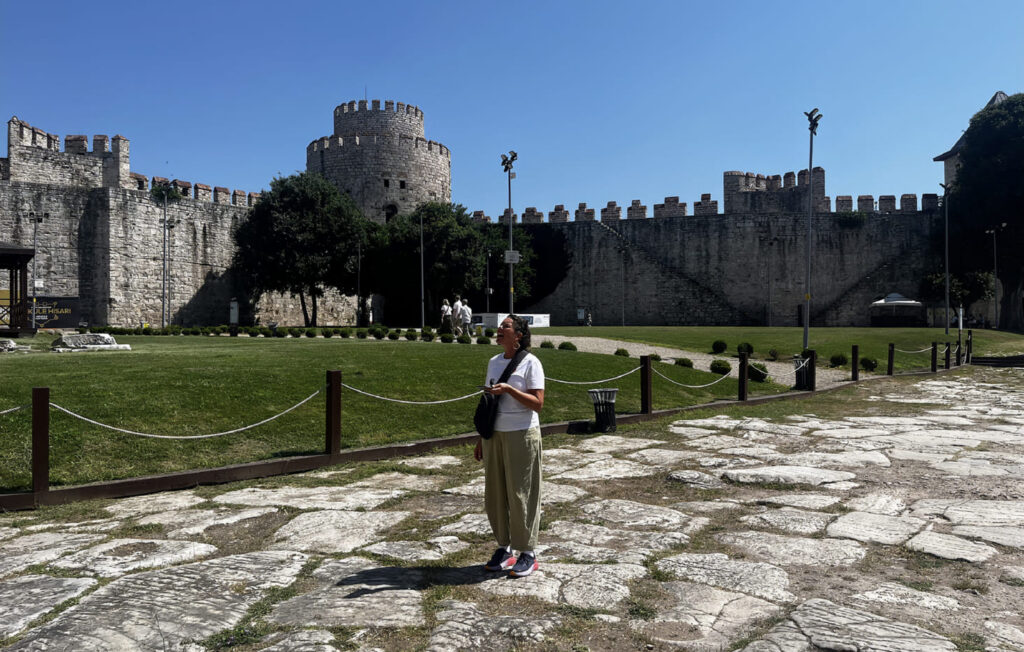
Visitor standing on the ancient Byzantine paved courtyard of Yedikule Fortress Istanbul looking up at the Ottoman round tower and crenellated walls

With one, you hear what Mehmed II understood the moment he commissioned the fortress in 1458: that repurposing a symbol of imperial entry is a more eloquent act of conquest than destroying it.

The Gate That Outlasted Two Empires

The Golden Gate is a triple marble archway raised by Theodosius I in 390 AD — the threshold through which emperors rode home victorious.
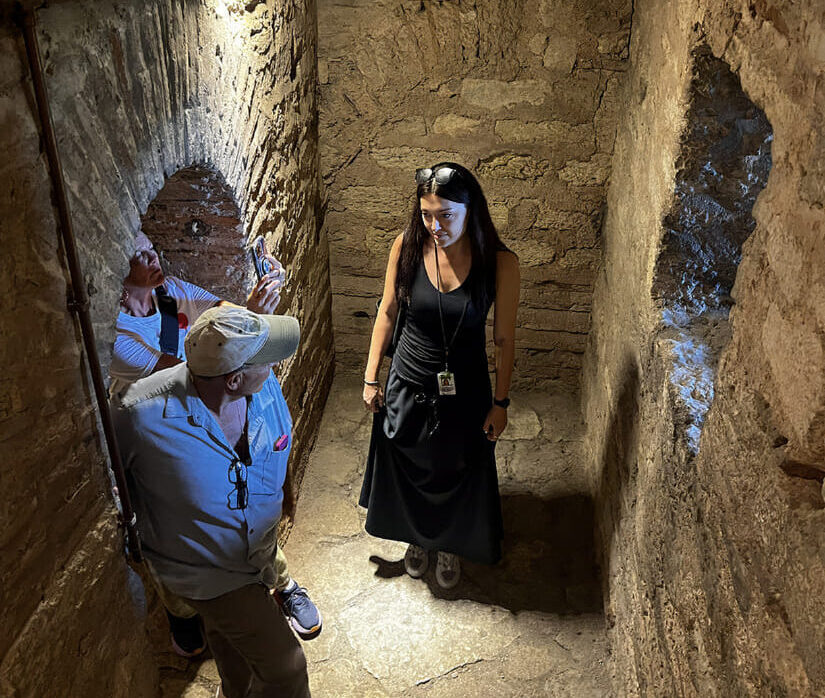
Tour guide and visitor inside a narrow stone dungeon corridor at Yedikule Fortress prison tower with stone walls and artificial lighting, archaeological survey markers visible

Mehmed II didn’t tear it down when he took the city. In 1458, he built around it, folding the sacred threshold into a new fortress and adding three Ottoman towers to the four Byzantine towers already standing, closing the whole complex into a near-pentagon. This is the version most visitors miss: a deliberate act of architectural argument — an emperor announcing that the city had changed owners, not vocation.

Yedikule then lived several lives at once: treasury, archive, and state prison. Ottoman storytellers understood exactly what they had here — a gate built for one empire’s victories, repurposed as the threshold of another. Stand inside and both empires are legible in the same stone. A private guide can show you which courses of marble are Byzantine and which are Ottoman additions; without that, the Golden Gate is impressive but mute.

The Vise That Closed the Straits

If Yedikule stages the moment the city’s keys changed hands, Rumeli Hisarı (1452) and Anadolu Hisarı (1394) show you how that moment was engineered months in advance.

Rumeli Hisarı
The symbol of Constantinople's conquest by the Ottomans
Read More
Anadolu Hisarı
Anatolian Fortress, a Byzantine-Ottoman battleground to a scenic Ottoman retreat, and a cultural legacy in Istanbul today.
Read More

Built facing each other across the narrowest pinch of the Bosphorus, the two fortresses cut Byzantine supply lines and announced Ottoman intent in stone nobody could misread. From the ramparts at Rumeli Hisarı you can still trace the sightline to Anadolu Hisarı across the water: two jaws of the same trap, built a lifetime apart, closing on the same city.

Visit Anadolu Hisarı, then Rumeli Hisarı, then Yedikule — the straits sealed first, the door closed last — and the strategy explains itself without a word of commentary. That sequencing is exactly what The Conquest of Constantinople Tour is built around: three sites in the order that makes the story cohere.

Inside the Walls & Towers

Cross the threshold and the temperature drops before your eyes adjust — thick marble and brick swallow the traffic noise behind you, moss furs the north-facing stone, pigeons scatter off ledges seven storeys up.
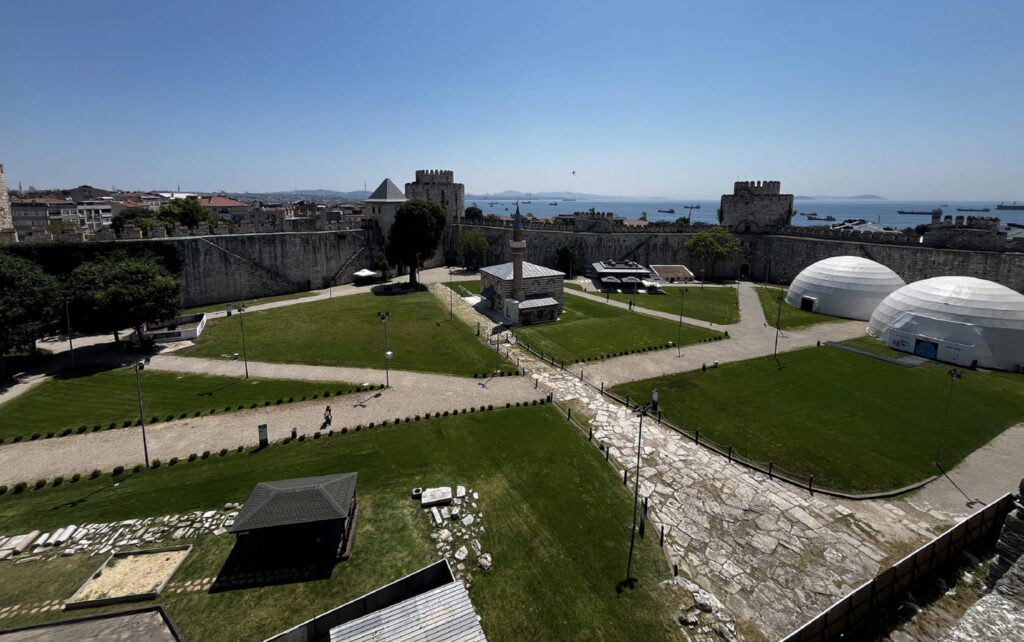
Aerial view from the wall walk of the full Yedikule Fortress compound showing courtyard, Ottoman mescit, event dome, towers, and the Sea of Marmara with ships beyond Istanbul

The Golden Gate had already hosted the ceremonial entrances of emperors like Heraclius and Michael VIII Palaiologos long before Mehmed II arrived, and when he commissioned the fortress in 1458, he built on the bones of an earlier fort raised by John V Palaiologos. The layering is physical — you can put your hand on the seam — and most visitors walk through it without realising they’re reading four centuries of construction stacked in one wall.
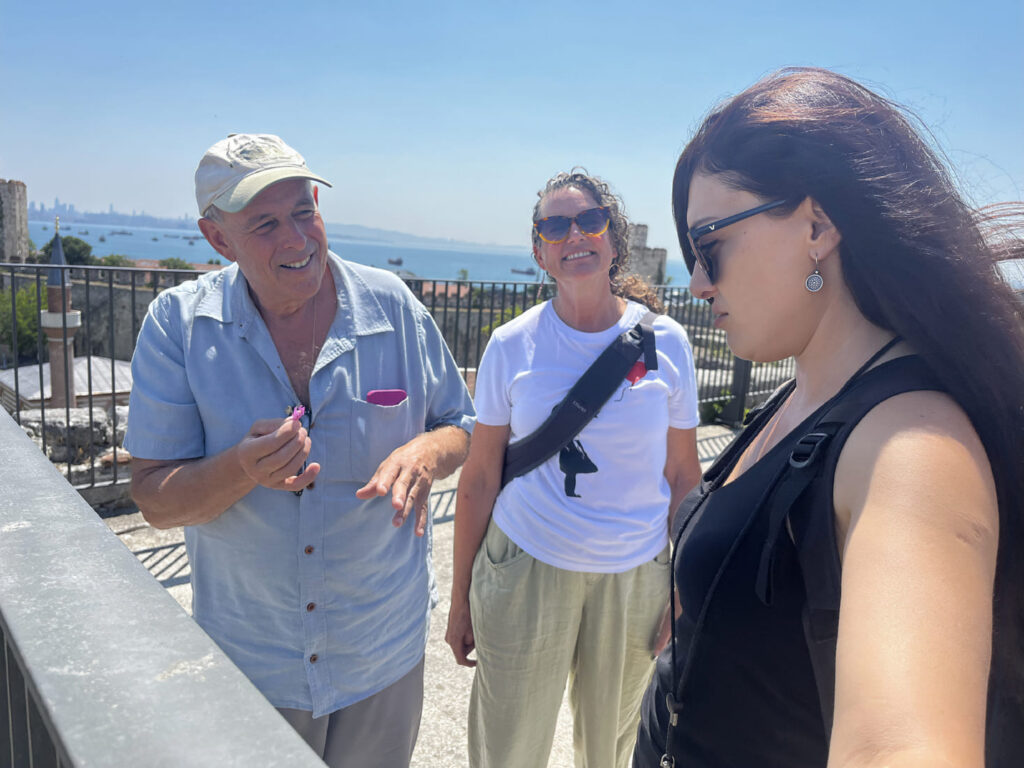
Tour guide and two visitors laughing together on the Yedikule Fortress wall walk with a round Ottoman tower and the Sea of Marmara visible behind them

A small domed mescit, traditionally attributed to Mehmed II, still marks the fortress’s central axis. Beneath your feet, the old Mese road — Constantine the Great‘s original thoroughfare — still runs toward the Golden Gate, the same route a coronation procession would have taken. Look down in the courtyard: a 1,500-year-old Byzantine sidewalk runs alongside an Ottoman-era road from the time of Mehmed II — two empires’ worth of foot traffic, layered a few feet apart. That detail alone is worth the entrance fee, and it’s the kind of thing you walk straight past without someone to point at the ground and explain what you’re standing on.

Treasury, Prison & Legend
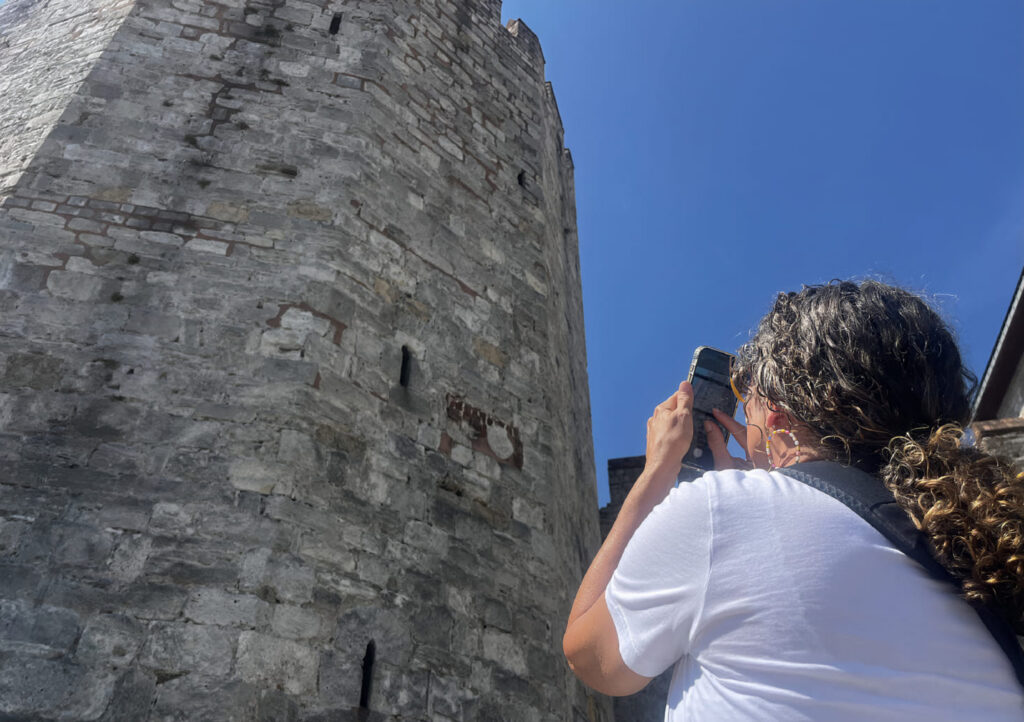
Visitor photographing the exterior of an Ottoman tower at Yedikule Fortress Istanbul from directly below, blue sky behind

Yedikule began as an imperial treasury, guarding documents, weapons, and precious metal behind seven towers nobody could breach easily. It didn’t stay that way. Over time the fortress became a state prison for the empire’s most dangerous guests: ambassadors of rival powers, palace rivals, political prisoners who knew too much or wanted too much. The walls absorbed all of them. Some walked back out; others didn’t.
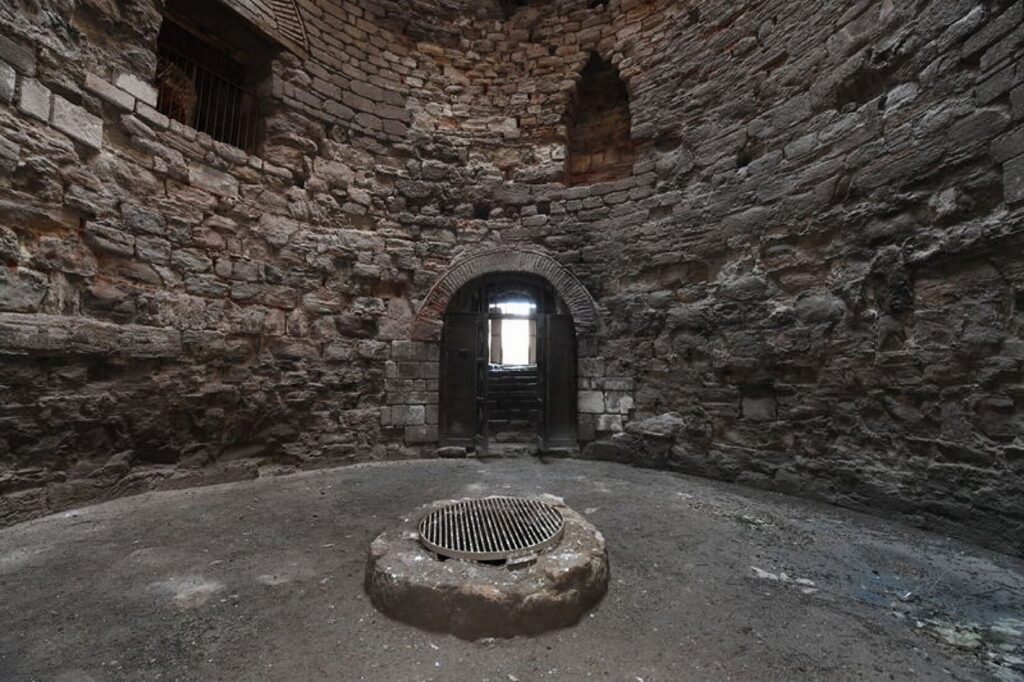
The room which Osman II was executed

The darkest chapter belongs to Osman II, imprisoned and executed here in 1622 in what is still called the Young Osman Tower — a young sultan brought down by his own janissaries, inside the very walls built to keep enemies out. The dungeons are still open, plain stone and a sober reminder that capital cities defend themselves with fear as much as with walls. The Ottoman Empire’s most notorious state prison eventually became a literary source: Ivo Andrić‘s The Damned Yard (1954) drew directly on Yedikule’s carceral memory to explore fate, power, and confinement.

The Young Osman Tower doesn’t need a sign — the stone tells you.

Watching a Fortress Come Back

Between 2020 and 2025, under İBB Miras and Fatih Municipality, Yedikule became Turkey‘s first major restoration site open to visitors mid-repair — you walk in while conservators are still working, not after the scaffolding comes down. If that sounds like a reason to wait, consider the reverse: the half-repaired state is the draw. You see the craft at close range — lime mortar being worked back into joints, five conical tower-roofs rising one course at a time from archival drawings — and the scaffolding belongs to the story as much as the stone beneath it. The finished version will have crowds that these first years of access have never seen. What’s here now is a working monument, and access like this is genuinely rare.

The craftspeople working on it joke that they’re giving the fortress its hats back. It’s a good line, and it’s accurate: Yedikule is lifting its head toward the Sea of Marmara again after a very long time looking abandoned. The surrounding Yedikule neighbourhood has changed with it — cafés and market stalls now sit where the walls once stood in near-total isolation, and the walk from the nearest train station feels unremarkable at any hour.

What You Can Actually Walk Through

The towers are massive enough that the walkable walls between them feel like a genuine climb, and the courtyard holds the remains of the Ottoman mescit and its old fountain. From the ramparts, the Sea of Marmara opens in three directions, and on clear days you can trace the full arc of the Theodosian Land Walls running north toward the Golden Horn. That view — the walls, the sea, the city compressed into a single skyline — is the one most visitors recognise from postcards rather than earn from the top of a tower they climbed themselves.
Tour guide serving fresh seasonal fruit to clients inside a private air-conditioned transfer vehicle with ambient lighting

None of this demands much of your knees. The ramps are gentle, the towers have handrails where it matters, and families run the full circuit in under two hours. It rewards curiosity far more than fitness. The dungeons are open too, and a private guide can walk you through which tower held which prisoner, how long sentences ran, and why the Young Osman Tower carries that name — the detail that turns a plain stone room into a coherent story.

One Day, One Change of Power
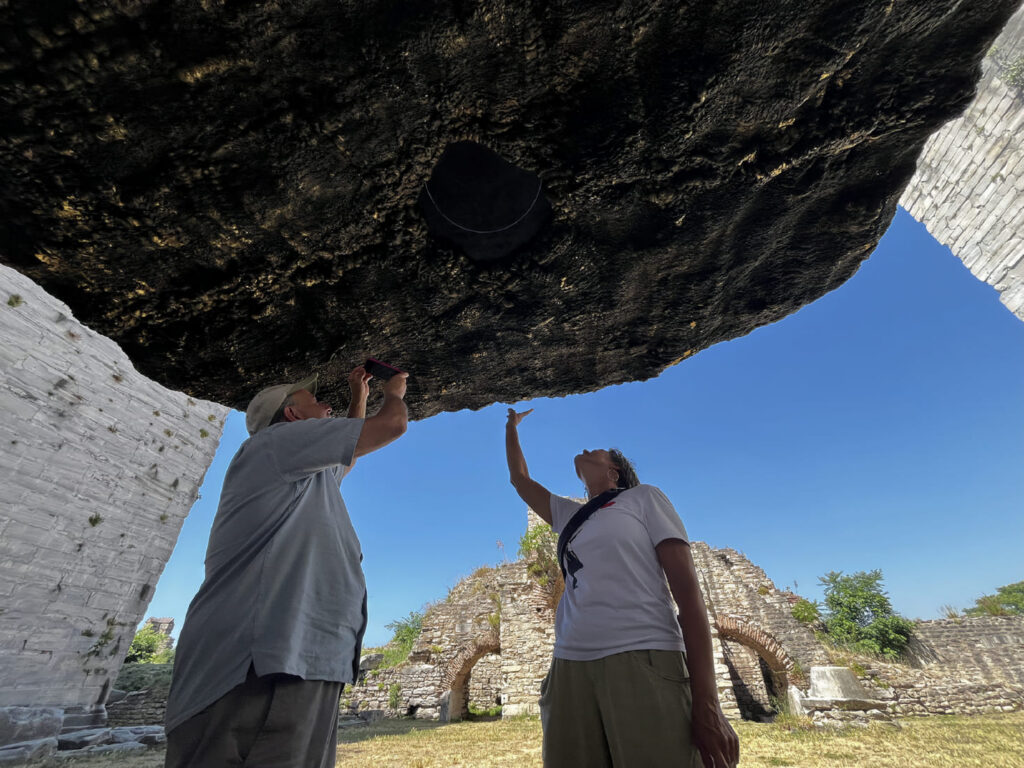
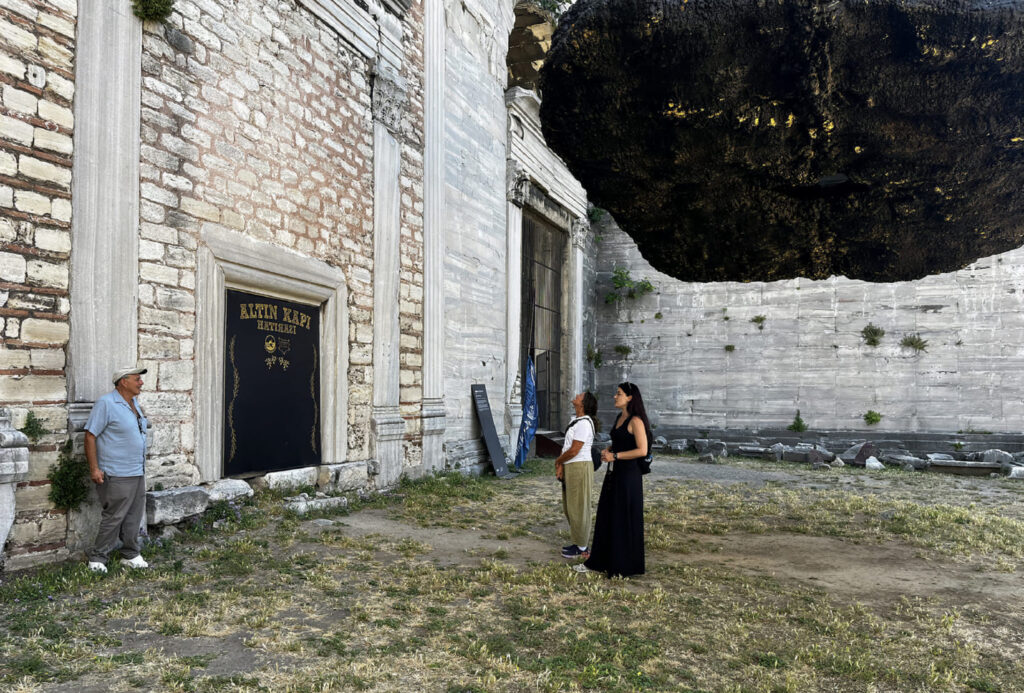
Tour guide photographing the underside of a large contemporary art installation at Yedikule Fortress while a visitor points upward at it, ruined Byzantine brick arches visible behind

Anadolu Hisarı, Rumeli Hisarı, and Yedikule are usually booked as three separate half-day stops, which is exactly why most visitors miss what connects them. Chain the three in sequence — the watch tower, its answering signal, the gate that closes the loop — and the story of how Mehmed II engineered the fall of Constantinople in stone, months before a single ladder went up against the walls, becomes a single legible argument.

The Conquest of Constantinople Tour is built around exactly this sequence — three sites, water crossings, and timing calibrated for good light and thin crowds rather than a coach tour’s schedule.

We had a guide from The Other Tour and I will say this: I would not have found the seam between the Byzantine and Ottoman stonework on my own. It looks like one wall until someone puts their finger on the exact line where one empire ended and the other began. We spent about two and a half hours on site, which was right. The neighbourhood around the fortress is also worth a short walk — there is a small tea garden near the station that is not on any list.
Luca F.Italy
I have been to Turkey twice and somehow never visited Yedikule until last spring. The restoration scaffolding put me off at first — I almost didn't book — but it turned out to be one of the more interesting things about the site. Watching workers re-pointing stones that have been there since Mehmed II is not something you see every day. The prison tower is bleaker than I expected, in a good way. The view from the wall walk over the Marmara was completely new to me.
Ema T.Bosnia and Herzegovina
I visited alone on a Tuesday in November and had most of the place to myself after 14:00. The audio guide they give you at the entrance is not very good — thin on the Ottoman period and says almost nothing about the prison. But the site itself compensated. The light through the tower windows in the afternoon is worth the trip alone. Would have given five stars with better on-site information, which is why I would now recommend booking a guide in advance rather than relying on what is provided at the gate.
Hana K.South Korea

Practical Tips

  • Opening Hours: Daily except Wednesdays, 09:00–16:30.
  • Tickets: 250 TL. Check 2026 entrance fees before you go, as prices shift year to year.
  • Guided Access: Free guided tours run on weekends; evening “Nostalgic Lantern” walks are available by reservation.
  • Getting There: Easiest by train from Sirkeci Station toward Halkalı — alight at Yedikule and the fortress is a five-minute walk.
  • Events: Concerts, exhibitions, and open-air programs now regularly animate the courtyards and walls — check the current schedule before visiting.

FAQ - Frequently Asked Questions

What is Yedikule Fortress and where is it in Istanbul?
Yedikule Hisarı — "Fortress of the Seven Towers" — sits at the southwestern corner of Istanbul, where the Theodosian Land Walls meet the Sea of Marmara. It was built by Sultan Mehmed II in 1458 around the Byzantine Golden Gate (390 AD), incorporating four existing Byzantine towers with three new Ottoman towers to create a single seven-tower compound. The result is one of the few sites in Istanbul where you can read both empires in the same stone.
Is Yedikule Fortress worth visiting?
Yes — particularly if you have any interest in the layers of Istanbul's history. The site combines the 1,500-year-old Golden Gate, active restoration works open to the public (rare anywhere in Turkey), the infamous prison towers including the Young Osman Tower where Sultan Osman II was executed in 1622, and a view of the Sea of Marmara from the wall walk. It is also significantly less crowded than Topkapi or the Hagia Sophia, which means you can move at your own pace. Two hours is enough to walk the full circuit; a private guide will fill a comfortable three.
What are the opening hours and entrance fee for Yedikule Fortress?
Yedikule is open daily except Wednesdays, from 09:00 to 16:30. The entrance fee is 250 TL. For the most current pricing — fees in Istanbul change regularly — check the 2026 entrance fees page before you visit. The site is managed by Fatih Municipality in coordination with İBB Miras (Istanbul Metropolitan Municipality Heritage); current restoration work is ongoing but does not restrict access to the wall walk or the main tower interiors.
How do I get to Yedikule Fortress by public transport?
The most straightforward route is the Marmaray suburban rail line from Sirkeci Station (central Istanbul, near the old Sirkeci Terminal). Alight at Yedikule Station; the fortress is a short walk uphill from the platform. The journey takes roughly 20 minutes from Sirkeci. There is no reliable bus route that drops you directly at the gate, so the train is strongly preferred. Taxis and ride-share apps also reach the site easily from Sultanahmet or Fatih.
How long does a visit to Yedikule take?
Allow at minimum 90 minutes to walk the full wall circuit, visit the Young Osman Tower, and take in the Golden Gate from inside the compound. Two hours is comfortable. With a licensed guide, expect closer to two and a half to three hours — the prison narrative, the architectural seams between the Byzantine and Ottoman construction phases, and the restoration story all take time to do properly. The site is not exhausting physically, but it rewards slow movement.
Is Yedikule Fortress accessible for families and visitors with mobility needs?
The ground-level circuit around the fortress interior is mostly flat and manageable for pushchairs and visitors with limited mobility. The wall walk — the elevated path running along the top of the Theodosian Land Walls — involves stairs and some uneven stone surfaces; handrails are present on the restored sections but not universal. The tower interiors include narrow spiral staircases that are not wheelchair-accessible. Families with young children manage the site comfortably; the 2hr circuit is not strenuous and has natural rest points at each tower.
What would I miss at Yedikule without a private guide?
Without a private guide, you will almost certainly miss the seam between Byzantine and Ottoman construction in the Golden Gate arch — it looks like undifferentiated stone without someone pointing to exactly where Mehmed II's bricklayers began. You will also miss the specific history of the prison towers: which ambassadors were held, which rivals executed, why the janissaries chose Yedikule for Osman II. The signage on site is minimal. The 1,500-year-old Byzantine sidewalk beside the Ottoman road is easy to walk past without knowing what you are standing on. A good guide turns a pleasant old fortress into something you will still be describing two weeks later.
What is the best time of year to visit Yedikule Fortress?
April–May and September–October are the most comfortable months — mild temperatures, reasonable daylight, and smaller crowds than the July–August peak. Summer visits are perfectly fine but the sun on the open wall walk between 11:00 and 15:00 is intense; bring water and a hat. Winter visits (November–February) are quiet and atmospheric — low light on old stone is genuinely beautiful — but check that restoration work has not temporarily restricted any sections, as İBB Miras sometimes closes tower access during intensive phases. The Wednesday closure applies year-round.
How does Yedikule connect to Rumeli Hisarı and Anadolu Hisarı?
All three fortresses are part of Mehmed II's strategic encirclement of Constantinople before the 1453 siege. Anadolu Hisarı was built by his great-grandfather Bayezid I in 1394 on the Asian shore; Mehmed added Rumeli Hisarı on the European shore in 1452 to close the Bosphorus to Byzantine supply ships. Yedikule, built after the conquest, was the architectural statement — the claim on the Golden Gate and everything it symbolised. Visiting all three in sequence, preferably in a single day with a guide who can hold the narrative thread, is the recommended approach. The Conquest of Constantinople Tour does exactly that.
Can I book a private guide for Yedikule Fortress through The Other Tour?
Yes. The Other Tour's licensed guides specialise in the Byzantine and Ottoman layers of Istanbul and can be booked for a standalone Yedikule visit or as part of The Conquest of Constantinople Tour (which includes Anadolu Hisarı, Rumeli Hisarı, and Yedikule in sequence) or The Walls of Istanbul Tour. Use the contact form on this page to tell us your dates — no deposit is required to hold a provisional slot.

Explore Yedikule with The Other Tour

Visitor photographing from the top of the Yedikule Fortress wall looking down at market gardens and citrus orchards between the inner and outer Theodosian Land Walls

A founder’s ambition, a triumphal arch, a council’s ruling on icons, a prophecy eight centuries in the making: none of it stayed in books. The details that make it cohere are exactly what most visitors walk past on their way to the next monument.

Tell us when you’re planning to come and how much of this story you want to cover — half a day on the straits and the gate, or a fuller circuit through Sultanahmet and beyond. We’ll build the timing around the light and the crowds, handle the ferries and tickets, and pair you with a guide who knows who was locked where, and for how long, and why the order you visit them in changes what the story means. There’s no deposit until you’re happy with the plan — just send us your dates and we’ll take it from there.

Explore More with The Other Tour
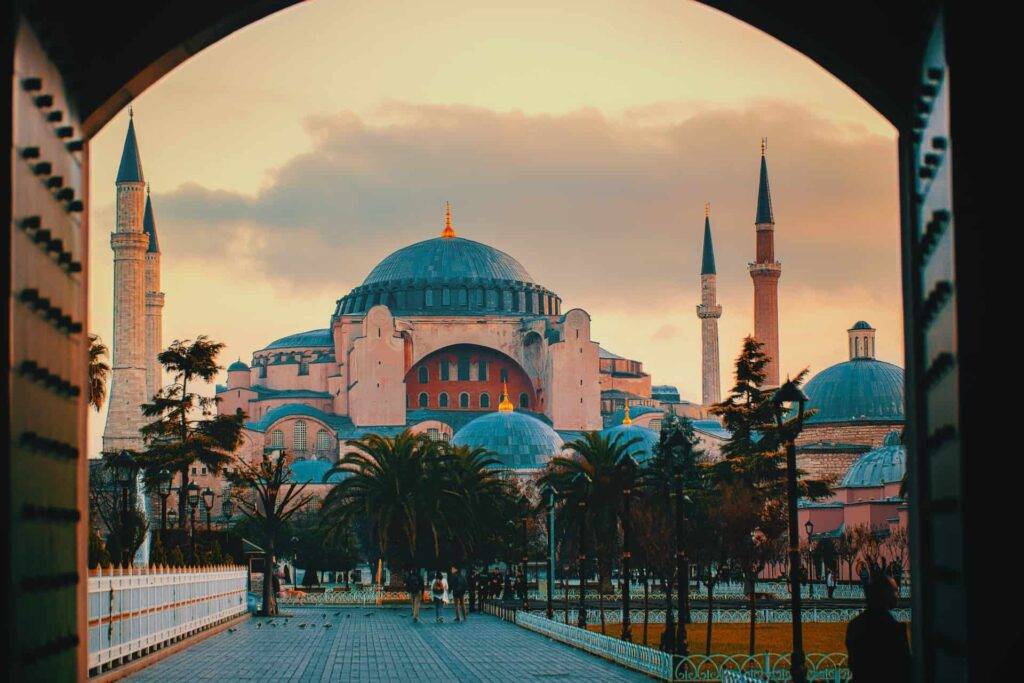
It’s a church. It’s a mosque. It’s Hagia Sophia.
Hagia Sophia is not only a masterpiece of Byzantine engineering and art, but also a symbol of imperial power and religious devotion.
Find Out More
A shot of a painting inside Istanbul Museum of Painting and Sculpture
Istanbul’s Best Museums
Istanbul is a city steeped in history and culture, with a wealth of museums to explore. Here are the city’s best museum that we recommend.
Find Out More
Exploring Istanbul’s Asian Side
Istanbul’s Asian side offers a unique perspective on the city’s history and culture, with its diverse neighborhoods and natural attractions.
Find Out More
Basilica Cistern – Istanbul’s Legendary Water Reservoir
Explore the Basilica Cistern: Medusa heads, James Bond filming spots, and skip-the-line tickets. Plan your visit with local experts!
Find Out More
Dolmabahce Palace – 19th Century Ottoman Imperial Grandeur
Dolmabahce Palace is a magnificent example of Ottoman-era architecture that has played a significant role in Turkey’s history.
Find Out More
The Grand Bazaar – World’s Most Popular Market
The Grand Bazaar is more than just a shopper’s paradise. It’s also a cultural landmark with a rich history that dates back to the 15th century.
Find Out More
Blue Mosque of Istanbul
The Blue Mosque
The Blue Mosque is a stunning example of Islamic architecture and an important cultural and religious landmark in Istanbul.
Find Out More
Topkapi Palace entrance 2026 - The Other Tour
Topkapi Palace
With its rich history, stunning architecture, and beautiful gardens, Topkapi Palace is a must-visit attraction of the majestic Istanbul.
Find Out More
Galata Tower from Barnathan (1)
Galata Tower – A Timeless Icon of Istanbul’s Skyline
Galata Tower stood tall in the city’s skyline for centuries, and it is a must-visit destination for anyone traveling to Istanbul.
Find Out More
spice bazaar
Spice Bazaar or Egyptian Market – Silk Road’s Final Stop
A true feast for the senses, visiting Istanbul’s Spice Bazaar (or Egyptian Market) is an essential part of any trip to Istanbul, Turkey.
Find Out More
Tags: Ancient CityArchaeologyArchitectureByzantine LegacyConstantinopleHistoryMuseumsOttoman EmpireOttomans
Share130Tweet81
TheOtherTour

TheOtherTour

Established in 2011, TheOtherTour has evolved from offering alternative city tours in Istanbul to becoming a trusted travel agency that provides top-quality services and curated travel experiences throughout Turkey. With 15 years of experience exploring the nooks and crannies of Istanbul, we delight ourselves in sharing the city's hidden gems, from underground art scenes to music schools and various intimate spaces. The focus is not just on showing you the sights but also on introducing you to the city's heartbeat, its people, and its unsung tales. We have tested and curated the best of what Turkey has to offer—be it boutique hotels, unique experiences, or cultural journeys. The company is committed to sustainable tourism, partnering with local artisans, guides, and businesses to offer an authentic experience that benefits communities as much as it delights travelers. Follow and join us for insider tips, exclusive reviews, and inspirational stories that will make your next journey truly unforgettable.

Related Posts

Photograhing the set of Ottoman mansions to the North of Kanlica - The Other Tour 2025
Istanbul Activities

Guided Tours in Rainy-Day Istanbul

Discover the best things to do on a rainy day in Istanbul: museums, cisterns, cozy cafés and bazaars. Plan your visit with experts!

Walls of Istanbul - Guided Istanbul Tour Itinerary - The Other Tour 2026
Istanbul Daily Tours

The Walls of Istanbul Tour

Discover Istanbul’s walls on a full-day tour linking Hippodrome, sea walls, aqueducts, Galata and Kadıköy across Roman, Byzantine and Ottoman history.

Late Medieval Istanbul Tour - The Other Tour Istanbul
Original Itinerary

Late-Medieval Constantinople Tour

Walk Istanbul’s Byzantine past—from Yedikule to Chora, tracing the fall of Constantinople and the dawn of the Renaissance by land and sea.

Zeyrek : Istanbul’s 12th-century Byzantine marvel
3-Day Tours

Empires of Istanbul: 3-Day Roman, Byzantine & Ottoman Tour

Explore Istanbul’s history on a 3-day private tour through Roman, Byzantine, and Ottoman landmarks and streets.

Topkapi Palace entrance 2026 - The Other Tour
Istanbul Attractions

Topkapi Palace

With its rich history, stunning architecture, and beautiful gardens, Topkapi Palace is a must-visit attraction of the majestic Istanbul.

Pera – Istanbul’s Window to the West
Daily Tours

Alexandre Vallaury’s Legacy in Istanbul Architecture

Explore Alexandre Vallaury’s iconic works in Istanbul, from SALT Galata and Pera Palace to the Archaeology Museums and Bosphorus mansions.

Leave a Reply Cancel reply

Your email address will not be published. Required fields are marked *

  • Is Istanbul Safe - Kadikoy - The Other Tour

    Is it safe to travel to Turkey in 2026?

    16 shares
    Share 2288 Tweet 1430
  • Istanbul Earthquake: A 2026 Update

    42 shares
    Share 1926 Tweet 1204
  • Exploring Istanbul’s Asian Side

    10 shares
    Share 824 Tweet 515
  • The Mystery of Turkish Language

    46 shares
    Share 682 Tweet 427
  • Top 10 Masterpieces of Turkish Cinema

    1608 shares
    Share 643 Tweet 402

Our Tags

Aegean Sea Ancient City Ancient Civilizations Archaeology Architecture Arts & Culture Asian side Best Tours in Turkey Bosphorus Byzantine Legacy Cappadocia Church Constantinople Cruise Culture Day trips Environment Ephesus European Side Events and Happenings Fun Hagia Sophia Historic Landmarks History Hotels Istanbul Istanbul Tours Istanbul travel Istanbul Trip Istanbul Visit Mediterranean Museums Nature Ottomans Recommendations Religion Reviews Sultanahmet The Other Tour Tour Guide Turkey Turkey Travel Turkish Cuisine Turkish Culture Water

About us

We offer a unique, immersive city tour experience in Istanbul that explores lesser-known areas, engaging participants in cultural activities like local home visits, market explorations, and Bosphorus cruises.

In addition to our signature tour 'The Other Tour', our travel agency also provides a variety of wheelchair-assisted guided tours, custom itineraries, and specialized tours covering historical, cultural, and niche interests like Jewish heritage, vegan spots, and bird-watching. We also offer transportation services with professional guides for a more personalized and flexible experience.

Newsletter

The Other Tour is an immersive way to experience Istanbul and the rest of Turkey, led by licensed local guides who take you beyond the tourist spots into the lived culture and quiet corners of Cappadocia, Antalya, Ephesus, Bodrum, and the Mediterranean. We also build personalized travel planning, private tours, and custom itineraries — crafted around what you’re actually curious about, in any region of the country.

Company

  • Explore
  • 2026 Itinerary
  • Services
  • F.A.Q.
  • Blog
  • Philosophy
  • About Us
  • Our Team
  • Clients/Past Tours
  • Contact

Our Services

  • Private Tours
  • Private Tour Guides
  • Event Planning
  • Airport Transfers
  • Made-to-order
  • Hotel Selection
  • Culinary Tours
  • Shopping Tours
  • Unique Activities
  • Accessibility-Assisted Tours

Turkey

  • Destinations
  • Istanbul
  • Cappadocia
  • Ephesus
  • Pamukkale
  • Bodrum
  • Antalya
  • Mediterranean
  • Eastern Turkey
  • Black Sea
  • Terms & Conditions
  • Privacy Policy
  • Jobs
  • Get in touch

© 2026 THE OTHER TOUR by BEFORE TRAVEL - TÜRSAB NO: 7651.

No Result
View All Result
  • Home
  • Explore!
  • The Other Tour
    • Introduction
    • 2026 Itinerary
    • F.A.Q.
    • About us
    • Reviews
  • Daily Tours
    • Istanbul
    • Cappadocia
    • Antalya
    • Aegean
  • Tour Guides
    • Our Tour Guides
    • Istanbul
    • Ephesus
    • Cappadocia
    • Mediterranean Region
  • Istanbul
    • Tours
    • Attractions
    • Neighborhoods
    • Food
    • Stay
    • The Bosphorus
  • Turkey
    • Turkey Tours
    • Destinations
    • Cappadocia
    • Ephesus
    • Pamukkale
    • Antalya
    • Bodrum
  • Services
    • Private Tours
    • Daily City Tours
    • Made-to-order Travel Planning
    • Unique Activities
    • Hire a tour guide in Istanbul
    • Layover Tours
    • Culinary Tours
    • Hotel Selection
    • Family Time
    • Event Planning
    • Corporate Group Tours
    • All Our Services
  • Blog
    • TOP 5 ISTANBUL
    • Read
    • Events
    • News
    • Turkey
    • Documentary
    • Turkish Food
    • Turkish Music
    • Istanbul Videos
    • All Categories
    • All Posts
  • Contact

© 2026 THE OTHER TOUR by BEFORE TRAVEL - TÜRSAB NO: 7651.