

Beneath the white marble of Ephesus lies a frozen secret. In 2022, archaeologists at Domitian Square uncovered a Byzantine commercial district sealed in thick ash in AD 614. Like an Anatolian Pompeii, this time capsule captures the exact afternoon an invading Sasanian Persian army extinguished the ancient city’s urban life forever.
Table of Contents
The Illusion of Permanence
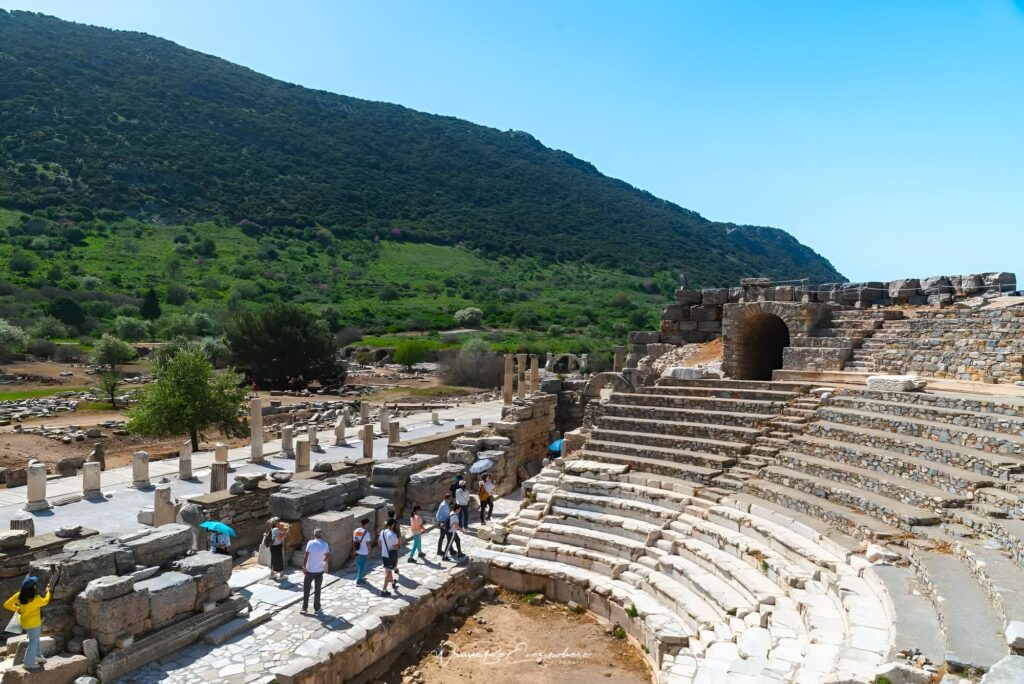
The postcard imagery of Ephesus is universally recognizable and deeply ingrained in the global cultural consciousness. Visitors are routinely greeted by sun-bleached marble columns, the grand two-story facade of the Library of Celsus, and the sweeping geometry of the Great Theatre cascading down the slopes of Mount Pion.
For the casual observer, these brilliant white ruins project an aura of classical permanence, presenting a static monument to Greco-Roman architectural supremacy. Yet, the true historical narrative of the metropolis is not one of static preservation, but of continuous, violent reinvention.
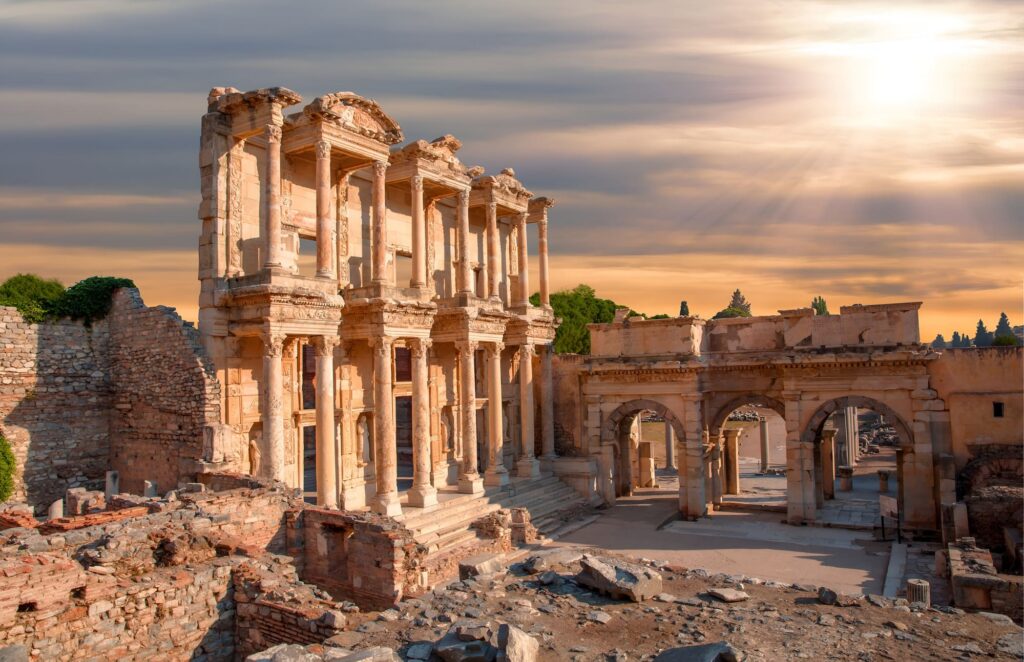
Beneath the polished marble avenues lies a tightly compressed stratigraphy marked by devastating earthquakes, shifting coastlines, and the consuming fires of imperial warfare.
For the dedicated historian, the most profound revelations at Ephesus are rarely found in its monumental architecture. They emerge from ordinary, easily overlooked corners of the city, hidden beneath layers of ash and debris.
In 2022, an excavation led by the Austrian Archaeological Institute (ÖAI) at Domitian Square pierced the Late Antique strata to reveal a time capsule of unprecedented preservation: a thriving early Byzantine commercial and gastronomic district that was utterly destroyed and sealed in a single, catastrophic military event in AD 614.
A City Reinvented: Byzantine City of Ephesus
To understand what was lost in the fire of AD 614, one must first understand the city that burned. By the early seventh century, Ephesus was no longer the sprawling maritime powerhouse of the Augustan age. The Küçükmenderes River had relentlessly deposited silt into the harbor for centuries, pushing the coastline westward and crippling heavy commercial shipping.
The Pilgrimage Economy of the Theotokos

To compensate for the loss of maritime trade revenues, Byzantine Ephesus adapted by leaning heavily into its identity as a holy epicenter.
Following the Council of Ephesus in AD 431—which formally declared the Virgin Mary as Theotokos (God-bearer)—the city became a primary destination for Christian veneration.
A robust tourism and pilgrimage economy flourished, supported by a continuous influx of travelers visiting the Basilica of St. John and the shrines on Mount Koressos.
The Downsizing of Domitian Square
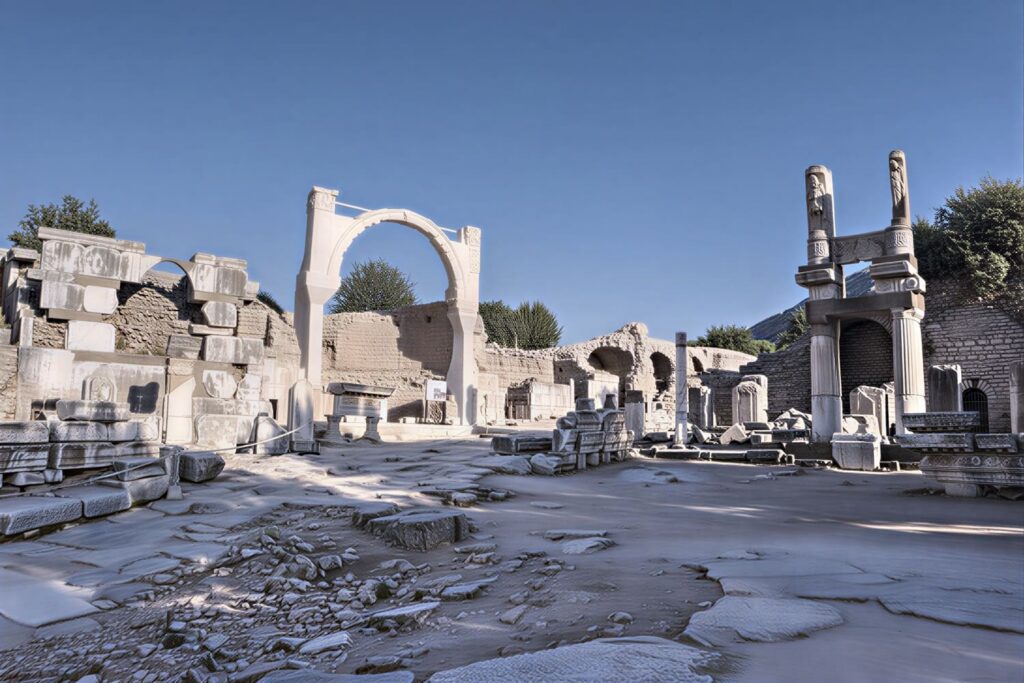
The civic center surrounding the Upper Agora and Domitian Square adapted to this new economic reality. The grand, open plazas of the early Roman period were gradually subdivided and built over with small-scale retail structures, artisan workshops, and taverns catering to Christian pilgrims.
It was a city scaling down its monumental grandiosity in favor of dense, functional commerce. This was the vibrant, bustling neighborhood that awoke on an autumn day in AD 614, unaware that a geopolitical storm brewing thousands of miles to the east was about to arrive at its gates.
The Byzantine-Sasanian War (AD 602–628)
The burning of Domitian Square was not an accidental fire—it was a direct casualty of the Byzantine-Sasanian War (AD 602–628), the “Last Great War of Antiquity.” Following the assassination of Byzantine Emperor Maurice, Sasanian King Khosrow II launched a devastating offensive against the Eastern Roman Empire.
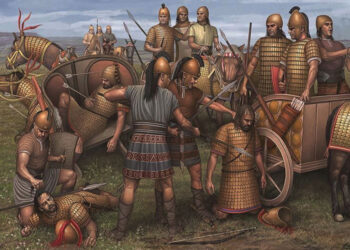
Utilizing elite heavy cavalry and mobile horse archers, Persian forces systematically dismantled Byzantine defenses across the Levant, sacking Jerusalem in AD 614 and seizing the True Cross.
With the Levant secured, the esteemed Sasanian general Shahin drove deep into Anatolia in AD 614, striking as far as Chalcedon—directly across the Bosphorus from Constantinople. During this march, Shahin detached military divisions to ravage the Aegean coast.
While historians long blamed Ephesus’s sudden seventh-century decline on earthquakes or harbor silt, the 2022 excavations provided definitive proof: Sasanian forces reached the western coast and put the city to the torch.
PhD-certified insider for Early Christianity and ancient ruins
ÖAI Excavations of Anatolian Pompeii in 2022
Here are all the details:
The 170-Square-Meter Time Capsule
In 2022, the ÖAI team focused on a 170-square-meter area in Domitian Square, situated at the transition point between the Upper Agora and the descent of Curetes Street.
Archaeologists expected to find standard Late Antique commercial encroachments. Instead, they broke through a dense, sealed lid of black ash to discover perfectly preserved rooms standing up to 3.4 meters high.
If you want to skip dry, scripted lectures for an energetic, laughter-filled exploration of Ephesus and St John Basilica, Ugur is the perfect pro guide!
The intensity of the fire had caused the upper floors and timber roofs to collapse instantly, trapping the ground-floor shops beneath an impermeable layer of rubble. This sudden burial prevented any subsequent scavenging of building materials or recovery of valuables, freezing the district in a state of suspended animation.
Ladstätter declared the site an “Anatolian Pompeii,” marking it as the most significant discovery at Ephesus since the unearthing of the Terrace Houses fifty years prior.
Excavating the Burnt Commercial District
Untouched Cockles and Salted Mackerel
The storeroom attached to the taberna contained ceramic jars filled with legumes and seasonal fruit stones, including peaches, almonds, and olives. The maturity of these specific fruit stones provided archaeobotanists with critical biological data, allowing them to pinpoint the exact season of the destruction to late summer or early autumn.
Large transport amphorae were also found packed with salted fish (salsamentum), which zooarchaeologists identified as Atlantic bonito and mackerel. The fact that half-eaten seafood dinners were abandoned mid-meal demonstrates that the citizens were killed or forced to flee in absolute panic during the course of a normal business day.
700 Christian Ampullae
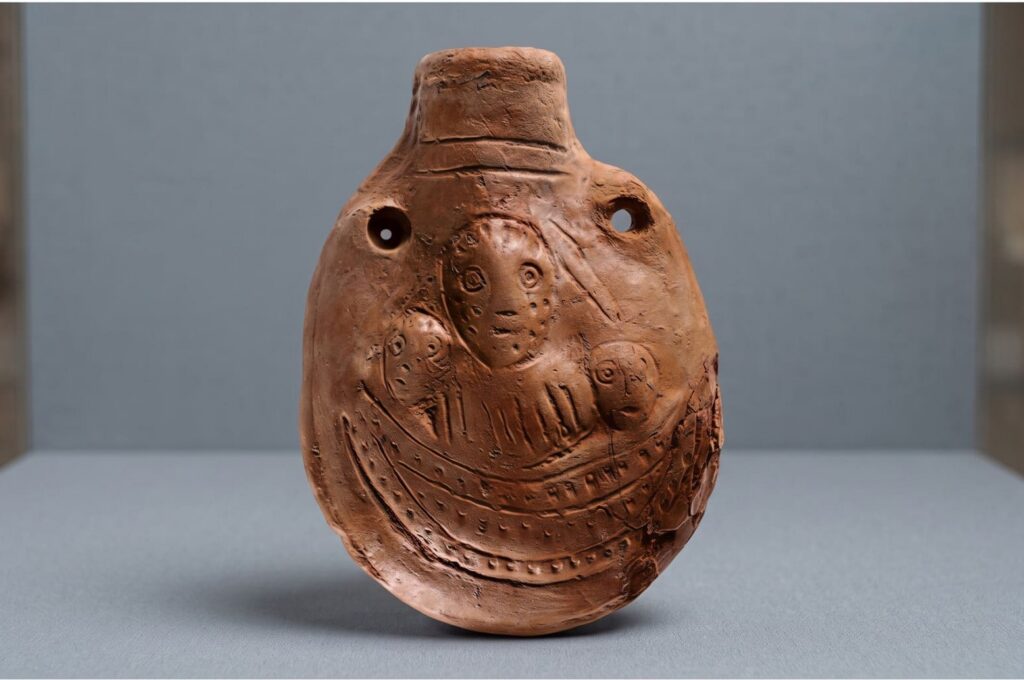
Adjacent to the cookshop was a specialized retail space catering to the city’s religious tourism industry. Excavators recovered hundreds of unused terracotta oil lamps alongside a massive inventory of Christian pilgrim bottles known as ampullae.
Between 600 and 700 of these small clay flasks were found stored in their original wooden shipping crates. Designed with loops to be worn around the neck, these vessels were sold to pilgrims journeying to the Basilica of St. John to hold holy water or blessed oil.
Finding such an immense cache of unsold inventory in a single shop unequivocally illustrates the industrial scale of the Christian pilgrimage economy in seventh-century Ephesus.
Abandoned Gold and Iron Arrowheads
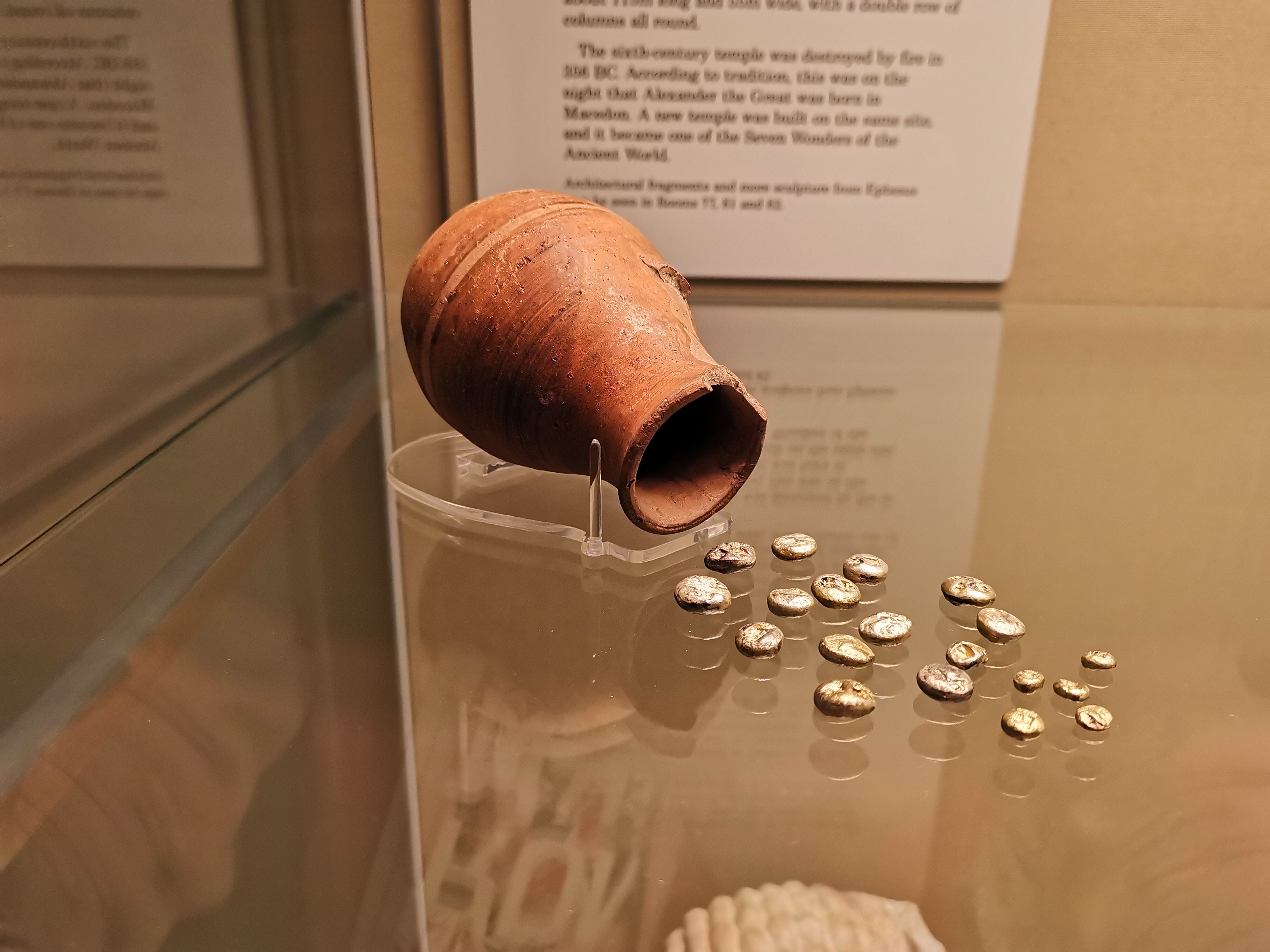
For archaeologists, coins provide the absolute chronology of a site. Within the burnt shops, researchers uncovered several copper money boxes containing the merchants’ daily earnings.
Over 700 copper coins (folles) were recovered, alongside a cash box containing four highly valuable gold coins (solidi). No merchant voluntarily leaves behind a day’s wages—let alone pure gold—unless facing immediate, unavoidable death.

Numismatists confirmed that the coin series runs continuously up to the early years of Emperor Heraclius’s reign, terminating strictly in AD 614. This provides a definitive terminus post quem that aligns flawlessly with historical accounts of General Shahin’s invasion.
To rule out an earthquake, structural engineers examined the excavated masonry. The walls showed no seismic cracking, tilting, or floor heaving. Instead, the ash layer was littered with deadly military hardware.
Excavators recovered numerous iron arrowheads and lance tips embedded in the collapsed masonry—the unmistakable signature of a violent Sasanian military assault.
Why Ephesus Never Recovered?
The uncovering of the Domitian Square time capsule finally solved the long-standing mystery surrounding the rapid seventh-century contraction of Ephesus. The AD 614 destruction layer proves that the city suffered a traumatic military shock from which its civic infrastructure could not recover.
While Emperor Heraclius eventually launched a daring counter-offensive that defeated the Sasanians in AD 628, the victory was pyrrhic. The Byzantine Empire was financially and demographically shattered.
Lacking the capital to rebuild the ruined commercial districts or dredge the rapidly silting harbor, the ancient Roman urban grid was left in ruins.
Just decades later, the weakened region faced new maritime incursions from the expanding Arab armies of the Islamic Golden Age. Seeking defensible ground, the remaining population abandoned the flat classical metropolis entirely.
They retreated to the steep, fortified heights of Ayasuluk Hill, clustering defensively around the Basilica of St. John. The marble avenues and burnt shops of Domitian Square were left to the encroaching silt and vegetation, safely entombing the AD 614 time capsule under four meters of earth for 1,400 years.
Get in touch for a guided tour

The ashes of AD 614 tell a story that cannot be fully grasped through standard guidebook summaries or crowded tour bus itineraries.
To truly comprehend the compressed stratigraphy of Ephesus—from the monumental Roman marble of the Library of Celsus down to the burnt Byzantine tills of Domitian Square—requires an unhurried, highly curated approach. We specialize in designing private, historically rigorous expeditions across western Anatolia.
Whether you are looking to integrate the latest Austrian Archaeological Institute discoveries into your itinerary, secure skip-the-line VIP access, or explore the ruins alongside premier regional scholars, our team handles every underlying logistical detail from Istanbul to the Aegean.




As a Classics student, I found this especially fascinating. The idea that Ephesus was simply destroyed in a single Persian attack in 614 is so often repeated that it begins to feel unquestionable, but this article shows how much more complicated the archaeological evidence really is.
I especially appreciated the distinction between dramatic historical narratives and what can actually be demonstrated through stratigraphy, coins, fire layers, and changes in the urban landscape. It is a good reminder that the decline of a city like Ephesus was rarely caused by one event alone.
I’ll be visiting Ephesus soon, and this has given me a much better framework for looking beyond the monumental Roman remains and thinking about the city’s transformation during Late Antiquity and the Byzantine period.
— John