
Ephesus rewards those who look past the postcard version. Beneath the famous Library of Celsus lie 2,500 years of history stacked century on top of century. For the history obsessives who travel with The Other Tour, the trench lines, ancient inscriptions, and ongoing archaeological mysteries are the real reason to come.
Table of Contents
Reading the Layers of Ephesus

Ionian Greek settlers founded Ephesus in the tenth century BC, but the ruins that draw modern crowds are mostly a later inheritance. Lysimachos re-founded the city on its present site in the third century BC, and the Hellenistic street grid still underlies much of what Roman engineers later paved over in marble.
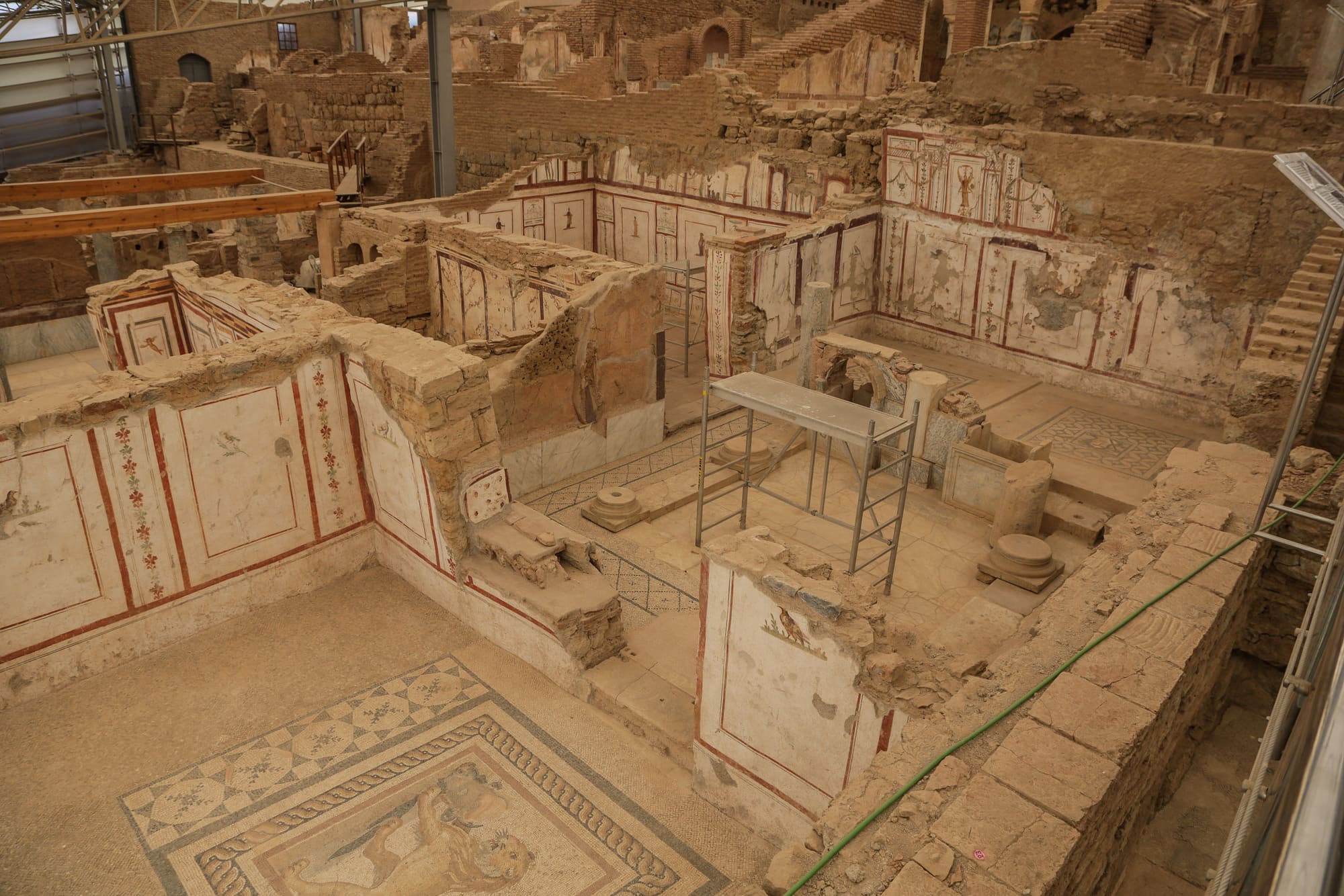
By the second century AD, Ephesus ranked among the wealthiest cities in the Roman East — a status its Library of Celsus and Terrace Houses still argue for today. Christianity arrived early and left just as deep a mark. Tradition ties the city to the apostle John and to the House of the Virgin Mary.
By the fifth century Ephesus had become one of the empire’s most important Christian sees — one of the Seven Churches of Revelation. Walking from a Hellenistic theatre to a Byzantine basilica in the space of an afternoon means walking through four distinct civilizations without leaving the site.
Stratigraphy & the Science Beneath the Stones

None of that layered history would be legible without careful excavation — and Ephesus has been dug, mapped, and re-mapped for longer than almost any other site in Turkey. The Austrian Archaeological Institute (ÖAI) began work here in 1895, and the dig remains Austria’s largest ongoing scientific project abroad.
Each layer of debris, ash, and rebuilt flooring is physical evidence of a specific century, and reading that sequence correctly is what separates an informed reconstruction from a guess. Excavation at Ephesus looks different today than it did a century ago.
Much of the current fieldwork relies on non-destructive geophysical prospection — ground-penetrating radar and magnetometry that map buried walls without lifting a single stone — reserving physical digging for small, targeted trenches where the questions demand it. The full record appears in the ÖAI’s own research series, Forschungen in Ephesos, now well over a century deep.
Epigraphy: Voices Carved in Stone

More than two thousand inscriptions have surfaced at Ephesus, carved into altars, tombstones, statue bases, and civic buildings — a written archive running alongside the physical one.
The most consequential is the Customs Law of Asia, a lengthy Latin and Greek text uncovered in 1976 that records exactly how Rome taxed imports and exports moving through the province for nearly two centuries.
Inside the Prytaneion, the city’s civic hearth, inscribed lists name the Kouretes — priestly officials tied to the cult of Artemis — year after year from the Augustan period onward. Texts like these turn Ephesus from a beautiful ruin into a legible bureaucracy, naming the officials, taxes, and rituals that stone alone could never explain.
A Time Capsule at Domitian Square
The most significant recent find at Ephesus has nothing to do with temples or theatres. Ongoing excavation at Domitian Square uncovered a Late Antique neighbourhood of shops, workshops, and a tavern destroyed suddenly by fire in 614 or 615 AD — then sealed, untouched, beneath its own ash.

Excavators recovered gold coins, roughly seven hundred pilgrim flasks, and even the remains of a mackerel dinner still on its plate. Sabine Ladstätter, who has led the excavation committee, called it the most important discovery at Ephesus since the Terrace Houses were uncovered half a century ago — a reminder that this site’s biggest revelations often come from its most ordinary corners.
The Octagon & Its Vanishing Princess

Along Curetes Street sits the Octagon, a monumental tomb first opened by Austrian archaeologists in 1904 and not fully excavated until 1929, when a marble sarcophagus was found sealed inside its burial chamber.
For decades, one theory dominated the conversation: that the tomb belonged to Arsinoë IV, the Ptolemaic princess and sister of Cleopatra, murdered in Ephesus around 41 BC on Mark Antony’s orders.
New osteological analysis has now overturned that theory entirely. Re-examination of the skeleton’s cranium shows the remains belong not to an Egyptian princess but to a boy of eleven to fourteen, one who lived with a significant developmental condition.
Why a child would be buried in one of the city’s most prominent tombs remains unexplained — proof that even a century-old mystery can still get stranger, not simpler, with better science.
The Theodosian Frieze on Hadrian's Temple
The Temple of Hadrian on Curetes Street looks Hadrianic at a glance, but its most striking feature belongs to a much later emperor. When Theodosius I restored the temple in the late fourth century, his builders added a frieze across the pronaos that had nothing to do with Hadrian at all.
The panels tell the mythical founding of Ephesus by the Athenian prince Androclus, chasing a wild boar to the spot where the city would rise, framed by Apollo, Athena, and Artemis alongside likely portraits of the Theodosian imperial family.
It is myth and contemporary politics carved into the same four slabs — the originals now held in the Ephesus Archaeological Museum in Selçuk, with copies standing in their place on site.
From Artemis to Theotokos: A Sacred Continuity
Ephesus worshipped Artemis for centuries as a mother goddess of fertility and protection, long before Christianity arrived at all — and when the Council of Ephesus convened in 431 AD to settle a dispute over Mary’s title, it chose this city, of all places, to declare her Theotokos, God-bearer.
Many scholars read that as more than doctrinal coincidence: a population that had venerated a supreme female deity for a thousand years found the elevation of Mary immediately legible, even natural.
Others push back — the title Theotokos existed before the council, and Ephesus issued no formal decree defining it there. The continuity question stays genuinely open, which is exactly what makes it worth arguing about on-site, standing between the ruined temple and the House of the Virgin Mary a few kilometres away.
Get in Touch with Us

Every one of these threads — stratigraphy, epigraphy, an unresolved tomb, a contested continuity — sits within walking distance at Ephesus, but almost none of it is visible without someone to point it out.
This month (on July 21st, 2026), The Other Tour is running a full-day private itinerary built around exactly these sites — Ephesus Ancient City and its Terrace Houses, the House of the Virgin Mary, a brief stop at the Temple of Artemis, Ayasuluk Hill and the Basilica of St. John, finishing at the Ephesus Archaeological Museum in Selçuk.
Book a full-day Ephesus tour with one of The Other Tour’s guides in Ephesus, including Özgür Varol, and go as deep into stratigraphy, epigraphy, or the Octagon’s mystery as you’d like.


i’ve been to ephesus once and now i wish i had taken a guided tour. there’s clearly so much more going on than the library and the theatre